Sophocles' Antigone
Lecture Notes
On Antigone
Paul Cantor · University of Virginia
Two Prototypical Tragedies
We have two prototypical tragedies here. Oedipus is Aristotle's model; Antigone is Hegel's — though, as we've seen, both theories can genuinely be applied to both plays.
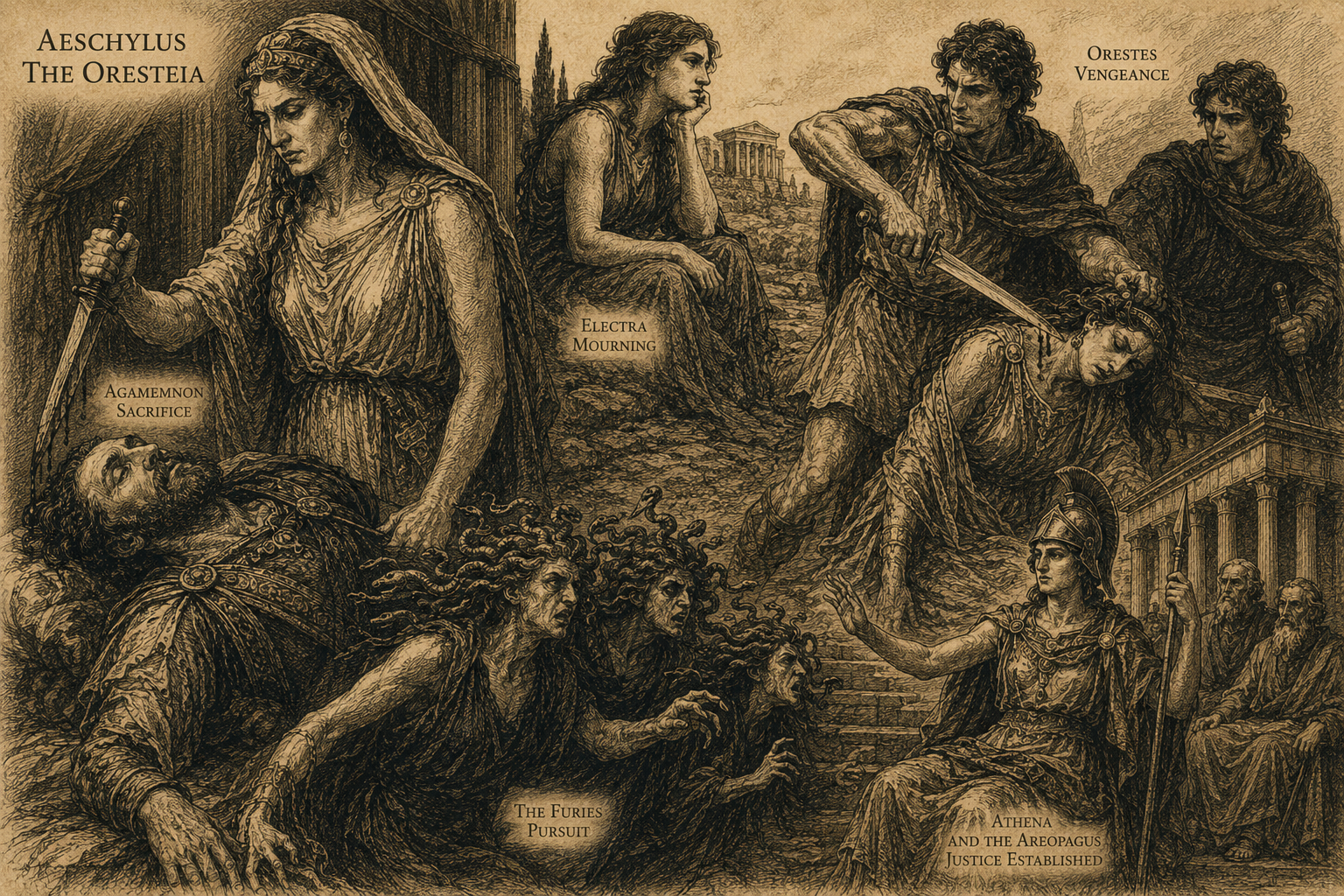
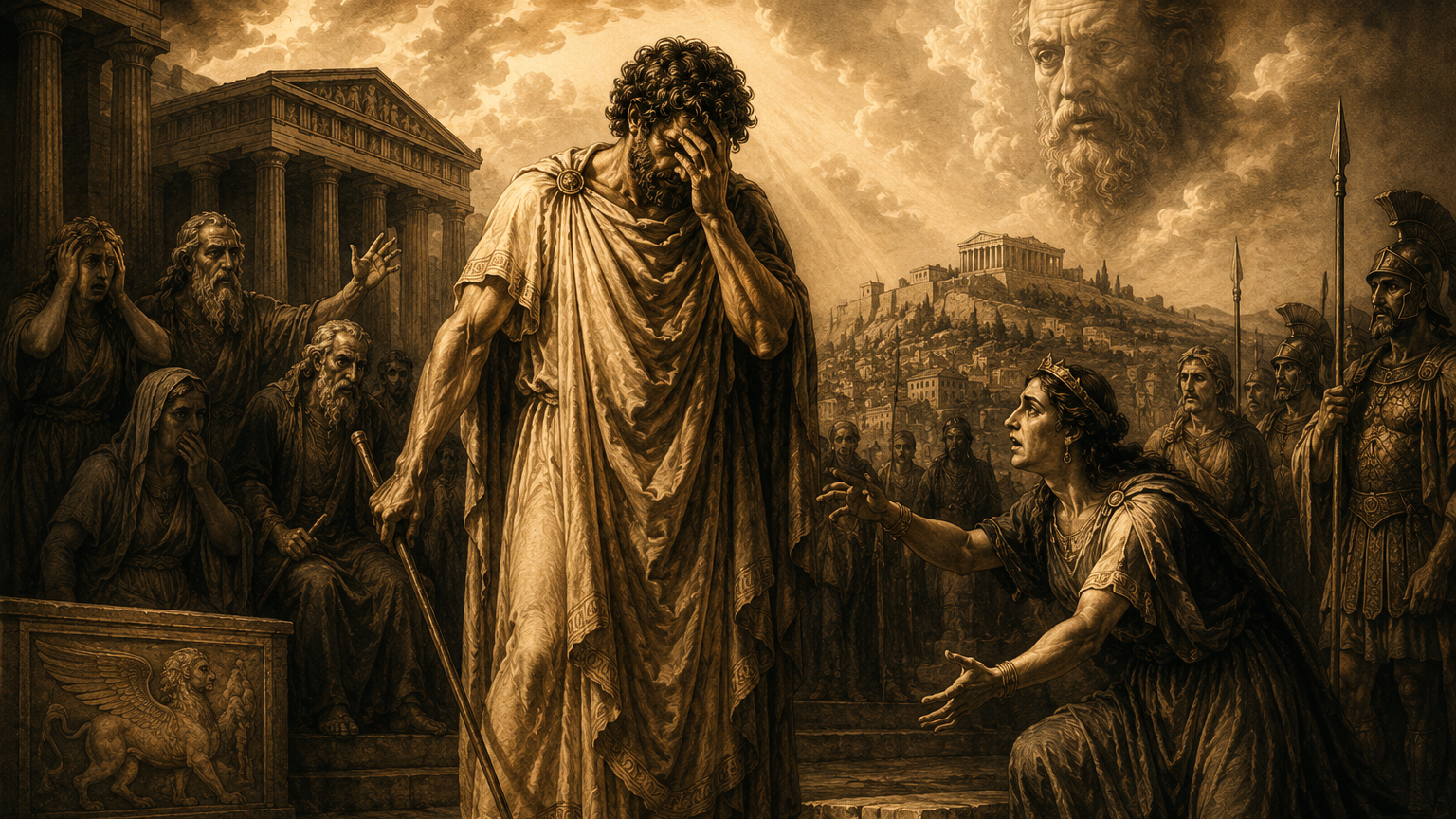
The prototypical tragic situation, on Hegel's account, involves two forms of right coming directly into conflict — two laws, two moralities: the city against the family. Notice how this differs from the Oresteia, where the underlying conflict is between two competing principles of right within the family itself — the right of the father against the right of the mother — with the city ultimately resolving that conflict on a higher plane of universality. In Sophocles, by contrast, the city itself can generate tragedy directly; its own principles are not fully all-embracing after all, and can come into real conflict with other genuine goods. Here the city is placed in tragic conflict with one of its own citizens, and there's no higher authority left to resolve that particular conflict — no god intervenes anywhere in this play. No Apollo, no Athena. Sophocles comes remarkably close here to writing genuinely secular drama, which is part of why Aristotle admired him so much. His dramas are stories of purely human action, without divine intervention, and this particular play openly questions whether the city really speaks for the gods the way it claims to in Aeschylus. Antigone raises real doubts about political authority as such — the authority of the polis itself (which is part of why the play keeps getting revived in moments of genuine political crisis — Anouilh's version during the Nazi occupation of France; Athol Fugard's The Island, in which Black prisoners attempt to stage Antigone inside a South African prison during apartheid).
Antigone's Dilemma
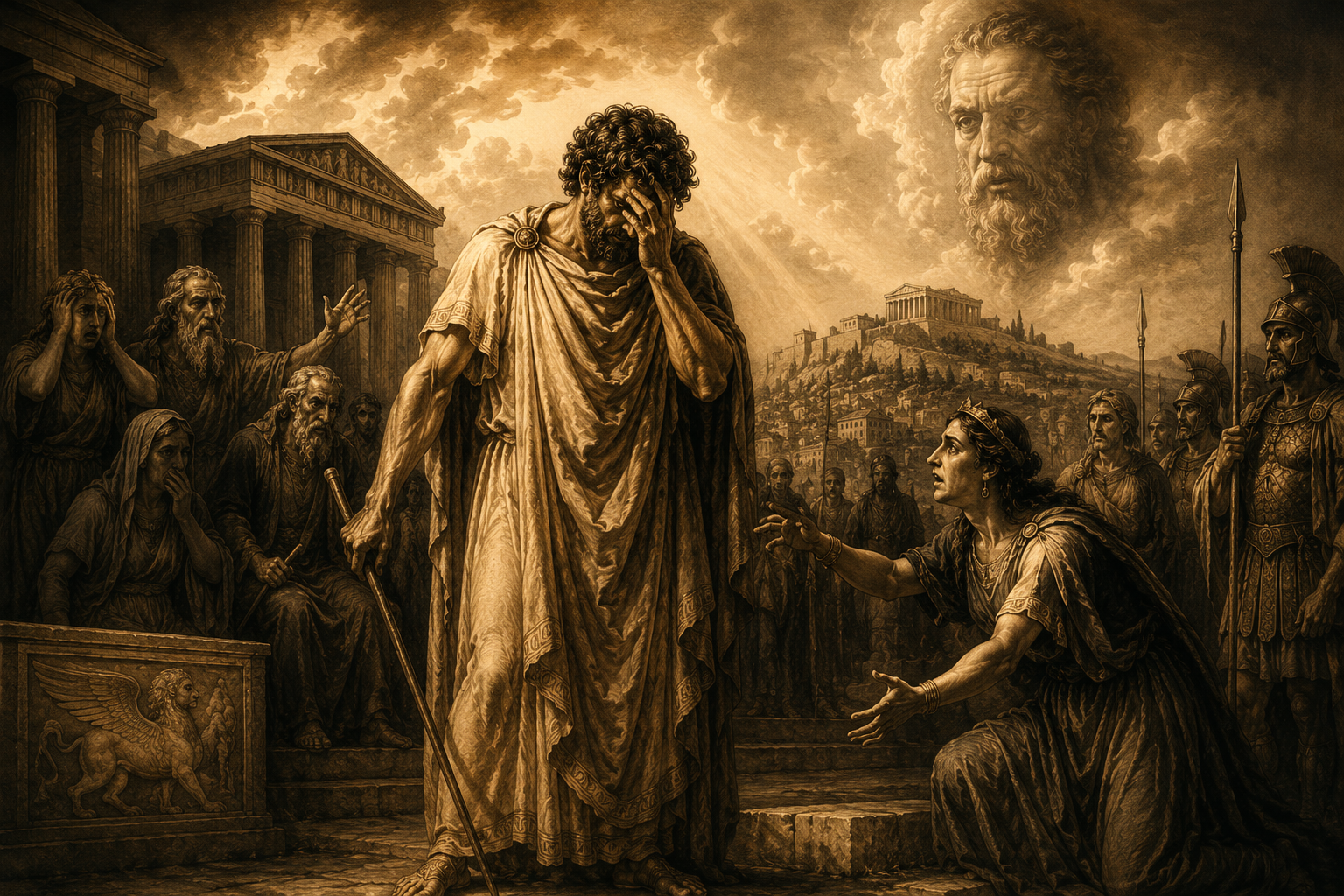
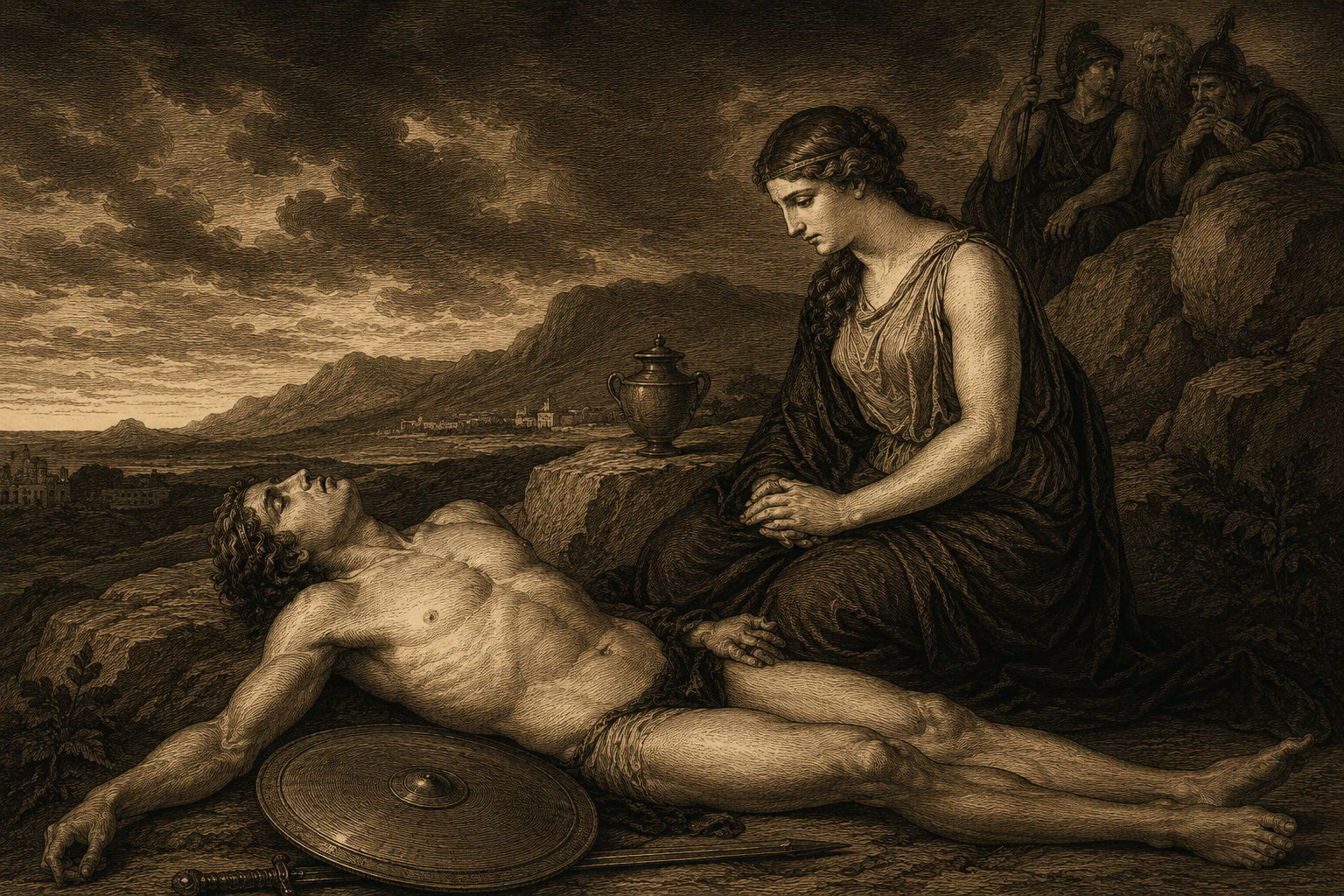
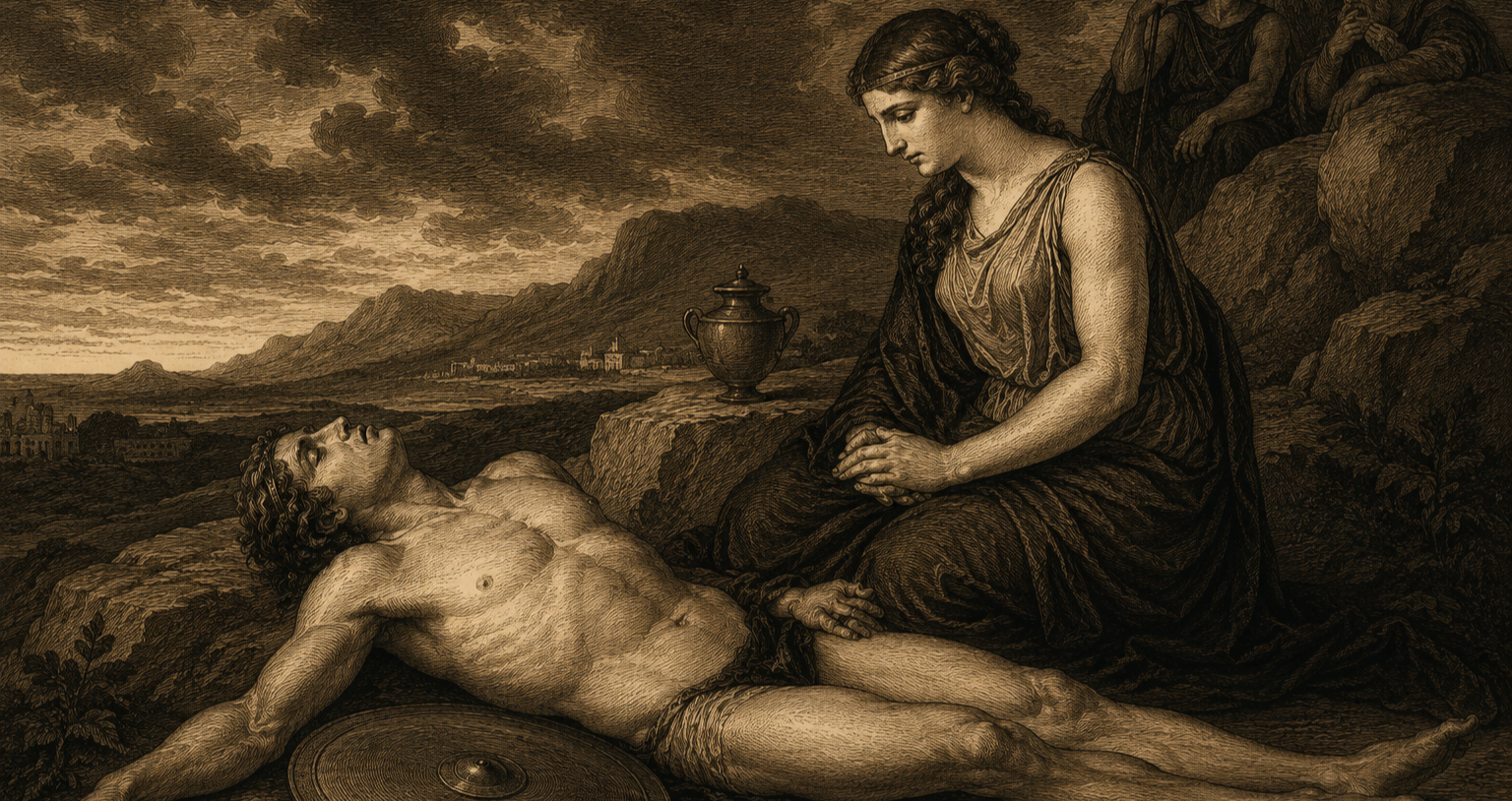
This is a doubly tragic situation, for both Antigone and Creon alike. Antigone's brother is dead, and she feels a deep obligation to give him proper burial — an obligation that specifically falls to women within Greek culture. Burial rites mattered enormously to the Greeks; we already saw this in the Iliad (Priam) and the Odyssey (Elpenor) — the soul cannot properly rest without proper burial. Burial rites mattered even more within paganism generally, precisely because there was so much less confidence about any afterlife, and no real sense that the afterlife was somehow a preferable state to this one; there was much less certainty that the soul could even be cleanly separated from the body. Even today we retain a real concern with proper burial (soldiers will still risk their own lives to recover the bodies of fallen comrades), but this concern ran considerably stronger in pagan antiquity. This obligation brings Antigone into direct conflict with the city, since Polyneices had been an actual enemy of Thebes, marching against it to conquer it — as a traitor, he isn't permitted burial at all. There's a real personal element here too, since this obligation also brings Antigone into conflict with her own sister and her own uncle.
Creon's Dilemma
Things are not so simple for Creon either, though he generally gets a bad reputation. He isn't simply evil, even though he does share some real elements of the tyrant — this isn't a melodrama, good guys against bad guys. Creon has a genuinely legitimate point: the city can't afford to honor traitors as though they were heroes (compare burying a traitor in Arlington National Cemetery). He believes he's doing the right thing. We ultimately end up siding with Antigone, but we can sympathize with Creon to a real degree along the way — he can appeal to a publicly defensible principle, rather than simply asserting "Polyneices can't be buried because I say so." He offers a genuinely legitimate argument, one that sounds quite persuasive when delivered in public. Bernard Knox notes, in Word and Action, that almost exactly a hundred years later, Demosthenes actually had a court clerk read a large section of Creon's speech aloud to Aeschines and an Athenian jury, as an example of the proper attitude for a loyal statesman — these lines, Knox observes, were clearly regarded as something like the epitome of democratic patriotism. Hegel never claims that both principles in a tragic conflict have to be equally right — only that there has to be some genuinely legitimate principle on both sides. There's a real personal element for Creon too: he's brought into conflict not only with his niece, but with his own son as well. He pays a terrible price for his choices in the end, losing both his son and his wife — appropriately enough, since in violating the underlying principle of family loyalty, he ends up destroying his own family in the process.
Character as the Test: Antigone versus Ismene
Antigone offers a perfect illustration of Hegel's theory of tragedy, but it's equally a good illustration of Aristotle's theory and of the underlying nature of the tragic hero — a character defined above all by integrity, by a genuinely unbending quality. Antigone and Ismene start out in an identical situation, both sisters to Polyneices, and yet they react in completely different ways. The situation itself, in other words, isn't sufficient on its own to define tragedy — the situation functions instead as a real test of character, and Creon himself essentially agrees with this (compare Yeats's later formula: "character isolated by a deed"). This matters enormously to the Greeks: action is the real test of character — words alone aren't enough, feelings alone aren't enough, thoughts alone aren't enough; you need actual deeds. You only find out whether a man is a hero or a coward once he's actually on the battlefield. Aristotle focuses on the tragic hero; Hegel focuses on the tragic situation — but you genuinely need both together: a heroic reaction to a tragic situation. The situation alone isn't enough — it's a necessary but not sufficient condition; you also need the hero (if Antigone were simply like Ismene, there would be no tragedy at all). And the hero alone isn't enough either — that's also necessary but not sufficient; you need the situation too (if Creon hadn't actually forbidden the burial, Antigone's claim that she would risk death to bury her brother anyway wouldn't actually prove anything real). Tragedy requires a very specific kind of hero in a very specific kind of situation, which is part of why Aristotle places so much emphasis on plot in the Poetics. This takes us back to the Homeric formula: fate equals character plus circumstance.
Ismene, by contrast, is genuinely mediocre — she says exactly what ordinary people always say: "we must be sensible," "I have no choice," as if Achilles himself had no choice in his own story. She refuses the heroic choice outright. This isn't simply physical cowardice on her part — it's intellectual cowardice as well; she simply accepts the role the city hands her, including its gender role. You might be tempted to point to Ismene as evidence that the Greeks held a simple stereotype of women as inherently weak — but Sophocles deliberately contrasts Antigone with Ismene precisely to undercut that reading: women, in his hands, can be either conventional or unconventional, and conventionality itself isn't tied to either sex. The male chorus, after all, proves just as conventional as Ismene throughout the play, equally unwilling to challenge the law. Antigone scorns Ismene for this, and rejects her outright. To the tragic hero, ordinary human beings look far too flexible and pliant, lacking any real integrity, willing to do anything at all just to stay alive. To ordinary human beings, in turn, the tragic hero looks stubborn and unyielding, even something close to insane — and the chorus itself takes essentially this view of Antigone (while also noting her clear inherited link to Oedipus — she's inherited his own unconventionality). Creon, for his part, clearly sees her thumos at work, invoking the same basic image used elsewhere: horses chomping at the bit. He accuses her directly of hybris. All the familiar elements of Oedipus reappear here — the very same combination of thumos and hybris.
Manliness Beyond Biological Sex
Manliness, in this sense, is not restricted to biological males. Think of Clytemnestra, elsewhere — the Greeks clearly knew what a strong woman looked like; she's actually called an aner in the original Greek. Here, remarkably, Antigone is called an aner too — a genuinely striking thing to say, calling a young girl a he-man. To get the real force of it across in English, you'd almost have to say something like, "you've got a lot of nerve, young woman" — or blunter still. What looks like integrity to the tragic hero looks like stubbornness to ordinary human beings; what looks like flexibility to ordinary human beings looks like a genuine lack of character to the tragic hero. These are simply different perspectives, and this difference takes us right back to Hegel — the gap between the perspective of the tragic hero and the perspective of ordinary human beings is exactly what provides the basis for genuinely Hegelian tragic conflict. In effect, this reconstitutes Homer's own contrast between aner and anthropos, only now with a considerably broader definition of aner — one that can include a woman, defined now not simply by physical strength but by what we would call strength of character (we're already partway on the road toward later Christian notions here). Antigone can't bench-press eight hundred pounds the way Achilles could, but she can stand up to the single most powerful man in the entire city. What defines Antigone is precisely her strength of character, every bit as strong as any man's. She is, in a real sense, the Achilles of this play — a genuinely remarkable claim: that a young girl can be every bit as much of an aner as Achilles himself. Antigone simply cannot yield on the question of burying her brother and still remain Antigone.
Death and the Proof of Integrity
The tragic hero is someone willing to die for their principles — this is the real underlying meaning of the deep connection between tragedy and death. Not every Greek tragedy actually ends with the hero's death, but it usually does, and this tells us something important about the heroes' underlying integrity: you prove your commitment to a principle precisely by being willing to die for it. The death that closes a tragedy doesn't matter simply because it provides an unhappy ending — it matters because it's exactly what allows the hero to demonstrate their integrity in the fullest possible way. Antigone is devoted to death from very early in the play, and there's a real, explicit contrast drawn later between her fate and Ismene's — not unlike Achilles's own choice in the Iliad. Antigone will die young, but she will act heroically and become genuinely famous for it. Ismene will live a long life, but only because she chose cowardice. The whole play carries something of the atmosphere of the Iliad — a city under siege, open warfare, heroes in need of proper burial; Sophocles is, in effect, rewriting the Iliad with a young woman as its hero. This is Antigone's one real chance at heroism as a woman, since her available options are considerably more limited than a man's — she can't go fight for Thebes and die gloriously in battle the way a man could. This is her one chance to die for a principle instead, to become a genuine hero in her own right — and she doesn't let that chance pass her by.
Creon and the False Universal of the City
Turning now to Creon's own story: he does genuinely represent the underlying principle of the city, but Sophocles ultimately begins to question that very principle, questioning whether the city actually stands for what it claims to stand for, revealing something like a false universality at the heart of the city itself. The city tries to impose its own definitions on everyone within it. Polyneices and Eteocles, after all, are essentially equal, mirror images of one another — and yet the city insists on treating them completely differently, casting one as hero and the other as traitor, imposing its own categories onto what was really a far more symmetrical situation. The city, moreover, tries to universalize its own particular rule — not simply "he can't be buried within the city," but "he can't be buried anywhere at all," even well outside the city walls (there's a strong sense of this claim throughout the play). This raises a genuinely concrete question: is there any place at all that lies beyond the city's authority? City against the universal, in effect. In the Oresteia, recall, "the ones below" — the Furies — were successfully incorporated directly into the city. Not here. Antigone is, in effect, saying that Creon cannot actually speak for the Furies — that the city cannot fully speak for the gods after all. In Aeschylus, the city appears to be the very highest principle available, capable of resolving every conflict; Sophocles instead raises a real question: is there some principle that lies beyond the city itself?
Creon's Tyranny Exposed
Creon turns out not to be such a solid representative of this principle after all — he behaves increasingly like a tyrant, and the supposedly universal law of the city is gradually revealed to be nothing more than the particular will of its ruler. This is exactly why we're inclined to side with Antigone: Creon appears to speak for the city, standing up for a genuine principle, but what he actually means by "the city" turns out to be himself. Like Oedipus, he identifies the good of the city directly with his own good, worrying above all about his own personal safety and standing. Creon rules purely by decree — his whole idea of law is simply the ruler's own will, which is exactly why his positions keep shifting: there's nothing eternal or fixed about his principles at all. He first wants to stone the offender publicly, then backs off once he senses the people might not actually support that particular action (there's a real, clear sense of the importance of public opinion throughout this play, clearly pointing toward Athenian democracy). He finally changes his mind about Antigone herself at the very end of the play, driven mainly by fear of the personal consequences to himself. This is the same underlying critique of the tyrant we already saw in Oedipus — arbitrary, endlessly changeable. Part of the reason is that he loses real touch with his own people. A tyrant tends to become cut off from the truth, since people around him learn to tell him only what he wants to hear — Creon is told exactly this by his own son at one point. The tyrant makes a poor ruler precisely because he allows himself to be flattered into believing he's greater than he actually is (compare Xenophon's Hiero on this same point). There's also an interesting variation on the "kill the messenger" theme earlier in the play — not quite the standard use of the messenger convention; Sophocles is clearly playing with the convention here, making a deliberate point about messengers as a type (the messenger in question almost doesn't come back at all, until he starts thinking he might actually get a reward for it). The tyrant is, at bottom, deeply insecure, jealously guarding whatever power he has; his pride makes it genuinely hard for him to ever give up his position. There's a particular twist to Creon's own insecurity too — a real fear of women running throughout, tied up with his own anxieties about his masculinity. Creon, in the end, is not really heroic — or at best, he's a distinctly lesser hero; he's no Oedipus. There are two tragic figures in this play, but the man turns out to be considerably less of a hero than the woman.
Antigone's Appeal to True Universals
This is one of the strangest aspects of the play: its most heroic figure is a woman — which seems to fly directly in the face of everything we assume about Greek patriarchy. Antigone is arguably the single most admirable figure in all of Sophocles. Against Creon, she appeals directly to a genuinely true universal — real laws, she insists, are not mere decrees; they are not made by men, not made by anyone at all, and it isn't even entirely clear whether they're made by the gods either — genuinely challenging words: Zeus, she says, did not proclaim this particular law. These laws simply are, from all eternity. We find something similar in Oedipus as well. There's more explicit talk of the gods here, but even so, it isn't quite Zeus specifically — the Greek text actually says "Olympus." Sophocles is clearly working to rein in tyrants throughout. There are principles of justice, on this view, that exist entirely independently of the city, which directly challenges the supposed comprehensiveness of the polis. In Aeschylus, family and gods alike are brought squarely within the city's own limits; in Sophocles, family and gods somehow retain their own independent basis (the city, after all, doesn't get to define who your actual brother is — a point Aristotle himself makes in the Rhetoric). Notice that Antigone genuinely needs some standpoint outside the city from which to judge its rules in the first place — this shows us the real function of the universal as such: it becomes a resource specifically for the oppressed. Antigone herself is essentially powerless, and can only appeal to principles of eternal justice — and yet doing exactly this is what actually wins public opinion over to her side.
Universal principles, in other words, can function as a tool of the ruling class, which is exactly what Creon attempts with his own decrees, trying to impose his own personal will as though it were universal law. But universal principles can equally become the only real tool available against the ruling class as well. The play reveals what might be the very highest Greek intellectual enterprise: learning to discriminate true universals from false ones — which is, in the end, essentially what philosophy itself means.
Nomos versus Physis
This brings us to the great opposition between nomos and physis. Nomos means law, custom, the settled way of the city, convention, tradition — essentially, whatever exists by virtue of human will, as opposed to whatever exists independently of human will, by nature. Nomos is what human beings themselves make; physis is what comes into being entirely on its own — what grows naturally, which is close to the word's actual root meaning. Shoes don't grow on trees, but apples genuinely do; laws certainly don't grow on trees either. Aristotle, in the Nicomachean Ethics, makes the point directly: fire burns exactly the same way here as it does in Persia, but the legal penalties for arson differ completely between the two places. If you light a fire in downtown Athens, or in downtown Persepolis, it's going to be exactly the same physical phenomenon either way — but whether you get punished for it, and how severely, depends entirely on Athenian law versus Persian law.
Greek Skepticism and the Critique of Slavery
There are two competing ways of studying the Greeks. An older view turns to them for supposedly universal truths about all humanity — which can end up being fairly simpleminded. A newer view holds instead that all such "universals" are actually false, that these are really just narrowly Greek or Athenian truths, with no genuine relevance to us at all — merely reflections of specific Greek power structures, Greek views as pure ideology, propping up a patriarchal, slave-holding society. There genuinely was a great deal that was narrow-minded and false in the ancient Greek world. But this is precisely what Sophocles himself is already showing us in Antigone — Creon disguises his own self-serving actions as service to the city. Sophocles is exposing exactly what we would now call ideology, and he couldn't possibly be its captive if he understands it this clearly. From the Odyssey onward, skepticism has been a genuinely distinctive Greek trait. The polis was, by our own standards, a very authoritarian kind of community — but that's not actually what's distinctive about the Greeks, since every community around the Mediterranean at that time was similarly authoritarian. What actually distinguishes the Greeks is that they learned to question authority — even within their own drama, itself a fundamentally public institution. Sophocles openly questions the power of the city inside a civic drama festival. Recall, by contrast, how thoroughly Aeschylus flatters Athens in the Oresteia — it's fairly easy, after all, to praise Athenian institutions to an Athenian audience: "you've got a damn good Areopagus right around the corner."
Many people today criticize the ancient Greeks for maintaining a slave-holding society, and they're right to do so — it's one of the genuinely most negative aspects of the ancient Greek world. But that doesn't mean we should reject everything the ancient Greeks gave us. Slavery, importantly, was never a distinctively Greek institution as such — it isn't that the Greeks had slavery while every other Mediterranean society somehow didn't. Quite the opposite, in fact: every other ancient culture we know of also practiced slavery as a settled institution. What actually distinguishes the Greeks isn't that they had slavery, but that they were the very first to raise real doubts about the institution itself — beginning to wonder whether it's genuinely just for one man to enslave another. Aristotle raises exactly this question in Book I of the Politics, framed in precisely these terms: is slavery natural, or merely conventional? Does it have any legitimate basis in nature at all, or is it simply the arbitrary imposition of one man's will over another's? Is slavery a matter of nomos, or of physis? Simply raising the question at all marks the beginning of the end for the institution — it can't really withstand sustained scrutiny once you actually begin questioning it. It took an extraordinarily long time in practice, but slavery becomes doomed the moment someone begins examining it philosophically, the way Aristotle did. To many modern readers, Aristotle seems to be supporting the institution of slavery — but he's actually profoundly undermining it. He does claim there's a form of natural slavery, but he defines it so narrowly that it ends up excluding almost all actual historical cases of slavery, which turn out, on his own definition, to be merely conventional instead. He says that if someone is genuinely mentally incapable of directing their own actions, someone else should direct them for their own good — but this obviously isn't the case for 99.99 percent of actual historical instances of slavery. So almost all real slavery turns out, by Aristotle's own logic, not to be natural at all, and therefore unjust. We don't have time to go deeply into this issue here, but it shows something important about the Greeks: they were the first to discover that the merely particular can masquerade as the universal. The Greeks pretended that their own institution of slavery existed by nature — but it was really merely conventional all along.
The Question of Natural Right
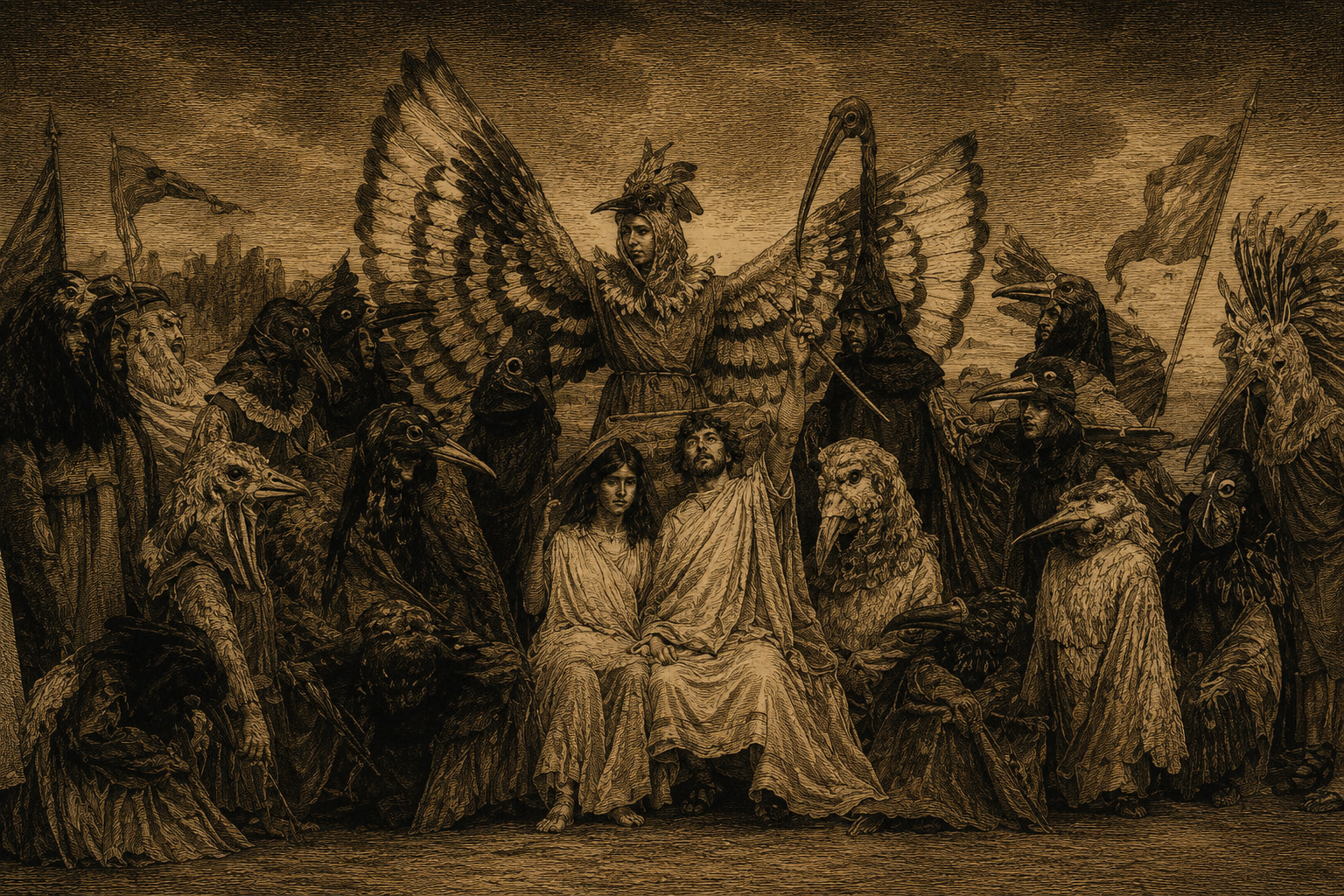
Just because some universals turn out to be false, though, doesn't mean that all universals are false — that claim would itself be a kind of universal statement, and would therefore be self-undermining in its own terms. Some universals are false; some, perhaps, are genuinely true. You can't tell in advance which is which without actually looking closely. Universal principles can function as a tool of the ruling class — but, as we've seen here, they can equally become the only real hope available to the oppressed, the basis for genuine opposition, an appeal from present oppression to something higher. Aristotle actually quotes Antigone directly, in the Rhetoric — a genuinely important passage, a philosopher directly quoting a dramatist, showing the real relevance of these plays to live political questions. But notice something telling: where Antigone speaks of the gods, Aristotle quietly speaks instead of nature — quietly substituting nature in place of the gods. This takes us back to the very moment Hermes gives Odysseus the moly. This is one of the great, defining questions of Greek philosophy, raised directly by Socrates: could there be such a thing as a natural law? (This is, in fact, the only place in the Rhetoric where the term actually appears in Greek.) A nomos that exists by physis — overcoming the very opposition between the two terms. This is a great and genuinely difficult question, sitting right at the beginning of Greek philosophical thought, in the opposition between nomos and physis first developed by the Presocratics. Socrates asks: could there be some independent standard of natural right — some way of saying that one law is genuinely more in accordance with nature than another? Do we actually have some independent standard for comparing different cities against each other? Or are we condemned to pure relativism instead — "that's simply the way of my city, and you have no right to question it"? You can see clearly in Antigone that this second approach plays directly into the hands of tyrants. This is one of the great recurring themes of Sophoclean tragedy — the questionable universality of the polis — and it becomes one of Socrates's own great themes as well, carried forward by both Plato and Aristotle, and it's a theme of Aristophanes too: The Birds raises exactly the question of the relation between the polis and nature, imagining the possibility of a more natural city altogether — a city of birds, a city of literal birdbrains. Next week, we'll continue our study of tyranny, but we'll also turn directly to philosophy itself.