
Middle Ages: Everyman Morality Play
Lecture Notes · Middle Ages
The Middle Ages and Everyman
Paul Cantor · University of Virginia
Cantor deliberately teaches Everyman first in the Middle Ages unit, even though it's actually the latest-dated work in the whole unit — probably written around 1500, well after the Song of Roland, Marie de France, Chrétien de Troyes, and Dante. The lecture itself explains why: pedagogically, it's the clearest possible entry point into what Christianity actually does to literature, even at the cost of strict chronology.
The Middle Ages: A Retrospective and Denigrated Term
We turn now to the Middle Ages — a bigger leap, in its own way, than the earlier move from the Greeks to the Romans. The Middle Ages are genuinely harder to grasp as any kind of unity than the ancient world was. First, "Middle Ages" is a retroactive, retrospective term — people actually living in the Middle Ages had no idea they were living in "the Middle Ages"; they had no sense of being suspended in the middle of anything. The Renaissance, by contrast, actually thought of itself as a renaissance, a rebirth; the Middle Ages never thought of itself that way. The term itself doesn't become common until the eighteenth century, and is really a product of nineteenth-century thinking, particularly Hegel's progressive philosophy of history. "Middle Ages" gets treated as a mere transition between the ancient and the modern world, often used as a rough synonym for "Dark Ages" — "it's positively medieval," we still say. The term tends to denigrate the whole period, as if people back then were simply marking time until the Renaissance finally arrived. There was, to be fair, a great deal genuinely wrong with the Middle Ages — religious superstition, bigotry, persecution — but there were also great cultural achievements: the beginnings of European music, for instance, or Gothic architecture, the great European cathedrals ("Gothic" was itself originally a pejorative term, meaning something like "it's barbaric" — there was a real movement at one point to tear down Notre-Dame; Victor Hugo had to write The Hunchback of Notre-Dame partly to defend the building, and Napoleon III did in fact tear down much of medieval Paris). The period only really got rehabilitated in the late nineteenth century. It deserves to be given its proper due.
The Difficulty of Grasping a Thousand Years
Second, the sheer unity of the period is hard to grasp because it covers such an enormous span of time — roughly a thousand years, if you date it from the fall of Rome to the fall of Byzantium, from the middle of the fifth century AD to the middle of the fifteenth. In this course we'll really be concentrating on roughly 1100 to 1500, and many different nations are involved. We'll be reading works from England, France, and Italy, though Germany and Spain matter too; I'm placing particular emphasis on France. I'm cutting back on English works specifically, leaving out Chaucer — one of the greatest writers of the whole Middle Ages, alongside Dante — on the assumption that you'll encounter Chaucer and other English writers in other courses. It's genuinely hard to select representative works from such a rich period. I'm focusing on epic and romance specifically, since that focus helps reveal both real continuities and real new developments, and keeps our attention on how the idea of heroism itself gets transformed across the Middle Ages. But be aware that we're leaving out whole categories of medieval literature this way — saints' lives, mystical visions, and so on. Much of medieval literature is fundamentally religious in nature, which itself suggests one real principle of unity running through the whole period — and even the specific works we are reading are heavily shaped by religion.
Why Begin with Everyman
The real key to understanding the Middle Ages is the new importance of Christianity, which transforms the whole nature of literature. That's exactly why I'm beginning our study of the Middle Ages with Everyman — it makes the changes Christianity brought about in literature especially clear. But this involves a real, deliberate departure from strict chronology. The probable date for Everyman is somewhere around 1500, which makes it later than every other medieval work we're reading — written nearly two hundred years after Dante's Divine Comedy, and only about fifty years ahead of Rabelais. Everyman was written when the Renaissance was already well underway in Italy. Please be aware of exactly what I'm doing here — don't go writing about the influence of Everyman on Dante; that would get the history backward. What I'm doing is, strictly speaking, quite unscholarly. But it's justified in its own way: Everyman happens to have been written very late in the Middle Ages, but very little in it is actually distinctively late — it reflects ideas that dominated pretty much the whole period, and in some ways it can serve to encapsulate what's genuinely distinctive about the Middle Ages as a whole. Jumping to Everyman first also makes a real point about literary history: put the Iliad and Everyman together, and you get Hamlet — the Middle Ages is really what gets us from ancient literature to Renaissance literature, by combining Christianity with ancient Greek and Roman culture.
Everyman: A Simple but Instructive Work
Everyman is not the most complicated work we'll read — it's straightforward and easy to understand, and it's not the greatest work of art either, not especially subtle. But it has a kind of simple grandeur and solemnity to it, and it's still performed today, especially in its German version, Jedermann, at the Salzburg Festival. Its educational value may well exceed its purely artistic value. Above all, it will teach us something essential about the impact of Christianity on literature. You can already see the change reflected in the title itself — the hero is "Everyman," meaning just anybody at all, nothing special about this particular hero — the anthropos, not the aner. Christianity brings about a real democratization of the hero: he no longer has to be a great man, possessed of some special form of excellence. Everyman stands in for the common man, faced with a genuinely common human problem — mortality. Everyone is eventually going to die. Notice: this isn't like Homer — there's nothing heroic about Everyman's death, nothing special or even especially specific about it. It's death in a fully generalized form; Death simply comes to Everyman as an external force, exactly the way it comes to every human being. What matters here is not the manner of your death, but the whole shape of your life — whether you lived morally. There's nothing you can do in the manner of your death itself that could turn you into a hero and redeem you. There's much less focus now on the actual moment of death itself — we no longer really have the idea of a specifically heroic death. For the ancients, how you died distinguished you, especially if you died a heroic death in battle; the specific manner of your death could define your whole life, whether you were a hero or a coward, since you proved your manhood by risking death itself. Not so in Christianity — your whole life defines your life, whether or not you lived as a good Christian. A heroic Christian death remains possible even so — we'll see it in the Song of Roland — so ancient heroism survives in some real ways. But we also now have the new idea that the ordinary death of an ordinary man is itself worthy of serious literary treatment.
Allegory and the Democratization of Literature
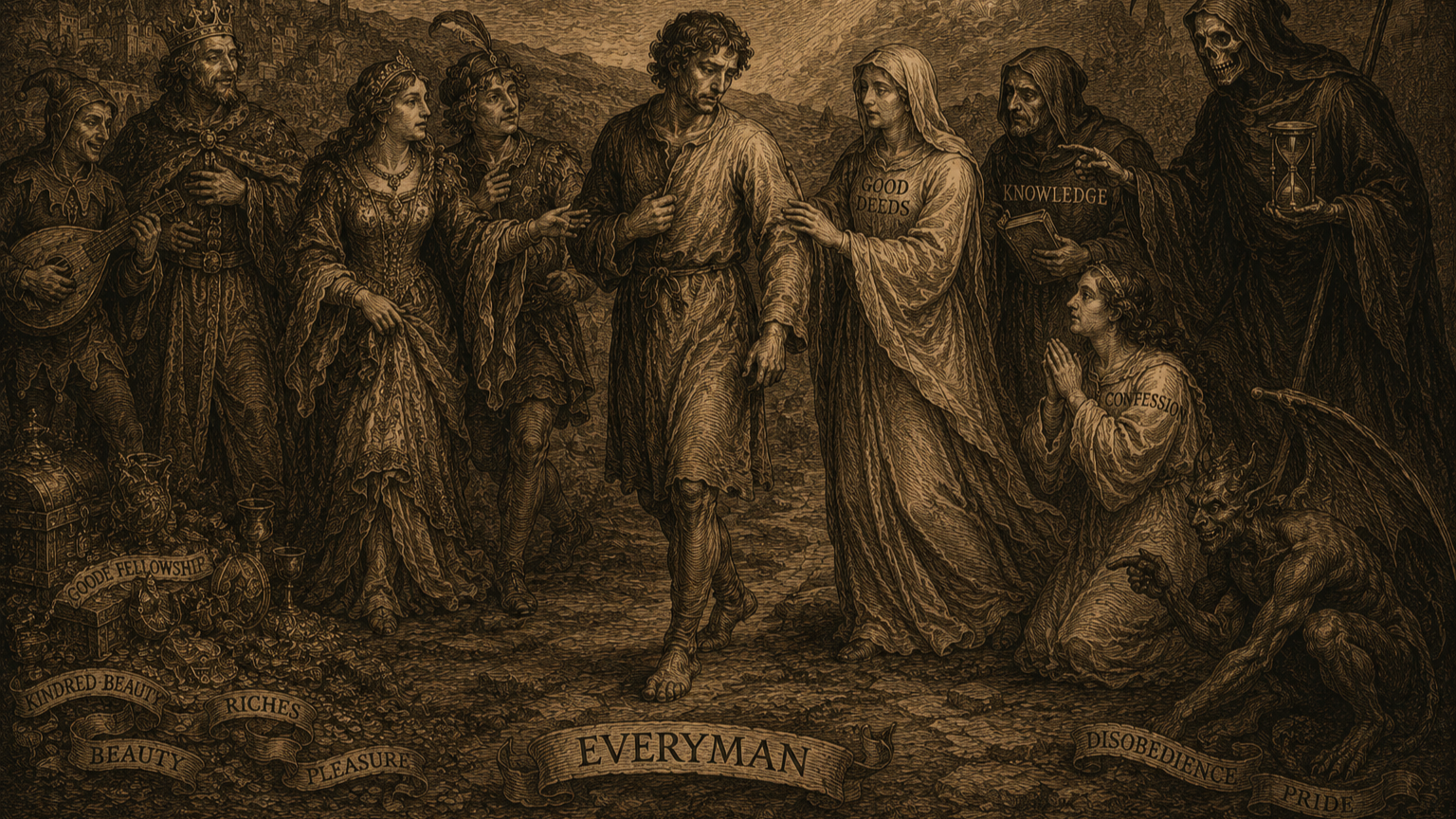
Death has become something genuinely generic here. This generalizing tendency shapes the whole form of the play, which takes the shape of allegory — a one-to-one correspondence between individual characters and general ideas, where the literal story points toward some deeper symbolic or spiritual truth, teaching a moral. This particular form is specifically called a morality play (a modern example of the same basic technique would be Orwell's Animal Farm, a political allegory). Allegory does appear already in the ancient world — it's a Greek word — mostly in late works, and people eventually began allegorizing Homer retrospectively too. But it becomes genuinely popular in the Middle Ages, a distinctively medieval form, the great age of allegory (Dante above all). Instead of individualized characters, you get characters who simply stand for general concepts — Good Deeds, Knowledge, Beauty — characters who are themselves abstractions. In the Iliad, we don't have a character literally named Beauty; we have characters who are beautiful, like Helen, who can in some sense represent beauty, typify it — but Helen isn't capital-B Beauty itself. Homer is dealing throughout with unique forms of excellence, characters who excel at something specific, who stand out in some particular way. Allegory, by contrast, is much better suited to dealing with common elements of human experience generally, which is part of why it appealed so strongly to Christian authors — the parables of the New Testament served as real models for medieval storytelling in this respect. Ancient literature is aristocratic, both in spirit and in principle. Christian literature is democratic (though not in a specifically political sense) — all men are now regarded as brothers, equally children of God, all human beings equally worthy of salvation, not just a select handful of heroes. God becomes the great equalizer within Christianity. He's raised so far above all human beings that he dwarfs the differences among them; no human being can meaningfully compare with the Christian God, so they all end up reduced, in effect, to the same basic level. The pagan gods, by contrast, were certainly greater than human beings, but not on some entirely different order of being — human beings could at least aspire to approach the level of the gods, which was the great hope animating the ancient heroes. The gap between gods and human beings was never absolute in antiquity — in fact it was a rather fluid boundary. In a sense, the pagan gods function as patrons of human excellence, embodying an essentially aristocratic view of the world. The Christian God, omnipotent and all-powerful, makes the gap absolute instead, making every form of human greatness look petty by comparison. The difference between Agamemnon and Achilles is something Homer takes extremely seriously; to Christianity, that difference doesn't look all that important anymore. This leads to a thoroughgoing critique of ancient conceptions of greatness as such.
Nietzsche's Revaluation: Master Morality and Slave Morality
There's a real revaluation happening here in ethical terms, and Nietzsche's account of it, in the Genealogy of Morals, is genuinely illuminating — he was a profound student of the ancient world, having begun his career as a professor of classics at the University of Basel, and he shows us a real way of getting back to ancient concepts, precisely by contrasting them sharply with Christian ones. He felt that Christian ideas actually get in the way of our understanding classical antiquity properly, and wanted to clear them away in order to get back to the originals. This is a heavily biased account — Nietzsche is extremely critical of Christianity and clearly admires classical antiquity; it's by no means a neutral scholarly treatment. Still, it's genuinely illuminating, and it helps define the underlying contrast sharply. Nietzsche gives us two paired sets of ethical opposites: the classical pair is good versus bad; the Christian pair is good versus evil. Good versus bad is the governing principle of aristocratic morality, what Nietzsche calls master morality — the aristocrats simply define their own way of life as good, and everything else as bad. "Good" here gets equated not with "moral" but with "noble" — the way of life of the nobility. In an aristocratic society, "good" basically means "strong," exactly as in Homer, where the standard of value is strength or power: everything that characterizes the triumphant warrior — courage, self-reliance, independence — that's what it means to be good. In aristocratic morality, to be good is to be superior to other human beings, to the general run of humanity (what Nietzsche calls "the pathos of distance"). The aristocrat feels himself raised above common people, and needs to define himself in opposition to them. That's exactly where the aristocratic concept of "bad" comes from — "bad" is simply everything the noble man is not, above all meaning "weak," the quality found in those the aristocratic masters defeat in battle. "Bad" means cowardly, dependent, unable to stand on your own. "Good" versus "bad," in this scheme, equals "noble" versus "ignoble" or "base." Nietzsche's whole analysis draws directly on his study of Homer, among other sources — "good" versus "bad" here is really just another version of aner versus anthropos, the heroic he-man against the ordinary human being.
The Christian Reversal of Ancient Values
Nietzsche's great insight here — still much debated today — is that Christianity effects a genuine revaluation of classical values: a reinterpretation, and a reversal. Christians take what the Greeks and Romans had regarded as good, and now regard it instead as evil; and they take what the Greeks and Romans had regarded as bad, and now regard it instead as good — it becomes, in effect, good to be what the ancients called bad. What counts as evil according to Christianity? Precisely everything that characterized the Greek and Roman hero — pride, aggressiveness, self-reliance. Pride is now regarded as a sin, in fact the worst of the Seven Deadly Sins — which is part of why we have such a persistent tendency to misread Greek and Roman literature today: we're always looking for the sin of pride in it. We look at how genuinely dangerous the ancient hero is, often hurtful to ordinary human beings, certainly not kind to them — which is exactly what the ancients themselves admired, power, even the power to do harm, visible even in their gods. Christianity, by contrast, very much takes the side of ordinary human beings, redefining virtue as specifically moral virtue, accessible not just to a handful of heroes but to absolutely anybody. Rabelais later sums up this whole change memorably: imitating the ancient heroes — Hercules, Alexander, Hannibal, Scipio, Caesar, and so on — runs contrary to the teaching of the Gospel; what the Saracens and barbarians once called prowess, we now call brigandage and evildoing (a point Rabelais's editor traces back to Augustine's City of God). Nietzsche is by no means the only one to have made this observation. The underlying logic of Christianity, for Nietzsche, runs like this: if what the ancients regarded as good is actually evil, then what the ancients regarded as bad must, in turn, actually be good. Christian goodness means humility rather than pride, submissiveness rather than aggressiveness, the virtues conducive to peace and harmony rather than war and competitiveness — above all, submission to God, but also submission to one's fellow human beings. Under Christianity, it becomes good not to be aggressive, to turn the other cheek — not the Greek, but the meek, shall inherit the earth.
Consider specifically the issue of revenge. Part of the ancient heroic ethic holds that you must never quietly suffer insult or injury; it's cowardly and base to accept an insult tamely. Achilles may get carried to genuine extremes, but he is basically admired throughout for refusing to take guff from Agamemnon and for avenging Patroclus. (There is a single "Achilles moment" in Everyman — it harks back to the ancient world, but it feels genuinely inadequate here, out of place.) In Christianity, Jesus becomes the operative model instead, a model of forgiving one's enemies. It becomes a genuine virtue to forswear vengeance altogether; you must learn to forgive your enemies, which becomes the only properly Christian way to show yourself superior to them — showing that you stand above mere insult or injury. To the ancients, this looks like straightforward cowardice. To Christians, it counts, in fact, as a higher form of courage. Christianity doesn't simply say "it's good to be cowardly" — it redefines what had previously been considered cowardice as a higher form of courage instead. And we do have plenty of real examples of this kind of heroic Christianity — the great Church martyrs, for instance; even the ancients themselves were genuinely impressed by Christian martyrs, which actually helped spread the new faith. This shows how thoroughly ethical terms get reinterpreted and redefined under Christianity — courage comes to mean forgiving wrongs done against you, rather than avenging them. This is the great ongoing debate between the ancient world and Christianity, one we'll see played out across the rest of the semester, especially in the Renaissance, culminating in Hamlet, precisely over the issue of revenge. In many ways, though not in all, the ancient world and Christianity stand as complete opposites here. The contrast isn't absolute, of course — the ancients weren't all simply running around killing each other, mad with revenge; Homer himself shows Achilles's desire for revenge getting genuinely out of hand, and clearly doesn't want him hacking Priam's body to pieces. But the poem still begins from the assumption that it's basically right for Achilles to respond as he does to Agamemnon's insult. You can't simply say the ancients were hot for vengeance while Christians renounce it outright — there are plenty of examples of vengeful Christians too, as we'll see, warrior Christians especially, in the Song of Roland next time. But broadly speaking, the contrast holds: these are genuinely antithetical ethical positions, Jesus and Achilles as competing models or heroes — one turns the other cheek, the other simply slugs back. This is part of why our own culture is so complex: we've inherited both of these contradictory ethical traditions at once.
Aristocratic versus Democratic Morality
Nietzsche is, admittedly, very negative on Christianity throughout, and he uses heavily loaded terminology — he doesn't dwell much on the ways Christianity actually marked a real advance over the ancient world, even though he clearly understood this himself. He calls classical morality "master morality," and Christian morality "slave morality," treating Christian morality as fundamentally reactive: slaves don't like their position within the ancient world, downtrodden, oppressed, made to feel worthless by their masters, who lay claim to every form of superiority and get to define what "good" even means in the first place. On Nietzsche's account, the slaves try to turn the tables on their masters, finding some way of appearing to be the truly superior ones after all. They can't fight back against the masters directly — they're simply too weak — so they make a virtue of necessity instead, claiming they've chosen weakness deliberately. It isn't that they can't fight back, on this telling; they claim instead to stand above all that. This makes renouncing aggression look like a deliberate moral choice. Virtue, on this account, is no longer a matter of some inborn power or excellence, the way it is for the ancients, but a matter of moral choice instead — which is exactly why virtue becomes newly accessible to everyone, not just to a handful of heroes. Whether you're physically strong or weak is simply determined by your birth, not a matter of choice at all. Whether you strike back against an enemy or not, though, is a genuine moral choice, within anyone's power regardless of birth — that, for Nietzsche, is how the slaves manage to turn the moral tables on the masters.
There's a real body of historical evidence supporting Nietzsche's view here — Christianity really did originate among the oppressed within the Roman Empire, drawing much of its early support from the slave population, which is part of how it spread throughout the empire in the first place; it appealed strongly to those who felt dispossessed or mistreated. Nietzsche's own characterization of Christianity as a slave revolt in morality clearly reflects his own preference for classical morality. I'll use somewhat more neutral terms for this same contrast — aristocratic morality versus democratic morality — though even that isn't entirely accurate, since Christianity isn't necessarily democratic in any strictly political sense. Christianity proved perfectly compatible with plenty of non-democratic forms of government throughout the Middle Ages — it coexisted comfortably with monarchy and feudalism across Europe. In many ways, Christianity is actually a fairly apolitical religion, teaching people to renounce politics, to renounce worldly concerns generally; it doesn't ultimately matter who runs this world, since the next world matters so much more. It teaches people to accept their given lot in life — largely true throughout the Middle Ages, though Christianity did also inspire some peasant uprisings along the way. Eventually, Christianity did become a genuinely powerful force in politics — the religious idea of human brotherhood gradually got translated into the political idea of human equality, something we'll see play out in the French Revolution, in the spring semester: the democratization of politics alongside the democratization of culture. This isn't yet a fully political issue within the Middle Ages itself — but we do already see the beginnings of a real undermining of the aristocratic principle here, a challenge to the aristocratic notion of greatness and human excellence inherited from the ancient world.
The Devaluation of Worldly Goods in Everyman
Let's see how these general principles actually play out within Everyman itself. The play involves a tremendous demotion of all the values of this world, especially the goods most prized in classical antiquity. Death teaches Everyman directly that wealth is worthless — it can't help him when he faces his single greatest challenge, death itself. Everyman tries to bribe Death to wait, and fails outright. Our wealth simply won't help us in the afterlife. Death is the great equalizer, coming equally to rich and poor alike. Think of ancient burial practices by contrast — Egyptian, even Greek — heaping up treasures in the deceased's tomb, meant to help him in the afterlife (the Egyptians had a highly developed conception of the afterlife, essentially imagined as continuous with this life — you'd need the very same goods over there, which is the whole point of these burial practices, including ships, servants, food, beer). Not so according to Christianity — Christians don't bury wealth alongside their dead. Death also doesn't respect worldly rank; it comes equally to the great and to the obscure. Notice, too, the appearance of the Pope in the play — a good reminder of one way the medieval Church actually compromised with this world and its political order, developing a hierarchy of its own, a kind of ecclesiastical aristocracy. Real hostility developed, across the Middle Ages, toward these princes of the Church, eventually leading to the Reformation in the sixteenth century — Luther, Protestantism, the break with the Pope and the whole church hierarchy. One real sign that Everyman is a comparatively late work is its own hint of criticism of corruption within the Church — a sign that the Reformation is only about twenty years away (Luther's theses date to 1517). But this doesn't necessarily date the play precisely, since criticism of church corruption runs throughout the Middle Ages generally — you find it in Chaucer, and we'll see it powerfully in Dante, who places corrupt Popes in Hell. Notice: Christians here criticize the Catholic Church specifically for betraying Christian principles and adopting aristocratic ones instead, criticizing the worldliness of the papal court — the way the new, Christian Rome had come to resemble the old, pagan Rome all over again.
Everyman still upholds the ideal of the Church itself as the only true force for good remaining in the world — notice again the same principle of overturning worldly hierarchy: the lowest priest carries more real authority than the most powerful king. This kind of division between secular and religious authority simply wasn't possible in the ancient world, with its civic religions — within the polis, religious and political authority were one and the same. Under Christianity, this split becomes possible for the first time: your priest may tell you to do something entirely different from what your king tells you to do. Church against state becomes a genuinely important issue throughout the medieval world. Christianity becomes a new kind of power, even a political power in its own right — the papacy held enormous power throughout the Middle Ages. This is one real way Christianity transforms the medieval world.
The New Importance of the Afterlife
Religion opens up an entirely new perspective on life, on this world specifically — this world now gets viewed constantly in light of the next one, reflecting the new importance Christianity places on the afterlife. You can see this throughout Everyman — everything gets judged by the single standard of how well it prepares us for the next world, involving a complete devaluation of the things of this world. Everything we value most here turns out, ultimately, to be worthless in light of eternity; our life in this world is temporary and brief, while we're going to be spending an actual eternity in the afterlife, and we have to rethink our values accordingly. What makes things pleasant in this life may turn out to make them hellish in the next. Riches, something we prize and strive after in this life, end up making us forget the other world entirely, forget God himself, which leads us straight to eternal damnation. The Christian view of the afterlife changes our whole view of human existence. The ancient world, by contrast, generally concentrates on this world alone — which is exactly why Christians called them pagans. The contrast isn't absolute — there were some ideas of an afterlife and another world among the ancients, especially the Egyptians — and views changed considerably over time; generally speaking, interest in immortality increases the closer you get to what we call the Christian era, while the further back you go, the less interest there is in any afterlife at all. You can see this shift even within the contrast between the Iliad and the Odyssey — there's almost no idea of an afterlife at all in the Iliad, but we begin to see one in the Odyssey, with the idea of an Underworld, Achilles somehow surviving death in some diminished form. But it's a very pale idea of an afterlife — existence reduced to a shadow, a shade, nothing to be desired, nothing worth striving for (remember Achilles saying he'd rather be a slave on earth than king of the Underworld). There's some sense of justice in this afterlife, some sense of reward and punishment, some sense that how you behave in this world determines how you'll live in the Underworld — but all of this remains very shadowy, with no single, definite conception of the afterlife anywhere in the ancient world. People were genuinely skeptical about the afterlife generally — Socrates speaks openly of his own skepticism even at his trial for impiety in the Apology, saying he doesn't know whether death is a punishment, since he doesn't know whether there's an afterlife at all, or what it might be like — remarkably frank testimony, given that he's on trial for impiety at the time (though remember, piety in the ancient world was a matter of ritual practice, not of settled belief). The afterlife was never a definite article of faith the way it became for Christians — there was no catechism; no pagan ever had to formally declare, "I believe in the resurrection and the life." This marks a great difference with Christianity, which made belief in the afterlife an actual cornerstone of religion — one real source of its appeal. Those downtrodden within the Roman Empire could now look forward to a genuinely better existence in the afterlife; the afterlife becomes, in a real sense, more important than this life. You now have to judge everything in this present life by its effect on how you'll live in the next.
What we see in Everyman is that all the conventional goods of this world will do nothing for Everyman once he has to face death directly. Allegorized as Goods, Fellowship, Kindred, Beauty, Strength, they will all desert Everyman at the crucial moment — all of them regarded as merely external to the hero. When it comes to salvation, all that ultimately matters is what's going on inside Everyman's own soul. There's a particular point of contrast with the ancients worth dwelling on here: the issue of strength specifically. In the classical world, strength was regarded as the chief aspect of the hero — it's fundamentally what makes him a hero in the first place, so much so that you can't really separate the hero from his own strength; you can't imagine Achilles without it — a weak Achilles would no longer really be a hero, would no longer really be Achilles at all.
Interior versus Exterior: Good Deeds and the Soul
The conception in Everyman is entirely different — the hero is understood here in fully moral terms, and the only thing that ultimately stands by him is Good Deeds — and these are not excellent deeds in the classical sense, but morally good ones instead, not heroic actions along the lines of "I conquered my enemy single-handedly." The model of a good deed in Everyman is charity — helping others is now what matters, rather than self-assertion, a sharp contrast with the classical heroes. The whole focus in Everyman falls on moral goodness in our own modern sense of the term — "good intent." It doesn't ultimately matter what you actually do, only that your heart is in the right place. There were, to be sure, forms of charity in the ancient world too, but you actually had to deliver on them concretely — wealthy Athenians assigned to pay for a chorus in a Greek play couldn't simply say, "I really meant to pay for the chorus, but I ran out of money"; the Greeks would have laughed outright at an excuse like that. In Christianity, by contrast, intent matters more than the deed itself — the single dollar a poor man gives to the church can be considered better than the million dollars a rich man gives, provided the poor man genuinely means to help and that dollar represents a real sacrifice for him, while the rich man is really just doing it for the glory, with plenty of money left over regardless. All the real focus falls on the interior of the soul — genuinely new territory that Christianity opens up for literary exploration.
Nietzsche sometimes makes it sound as though the ancient world was simply superior across the board and Christianity was purely a turn for the worse. But there are real ways in which Christianity marks a genuine advance over the ancient world, and Nietzsche himself actually understood this — he even said that Christianity made human beings genuinely "interesting." The ancient world had a fairly limited conception of the soul, the psyche — little more than a pale shadow accompanying the body, with the body considered more important than the soul, indeed a fairly bodily conception of the soul itself, which clings to the body at the moment of death. (We start to see the beginnings of a real change already in the Symposium, which tries to rise above the body — part of why the dialogue became so important to later Christian readers, pointing toward the real superiority of soul over body. This is part of why Nietzsche himself disliked Plato so much, famously calling Christianity "Platonism for the masses" — even though it's really Socrates who begins this whole process of Christianization in advance, turning attention from body to soul, which is, for Nietzsche, exactly when ancient civilization began its own real decline. But this kind of talk about the soul remains genuinely rare in antiquity as a whole.) The ancient heroes focus overwhelmingly on what they actually do, their heroic deeds — recall Aristotle's own emphasis on plot rather than character in Greek drama; character reveals itself only in deeds, the one true test of character for the Greeks. Anybody can feel something, or think something — the real Greek question is always: but can you actually do it? Christianity brings a wholly new emphasis on what goes on inside a man's own soul instead. That's really the whole point of the phrase "Good Deeds" in the play — the real emphasis falls on the "Good," not on the "Deeds." There's a great new concern here with purity of motive and intention — lust in the heart is now considered just as bad as the lustful deed itself, a point that goes back to the Hebrew origins of Christianity. Consider the story of Cain and Abel: it's not enough simply to perform a sacrifice — Abel's sacrifice is accepted, while Cain's is not. The telling hint is that Abel sacrifices the very best of what he has, the firstlings of his flock and their fat — his heart is genuinely in it. Cain isn't selective at all; he just brings some of the fruit, without really caring about God one way or the other. This already shows a new emphasis on intent taking shape. In the pagan world, you simply had to perform the sacrifice correctly — it didn't much matter what you were actually thinking while you did it. It's different in the Bible — "thou shalt not covet thy neighbor's goods" would have been inconceivable to an ancient Greek. You might get "thou shalt not steal thy neighbor's goods," perhaps, but of course you shall covet them — that's simply human nature, as far as the Greeks were concerned, the great driving force behind ancient Greek culture as a whole: envy, ambition, competitiveness, covetousness. They were perhaps the most nakedly competitive people who ever lived — which is part of why they even competed literally naked. Christianity sets itself firmly against all of this — you mustn't even harbor evil thoughts, which is exactly why there's so much more concern here with the interior life of characters. Classical religions were content simply to regulate what your body actually does; Christianity seeks to regulate the soul instead — a considerably more difficult undertaking.
Allegory as a Way of Dramatizing the Soul
This is part of why allegorical form develops to such an extraordinary extent throughout the Middle Ages — as a way of personifying otherwise invisible psychological states. Deeds are readily visible; you can directly see what people actually do. States of the soul are invisible by comparison, which is exactly why you need allegorical figures to represent them concretely. Greek drama, by contrast, is full of external conflict — one man against another, heroes actively fighting each other; even when some larger moral principle is genuinely at stake, it's usually embodied in the direct clash of two individual characters — Antigone against Creon, family against city — rather than in two characters literally named "the Family" and "the City." We don't get all that much of a direct look inside these characters' interior lives. The dramatic device of the soliloquy — a genuine self-revelation of inner character — isn't at all common in ancient drama; there are monologues, certainly, but they aren't real soliloquies in this sense. Ancient monologues mostly just supply narrative information or announce plans of action. The true soliloquy is something that really develops later, in Renaissance drama — we'll see it fully in Marlowe and in Shakespeare — reflecting the new fascination with the interior of the human soul that Christianity itself developed. You can already see faint stirrings of this in Everyman itself. It culminates in Hamlet, where the great dramatic conflict takes place entirely within the soul of the hero — not really between Hamlet and Claudius at all, but between Hamlet and Hamlet, which turns out, on inspection, to be a conflict between Christianity and classicism, between two entirely different attitudes toward revenge. Everyman is certainly not Hamlet. But it eventually leads there (only about a hundred years later), which is exactly what I mean when I say we get from the Iliad to Hamlet by way of Everyman. Everyman itself remains, in this sense, still very primitive — in some ways, allegory is really a fairly crude way of dramatizing internal conflict, presenting what's actually an internal conflict as though it were an external one, simply by creating two separate characters to represent the two sides — Good Deeds against Bad Deeds, say (we still do exactly this in cartoons today, the good angel against the evil angel on someone's shoulder). We'll see Marlowe use essentially the same technique in Doctor Faustus, doing it rather better than Everyman manages to. Renaissance authors go on to create genuinely internal conflicts, genuinely tragic ones. Not so in Everyman, where we're never really given a sense of two equally legitimate principles in conflict. The author quite clearly prefers one principle over the other throughout. Christianity supplies him with an absolute standard for resolving any dispute in advance — there's no real question, in Everyman, that the hero should renounce the goods of this world. There's a strong underlying sense here of the contrast between relative and absolute goods: the goods of this world, like strength and beauty, are merely relative — good only within this present life. The salvation of Everyman's soul, by contrast, is an absolute value, holding for all eternity, and everything else should properly be sacrificed for that eternal goal.
Is Everyman a Tragedy?
This is exactly why Everyman doesn't really count as a tragedy in Hegel's sense — it's a conflict of two goods, but the two are not really regarded as equally legitimate. The Middle Ages actually remake the whole notion of tragedy in their own way — a genuinely complicated issue, and in some sense simply a matter of semantics, depending on exactly what you choose to call "tragedy." The common medieval definition of tragedy, found for instance in Chaucer's "Monk's Tale," is simply the fall of a man from a high station (related to Aristotle's own conception of the tragic hero). That's certainly not true of Everyman, who is emphatically a common man. But in a limited sense, Everyman is still something like a tragedy — it's a genuinely serious play, not remotely funny, and it ends with the death of its hero; you could reasonably call it a tragedy, even if many people wouldn't. But if it is a tragedy, it's a very different kind from anything we've encountered so far — there's no real sense of the perplexity that normally accompanies genuine tragedy. We're never left wondering what Everyman ought to do; religious values clearly and unambiguously take precedence over every other competing value. The author never actually sets up a genuinely tragic choice for his hero — Everyman might, in principle, have had to choose between loyalty to his family and loyalty to the Church, and we could easily imagine a real tragedy built around exactly that kind of conflict. But that isn't what happens in Everyman. Christianity supplies the author with an absolute value from the outset, leaving no real doubt about what Everyman ought to do (we'll see something quite similar again in the Song of Roland). The author simply can't imagine any value that could genuinely compete with the commands of Christianity. We'll see, later on, that Marlowe actually can imagine exactly that kind of competing value — which is exactly why Doctor Faustus counts as a genuine tragedy, even though it borrows the outward form of a morality play. Marlowe has a real appreciation for the goods of this world that the author of Everyman simply lacks. Everyman itself raises a genuinely interesting question: whether true tragedy is even possible within a fully and purely Christian context at all. In a real sense, Everyman actually ends happily — Everyman goes to Heaven at the very end. In that sense, you could even call the play a comedy — not funny, certainly, but resolved happily, with every issue clearly settled by the end. This is really the same sense in which Dante calls his own great Christian poem a "comedy," the Divine Comedy. Everyman is, in its own modest way, a kind of divine comedy too — which shows us how closely literary form itself stays bound up with larger developments in the surrounding culture. Christianity comes along and changes the whole nature of literary tragedy, perhaps even making true tragedy genuinely impossible for a time (we'll see tragedy become possible again in the Renaissance, once the Renaissance revives classical notions in direct competition with Christian ones). What we'll be tracing throughout the medieval unit generally is exactly this: how Christianity transforms inherited literary forms. The Song of Roland transforms epic. Marie de France and Chrétien de Troyes create an entirely new form, chivalric romance — a thoroughgoing Christianizing of heroism itself.