
Greek Drama Introduction
Lecture Notes
Greek Drama: An Introduction
Paul Cantor · University of Virginia
From Homer to Aeschylus: A Historical Leap
The move from Homer to Aeschylus is a big jump. The past tends to blend together for us — everything that old just looks uniformly ancient, one big blur — but we're actually talking about a leap from the middle of the eighth century BC to the middle of the fifth century BC. The Oresteia dates to 458 BC, and this is the first point at which we're dealing with real literary history rather than literary legend: we know there really was an Aeschylus (though there's still some dispute over the authorship of Prometheus Bound), and we can date certain plays with real accuracy. Three centuries separate Homer from Aeschylus — roughly the distance from 1700 to 2000 in our own terms.
The Homeric poems came into being during what's known as the Greek Dark Ages, a period marked by real decline in Greek civilization and power. Aeschylus, by contrast, was living at the beginning of the great age of Athens — the fifth century, when the great buildings were constructed, including the Parthenon. This is essentially what we picture when we picture the ancient Greeks. Athens had just led the Greek resistance against the Persian invasion, and Aeschylus himself fought at the Battle of Marathon — something he was proud enough of to mention in his own epitaph. Athens at this moment was at the very peak of Greek civilization. Homer, by contrast, was already ancient history even to them — his language already seemed archaic. Whatever we might think today, the ancient Greeks themselves believed there really was a poet named Homer, and that he had composed his poems around 800 BC. They admired him greatly, but still thought of his poems as coming from a distinctly more primitive time — as if there were a real dividing line between the archaic and the civilized, with Homer sitting on the far side of it, looking almost barbaric by comparison.
Plato's Critique of Homer
You can see this attitude clearly in ancient criticism, especially in Plato. What I've described as distinctively Greek doesn't mean all Greeks thought alike — there was real room for criticizing Homer even within Greek culture itself. In the Republic, Plato has Socrates look at some of the very same passages we've already examined, questioning Homer's portrait of Achilles's heroism as simply too passionate, while praising Odysseus specifically for the way his intelligence manages to control his thumos — again, exactly the passage we already looked at closely. Plato, in effect, would like to remake the Homeric hero into a philosopher. The ancient Greek world was never a uniform culture, any more than ours is; Plato questioning Homer is really Plato looking back at Homer as something primitive. Greek drama, in its own way, is also partly a reaction to Homer — a development that grows directly out of Homer, while also attempting to correct him.
Why Study Greek Drama
There are several good reasons to study this material closely.
First, this is the oldest drama we actually have — not Greek drama generally, but specifically Athenian, or Attic, drama (Athens being the "capital" of the region of Attica). It began in the sixth century, flourished in the fifth, and declined in the fourth. Other Greek cities, even Sparta, had their own dramatic traditions, but no texts from them have survived — only their theaters remain. It matters that we can see the actual origins of tragedy and comedy here, since it teaches us something about the underlying nature of these genres.
Second, this drama exerted enormous influence on everything that came after — though not always directly. It reached later periods largely by way of Roman drama (Seneca, Plautus, Terence). Shakespeare almost certainly did not know Greek drama directly, but his first play, The Comedy of Errors, is an imitation of a play by Plautus. Greek drama doesn't become directly influential again until after the Renaissance, with figures like Milton. It's a bit like Greek statues, which we mostly know today only through later Roman copies in marble or bronze.
Third, this is simply drama at its highest quality — one of the great eras of the form, on par with the English and Spanish Renaissance stage.
What Survives
Of the tragedians, we have seven surviving plays by Aeschylus (out of some sixty-one more that are lost), seven by Sophocles (out of eighty-one more lost), and nineteen plus one satyr play by Euripides (out of fifty-two more lost). Ten other tragedians are known to us by name, accounting for fifty-four more known plays, plus fourteen further plays whose authors are unknown — bringing the total number of tragedies we know to have existed to around two hundred ninety-five, out of perhaps a thousand actually produced.
Of comedy, we have eleven plays by Aristophanes, and from Menander just one complete play, the Dyskolos (not discovered until the 1950s), plus six substantial fragments. Comedy was generally more ephemeral than tragedy and less likely to survive — full of topical in-jokes and contemporary references that gave later generations less reason to bother preserving it.
The Status of the Texts
A few things are worth understanding about what we actually have.
First, we have only a selection, and what survived did so partly by accident — though we probably do have most of the genuinely best material. We don't find ancient commentators saying anything like "Sophocles is pretty good, but he's no Agathon" (we'll see soon that Plato, in fact, thought Agathon was something of an idiot). What we have, in large part, are the plays Aristotle himself liked best, such as Oedipus Tyrannus — later generations worked hard to preserve exactly the plays Aristotle had praised. Part of what shapes our whole impression of Greek tragedy, in fact, is that we have access to only the best authors, and mostly their best plays. It would genuinely help our understanding to be able to read some second-rate or outright bad Greek drama too — it would give us a fuller picture, and would help us better understand exactly what Plato and Aristotle were criticizing.
Second, there are real questions about the accuracy of the surviving texts — passages go missing, different quoted versions of the same lines appear in different ancient sources, and so on.
Third, we're often missing basic information. The Suppliant Maidens was long assumed to be Aeschylus's earliest surviving play, until evidence surfaced in the 1950s requiring the play to be substantially redated — which in turn required a whole revision of theories about the historical development of the chorus. Many mysteries like this remain unresolved, and new plays may yet turn up — the library at Herculaneum remains only partially excavated and read.
How Greek Drama Differs from Modern Drama
This material can seem disappointing at first encounter, for a few real reasons.
First, we're reading these plays in translation, which loses a great deal — the original meters are highly complicated, and shift meaningfully between choral passages and ordinary dialogue in ways translation simply can't preserve.
Second, what survives is really just a bare libretto, closer to an opera script than to a modern play text. The original productions were total works of art, combining music and choreography, with dance playing a particularly important role — ancient accounts suggest an overwhelming, visceral effect (at the first performance of the Oresteia, according to legend, audience members reportedly fainted, and there were even reports of miscarriages). This became a real model for modern opera — Baroque composers genuinely believed they were reviving Greek tragedy, and wanted to match its original power (compare, much later, Carl Orff's musical settings of Antigone, Oedipus, and Prometheus; or, further afield, Japanese Noh and Kabuki theater). We can never fully recapture this effect in a modern performance, because we've lost the music itself.
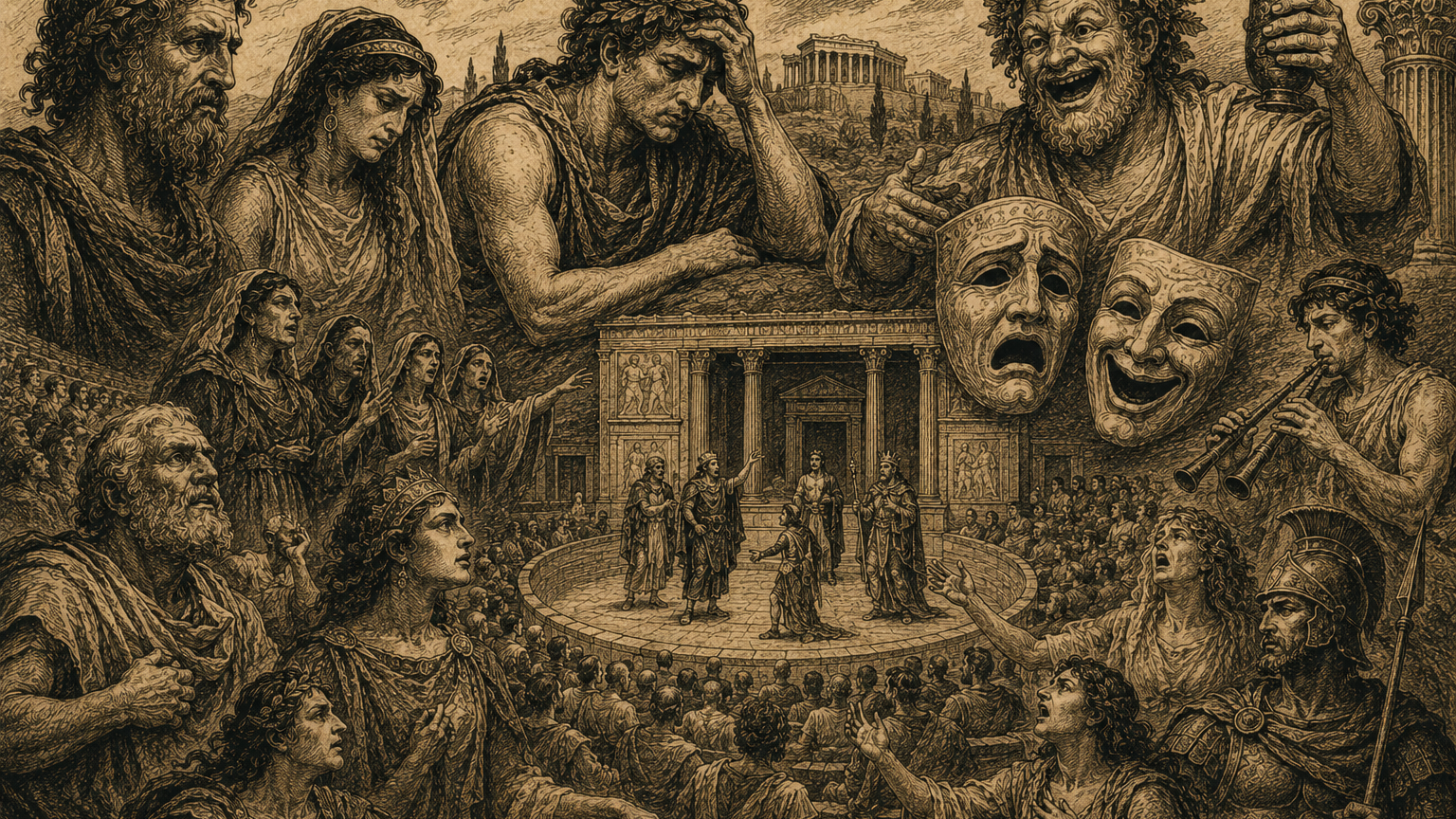
Third, ancient staging followed many conventions quite different from our own: an all-male cast, the use of masks and elaborate costumes (much like Noh and Kabuki again), professional actors (the number allowed on stage grew from one, to two, then three, with actors doubling multiple roles — there were even formal acting competitions), while the chorus, by contrast, was made up of amateurs, funded by wealthy citizens as a form of civic service (the actors were closer to our modern stars — getting top billing, their names announced before the title of the play). There was very little scenery. This was fundamentally an oral medium, performed in enormous outdoor theaters holding as many as fourteen thousand spectators, which put a real premium on vivid verbal delivery — a great deal is simply narrated rather than shown ("Look, she is weeping"), and violent action generally happens offstage, reported afterward by messengers. This was a literate society that nonetheless remained deeply oral in its habits — epic poetry was still recited aloud, and the law courts and public assembly relied heavily on legal and political rhetoric (public speaking became genuinely important once democracy took hold, and the sophists were the first professional teachers of rhetoric). This same rhetorical culture shows up constantly within the plays themselves — the courtroom scene in the Oresteia is a clear example.
Theatre as a Civic and Religious Institution
Fourth, and perhaps most importantly, the theater was not a private institution in anything like our sense — not a commercial theater. Aeschylus and Sophocles were not worrying about box-office receipts. This was fundamentally a religious and political institution, not mere entertainment. The Dionysia was a great civic festival lasting three days, at which three competing playwrights were formally selected, each producing three tragedies plus a satyr play (only one complete satyr play survives, Euripides's The Cyclops — genuinely obscene comic relief, presented not interspersed within the tragedies the way Shakespeare might do it, but afterward as a separate piece; it's hard to imagine Aeschylus or Sophocles writing anything quite like it). The playwright himself typically served as producer, director, composer, choreographer, stage designer, and often lead actor all at once. The first playwright on record is Thespis (the origin of our word "thespian"), though he may be a partly mythical figure. As with everything else in Greek life, playwrights competed for prizes — originally, tradition holds, a goat, which is where "tragedy," literally "goat-song," gets its name. The Oresteia is the only complete trilogy to survive intact; Sophocles's three Theban plays, by contrast, do not form a real trilogy in this technical sense, since they were written and produced at very different times. Comedy had its own separate festival too, the Lenaea, established around 440 BC.
Plays were generally produced only once, and were not typically revived — which helped preserve a certain aura around the experience; you couldn't simply go order a copy of the Oresteia to watch again at home. You essentially had one chance to see a given play performed (though written texts were available afterward — Aristotle refers explicitly to reading tragedies, not just watching them). Aeschylus's own plays were revived after his death, and occasionally an existing play would be reworked and re-staged (Aristophanes did this with The Clouds). This was a genuine religious institution in the fullest sense — a priest and a representative of the god were both formally in attendance, with reserved seating. Going to the theater was something like a religious experience because it actually was one, part of a larger religious festival, a genuine religious rite — nothing like going to see a movie. There was a strong ritual element throughout. Some spectators were able to maintain real critical distance from all this — Socrates, Plato, Aristotle among them — but many others were swept up completely in the experience, something close to a state of transport. This is genuinely hard for us to fully grasp today: Greek tragedy was never mere entertainment, never something you'd take a date to on a Saturday night. The play became a focal point for the entire community, which is exactly what gave it its seriousness and gravity. A substantial portion of the whole citizen population would turn out for it; for those three days, essentially everything else in Athens came to a stop, not unlike the Olympics. Judging from what Plato says elsewhere about drama, many spectators seem to have genuinely believed, at some level, that what they were watching was real.
The Polis as a Comprehensive Community
The status of the theater tells us something important about how different the polis is as a form of community. The polis is not simply a "city-state" in our modern sense — Athens was not some pint-sized version of Canada. The polis is really an alternative to the modern idea of the state altogether. In the contemporary United States, the state stands opposed, in a sense, to society at large — individuals pursue most of what matters to them privately, on their own, and don't generally expect to find real fulfillment through public life (aside from a few unusually devoted politicians). The state, in this view, is basically a policeman, supplying and enforcing a basic set of ground rules. We maintain a sharp church/state distinction, on the assumption that the highest human activities shouldn't be bound up with the state at all.
The polis recognizes no such separation between church and state. There was, properly speaking, no such thing as "Greek religion" as a single unified system — only Athenian religion, or Spartan religion, or Theban religion, or Corinthian religion. There were certainly some deities held in common, the Olympian gods, but each city also maintained its own particular gods, with a special relationship between individual gods and individual cities — Athens and Athena above all, embodied in the Parthenon itself. The city defined religious obligations and rites, and actively enforced them. The polis is what we'd call a comprehensive community — the one community that includes and subordinates every other community within it. This is quite unlike our own arrangement, where church and state function as parallel, largely independent communities: you can belong to the United States and simultaneously belong to any of hundreds of different churches, or belong to a Methodist congregation while holding citizenship in any number of different countries. None of that was possible in Athens. Religion there was simply a function of the city of Athens itself: if you were an Athenian, you practiced the religion of Athens, participated in Athenian religious festivals, and the city determined exactly when, where, and how you worshiped, through a fixed calendar of festivals.
The polis, in other words, includes what we would think of as specifically church functions — priests were themselves officials of the city, formally responsible for shaping the character of its citizens. The city, in this sense, is prior to its citizens. This is exactly why theater counted as both a political and a religious concern at once — it functioned as part of what we might call religious education, helping to educate citizens, build their character, teach them what to laugh at and what to weep over. This is why there was such a lively ancient debate over the actual effects of theater, running through both Plato and Aristotle (it's part of why Aristotle discusses music at length in the Politics). We tend to get nervous today whenever the state tries to dictate what can be shown on stage, immediately crying "censorship." Greek playwrights, for their part, actually got away with a great deal on stage — Aristophanes openly mocked prominent political figures by name, though he may well have been banished at some point for it. Major Athenian political figures regularly attended these plays in person. The theater was, in short, a matter of serious political concern.
The polis itself becomes the great subject of tragedy — its heroes are fundamentally political figures, and there's a constant underlying tension between the polis and the hero. What we'll be watching throughout this material is essentially what happens when you try to force Homeric-style heroes into a genuine community, try to make them actually live together in peace. It's an inherently volatile situation.
The Nature of Tragedy
There are three great philosophical theories of tragedy worth knowing — it's been a subject of enduring fascination for philosophers specifically: Aristotle's Poetics, centered on the tragic hero; Nietzsche's The Birth of Tragedy; and Hegel's Aesthetics, centered on the tragic situation itself.
Tragedy, at its core, dramatizes a conflict between two genuine goods — not a conflict between good and evil. That latter kind of conflict is really the stuff of melodrama, not tragedy: good against evil isn't genuinely perplexing, since we already know exactly who to root for, good guys against bad guys. Hegel's favorite example is Antigone — a situation where both sides are genuinely right: Antigone stands up for the family's right to bury its own dead, while Creon stands up for the city's right to formally denounce traitors. Consider Hamlet in similar terms: the real conflict isn't simply Hamlet against Claudius, but Hamlet against himself — an internal conflict between revenge and the refusal to take revenge. A situation like this is genuinely perplexing, and therefore genuinely dramatic, precisely because we don't actually know what the hero ought to do. It reveals a real, tragic incompatibility built into our own values.
This isn't really the American way of thinking, which tends to want to have it all at once, and so tends to have real trouble understanding tragedy on its own terms. The Declaration of Independence promises "life, liberty, and the pursuit of happiness" — not "life, liberty, and the pursuit of tragedy." Tragedy, as a form, has never really flourished in the United States; Hollywood prefers happy endings almost by reflex ("Why can't Hamlet just marry Ophelia and live happily ever after?" is a real kind of response people have; audiences complained about the DiCaprio Romeo + Juliet, "it's a great movie, but why did it have to end so sadly?"). There are many common ways of simply misreading tragedy — treating it as if there were some simple way out of the dilemma, some moralistic reading in which we could just tell the hero the obviously right thing to do. In genuine tragedy, the characters cannot avoid doing real wrong to one principle or another. Consider Orestes in the Oresteia: his mother has killed his father; if he takes revenge and kills his mother in turn, he's violated her rights; but if he refrains, he's violated his father's right to be avenged. There's no way to escape guilt entirely. The whole point is that tragedy reveals morality to be far more complicated than we ordinarily assume — you can't simply say "obey your parents" and be done with it. What if your mother has killed your father? Ordinary morality may turn out to be internally contradictory in situations like this, demanding genuinely incompatible responses at once — or morality may simply come into conflict with other real values, since not every good is a specifically moral good. You can't always remain fully loyal to both family and country at once; you can't always have both love and friendship without cost. This is a large part of the real importance of tragedy: it teaches us our own limitations, teaches us that we can't, in fact, have it all.
Hegel and the Historical Conditions for Tragedy
Hegel argues that what tragedy actually requires is a particular kind of historical situation — a genuine transition, a society moving from one whole conception of morality to another, which generates real conflicts between goods that used to coexist more comfortably (compare the Renaissance more broadly, caught between classical and Christian values; or Hamlet specifically, caught on the question of whether to take revenge at all). Ancient Athens, at this moment, was living through exactly this kind of transition: the emergence of the polis is the great fact of the sixth century, a broad movement away from family and tribal loyalties and toward specifically civic and political loyalty instead — a movement that inevitably produces real conflict between the old loyalties and the new ones. This is precisely what gets dramatized in the Oresteia, and again in Sophocles's Theban plays.
You can already see this theme beginning to emerge back in the Odyssey. The Iliad stays focused entirely on the world of heroes, who come into conflict with each other but have no higher authority to appeal to for resolution — there's no real principle of resolution available. Agamemnon believes himself to be the highest authority, but Achilles simply doesn't accept that claim, which is the whole underlying problem. In the Odyssey, by contrast, we begin to see the emergence of something like public opinion as a real force. Both Odysseus and the suitors have to worry about what the ordinary people of Ithaca will think of their conduct — this isn't yet a democracy, but it's no longer a purely heroic world either; you can already see the beginnings of something like a democratic spirit. We start to hear the actual voice of ordinary people (even when it's technically voiced by a noble character) — describing what heroism looks like from the other side, sounding remarkably like the opening chorus of the Agamemnon. Elsewhere in the same poem we still hear the older, purely heroic voice too. Greek tragedy emerges directly out of the tension between these two voices — the andres and the anthropoi. The anthropoi are, in a real sense, disgusted by all the destruction the andres have caused, and want to hold them properly accountable. This same underlying tension between he-men and ordinary human beings becomes, in Greek drama, the tension between hero and chorus.
The Odyssey's Ending and the Problem of Revenge
Notice how the Odyssey itself ends — with a genuine deus ex machina, Athena personally intervening to end the bloodshed and resolve the dispute. A feud between families, left to itself, could in principle go on forever; it contains no real principle of its own resolution, exactly as in the Oresteia.
Revenge is the single most prevalent theme in all of Greek tragedy, since revenge is itself a core part of the heroic code. In many societies, and certainly around the Mediterranean, revenge functions as a genuine moral obligation — you are personally responsible for avenging the death of your own relatives. Left unchecked, this produces an endless cycle of violence. Institutions eventually develop to manage this — the blood price, which we already see even in the Iliad. This is, in fact, one real reason the city comes into existence at all: to institutionalize and depersonalize the pursuit of justice. Murder becomes a crime rather than a purely personal injury, a crime against the public as a whole, handed over to a public prosecutor rather than left to private vengeance. This produces a genuinely safer situation overall — but one that remains emotionally unsatisfying in an important way. This is essentially what we mean by "poetic justice," as distinct from ordinary political or legal justice. Tragedy arises directly out of the tension between these two kinds of justice, poetic and political, which is exactly why revenge supplies such reliable material for tragic conflict: revenge is simultaneously demanded by the older heroic code and forbidden by the newer civic code.
Tragedy, in this sense, focuses on a genuinely deep problem of civilized life: for the sake of order, we have formally renounced personal vengeance, and yet we still feel its real appeal — hence the enduring popularity of vigilante stories in movies and television, the enduring popularity of Westerns and gangster films, which portray a world where personal vengeance is still the operative code, still "personal justice" ("this time it's personal," as the tagline goes). The Oresteia is, in effect, the original courtroom drama. The basic underlying movement of Greek tragedy is a civilizing one — moving into the city, moving from the world of heroes into the world of ordinary human beings, of citizens. Heroes can do essentially whatever they like, exceeding all normal limits, in a way that's fundamentally childlike, even childish — insisting on having their own way without interference (this helps explain the continuing popular appeal of stories like this — compare the Odyssey to something like Terminator 2: a child's fantasy of a heroic father figure showing up to accomplish the vengeance the child himself cannot — the Odyssey, in a real sense, as Telemachus's own dream). Ordinary citizens, by contrast, have to make constant compromises in order to actually live together.
This is the underlying movement from family to city. The family — and the extended family, the tribe — is the single most important unit of pre-political organization. But the family cannot resolve its own deepest problems on its own; it eventually has to go outside itself and appeal to some larger political authority instead. There's a real dream, in this material, of one big happy family — you can see it in the Odyssey itself, with Penelope as the perfect wife, Telemachus as the perfect son, Odysseus as the perfect father. But there's also a nightmare counterpart shadowing that dream throughout, in the story of Agamemnon and his own family: a father, Agamemnon, who kills his own daughter, Iphigenia; a wife, Clytemnestra, who kills her own husband; a son, Orestes, who kills his own mother in turn. This is the all-time dysfunctional family — a family turning in on itself and effectively consuming itself. Incest and cannibalism both function as recurring images of exactly this kind of all-consuming, self-devouring family — a persistent image throughout Greek mythology generally is the father who eats his own children, an abiding sense that something is fundamentally wrong at the core of the family as an institution. Left entirely to itself, the family is self-destructive — which is exactly why the polis becomes necessary. The Oresteia, in effect, takes us all the way from Family Feud to the People's Court.