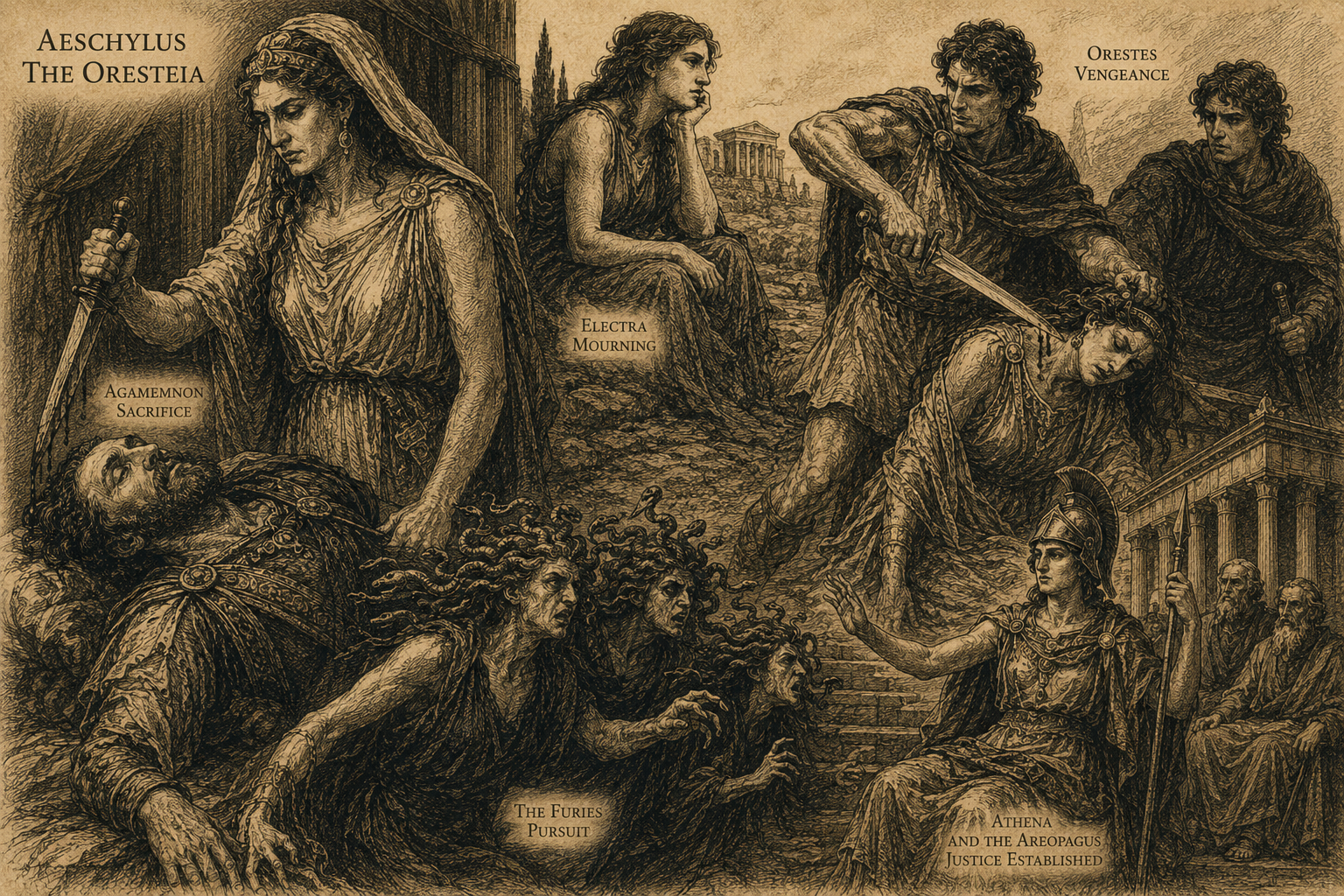
Aeschylus' The Oresteia
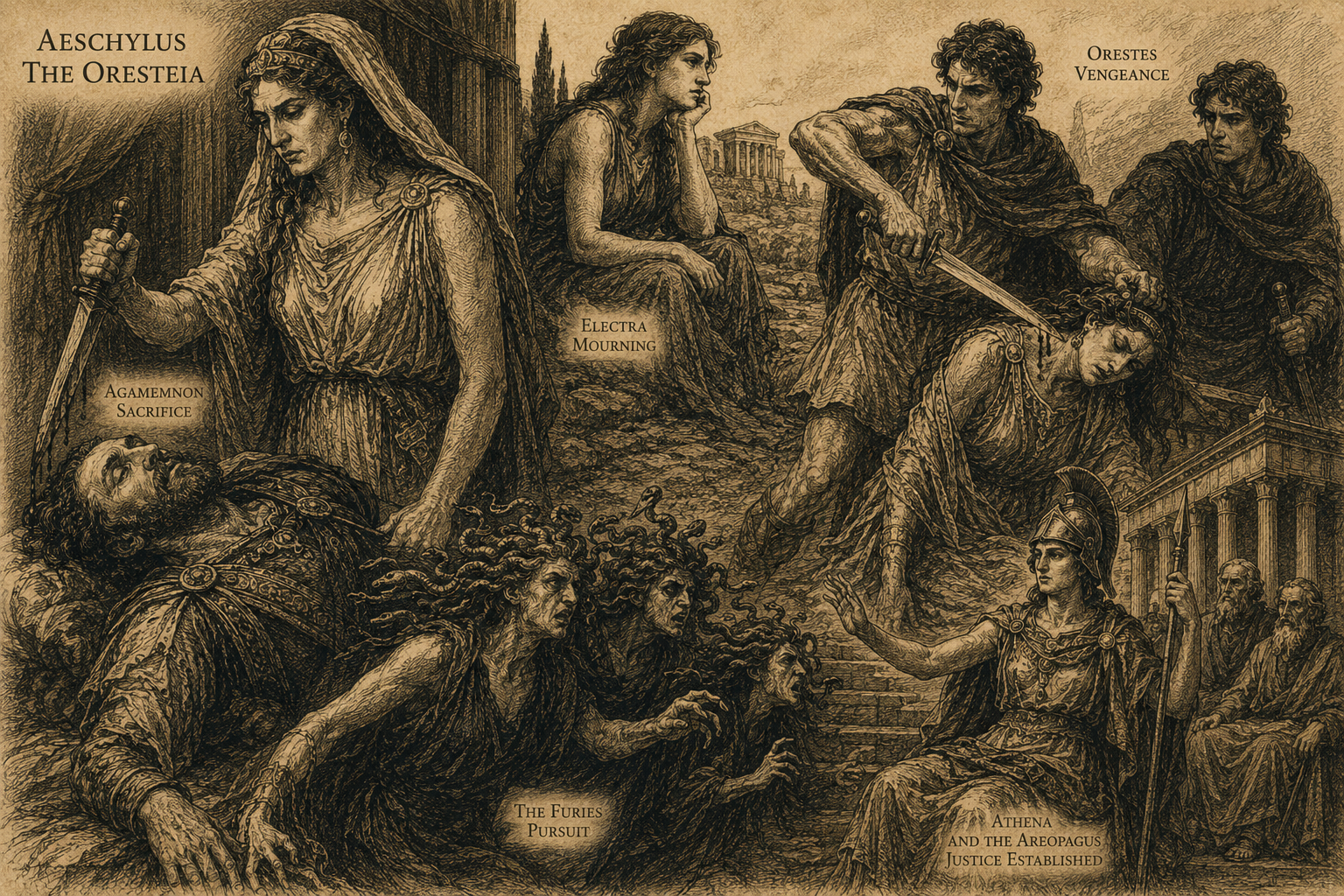
Lecture Notes
On Aeschylus's Oresteia
Paul Cantor · University of Virginia
From Homer to Aeschylus
The move from the Odyssey to the Oresteia skips over a great deal — a lot of history, a lot of literature, most of which is simply lost to us. Still, it's a helpful jump to make, because Aeschylus is writing with Homer very much in mind, in direct response to him. It's worth remembering that the Athenians didn't know what we think we know about the Homeric poems. Like everyone else in the ancient world, Aeschylus believed there was a poet named Homer, and the Athenians generally thought he had lived around 850 BC — which meant this material already seemed very archaic by Aeschylus's own day, and the world of the Trojan War that Homer describes felt distinctly primitive to them. And yet Aeschylus clearly felt he had to come to terms with it. This shows that Homer provided the actual basis for Greek tragedy — a claim Aristotle makes explicitly, and one Aeschylus himself apparently admitted, supposedly calling his own works "slices from the banquet of Homer."
You can see Aeschylus working directly with Homeric material throughout the Oresteia. The Agamemnon story runs as a kind of shadow to Odysseus's story in the Odyssey: Agamemnon returns home first, only to find catastrophe waiting; Odysseus returns home last, and finds fidelity waiting instead. Agamemnon has the all-time nightmare of an unfaithful wife; Odysseus has the all-time dream of a faithful one. It's almost as if Aeschylus were writing an alternate Odyssey. Just as the Odyssey itself offers an alternate Iliad, the Oresteia offers an alternate Odyssey — an alternate homecoming. Aeschylus is looking for material Homer didn't cover directly, which turns out to be a good general formula for Greek tragedy as such: dramatizing Homer, applying the power of theatrical representation to Homeric material.
The Origins of Tragedy
The actual origins of tragedy are shrouded in real historical mystery, but Aristotle's account in the Poetics (chapter 4) gives us a plausible outline. Alongside the public recitation of Homer, dramatic forms began to develop in parallel — stories acted out rather than simply recited, which was itself quite an innovation (Plato feels the need to carefully explain, in the Republic, what it even means to act something out rather than just narrating it in your own voice). Tragedy may have started out as a fairly low, popular form, involving satyrs — which may explain the term "goat-song," the literal meaning of "tragedy." This can sound strange to us, but only if we forget the etymology: "tragedy involved goat-men" sounds odd, but "goat-song involved goat-men" doesn't sound odd at all.
At some point, someone realized the real dramatic potential of this form — realized it could serve higher purposes, dramatizing heroic tales rather than just low comedy. This may have been Thespis, or possibly Aeschylus himself. In any case, by the time we first encounter the form, it is already highly developed. These are the earliest dramas that survive, but Aeschylus is no primitive — the Oresteia isn't even his first work, and even his earliest surviving plays don't read like anyone's first attempt at the form. (Compare film: it started as a novelty item and very quickly became a full art form.) The Oresteia has Homeric power of construction, is grandly planned, and shows a tremendous sense of theatricality — genuinely astonishing for our earliest surviving dramas: the use of ritual and religious rites, stage props like the tapestries, a real variety among the choruses (old men, female slaves, the Furies), startling visual contrasts (the Furies against Apollo), music that was probably strikingly distinctive, and audacious imagery throughout. Aeschylus pulls out all the stops — it's genuinely operatic.
Heroism Already Diminishing in Homer
All of this theatrical power is put in service of dramatizing the problem of heroism — a problem Homer had already begun to sense. The overall movement of the Iliad and Odyssey together takes us from a world of he-men to a world of ordinary human beings, from heroes to ordinary citizens. Homer's implicit sense is that humanity used to be grander — there were giants in those days, capable of building Cyclopean walls. How did we get to be the way we are now? There was once a titanic conflict, one the gods themselves were involved in, and the heroes essentially destroyed each other in it; the gods, in turn, began to withdraw from direct participation in mortal affairs. This explains why we now live in a diminished world, one where the gods no longer speak to us directly. The heroes themselves used to be demigods, the literal offspring of unions between gods and human beings.
Odysseus is, in effect, the last of these heroes. Once he's gone, we're left in the ordinary world of an ordinary community like Ithaca. There's already a much stronger sense of the domestic world in the Odyssey than in the Iliad — goatherds and swineherds everywhere (in the Iliad, goatherds appear only in similes; in the Odyssey, they appear as real characters). Odysseus himself spends a great deal of the poem disguised as a beggar — something Achilles would never do. A great deal is lost in this transition, and Homer carries a genuine elegiac sense of the passing of a noble heroic age (epic, as a form, is often elegiac in exactly this way). But perhaps it's for the best — things do calm down. While Odysseus is still alive, we can see real tension between the hero and ordinary citizens, a tension that could easily have led to a battle to the death if Athena hadn't personally intervened at the end of the poem. Consider the larger arc: the Iliad begins with the gods causing strife between heroes; the Odyssey ends with a god actively creating peace between a hero and ordinary human beings. The heroic world is given up in exchange for domestic tranquility.
The Oresteia's Great Anachronism
Greek tragedy develops this same idea much further, exploring the problems that arise when you try to integrate the hero into the polis, the city. The Oresteia begins in the world of the Odyssey — the world of Mycenaean kingship — and ends in an Athenian law court. This involves a genuinely enormous anachronism: Agamemnon would have lived around 1200 BC; Athenian law courts date to roughly 450 BC. Over the course of the trilogy's three plays, we make an eight-hundred-year jump. What we're actually watching is an extraordinary claim: that Athens can solve the very problems the Homeric heroes were never able to solve among themselves. These problems will, in the end, be resolved in an Athenian courtroom. The trilogy encapsulates the whole movement from the heroic world to the world of the polis, powerfully bringing the two into direct conjunction — almost as if we were moving from one side of Achilles's shield to the other.
A Unique Historical Moment
This is a genuinely unique historical moment for Greek tragedy as a form. Jean-Pierre Vernant, in Myth and Tragedy in Ancient Greece, tries to explain why so many great tragedies were written within this one narrow window. Tragedy, as a flourishing form, is actually quite rare historically — really just fifth-century Athens and sixteenth- and seventeenth-century London. The Athenian moment is distinctive because it sits close enough to the heroic world to still feel its attraction, while having enough distance from it to be genuinely critical, to see its dangers. This produces exactly the kind of divided attitude tragedy requires. Fifth-century Athens was, in effect, in the process of being tamed and domesticated — men had recently given up the practice of carrying weapons in the city, not unlike Dodge City or Tombstone once Wyatt Earp cleaned them up — but not everyone was happy about this. Many still felt the real pull of the heroic ideal: to be self-sufficient, to do exactly what you want, to not have to rely on others, to give free rein to your thumos. This was, after all, a city of tremendous political ambition, as we'll see — tyranny, empire, even world conquest were all live possibilities. Athens had to keep being reminded of how fragile civilization actually is, how easily it could be torn apart by passions like thumos.
Tragedy as a form declined once the heroic world came to be thought of as purely mythical, irrevocably confined to the distant past — just a set of old stories, no longer felt as a real, viable option (you can see this already happening in Euripides, whose Orestes comes across not as heroic but simply as psychotic). Genuine Greek tragedy requires feeling both the attraction of heroism and the real need for community at the same time. Put another way: in the heroic world, men still carry swords, and expect to secure justice for themselves through revenge. In a fully domesticated world, men no longer carry weapons at all, and simply defer to the law, expecting the authorities to secure justice on their behalf. Fifth-century Athens sits at a rare moment in between — men have only just been domesticated, have only just given up carrying weapons. Their first instinct, when insulted or injured, is still to reach for a sword that is no longer there — they notice its absence, still feel it. In a fully heroic world, your first instinct is to reach for the sword, and it's there, and you kill your opponent. In a fully domesticated world, you gave up weapons so long ago you've simply forgotten about them; your first reaction to being wronged is to call the police. Fifth-century Athens is the rare historical moment in between, where people still feel the phantom presence of that absent sword, still genuinely appreciate the heroic world even as they've left it behind. As long as that first instinct — reaching for the absent sword — persists, tragedy flourishes; once people lose that old instinct entirely, the power of tragedy weakens correspondingly.
This is admittedly an oversimplified explanation, but it gives some sense of why fifth-century Athens was such an unusual historical moment. It's not that we can't appreciate tragedy today — we can, and do — but we have to make a real effort to recapture that divided feeling; deep down, we still feel the pull of heroic urges ourselves. Many of the same issues get recapitulated in the mythology of the American West — there's a real kinship between John Ford and Aeschylus. The Searchers carries the same underlying sense of civilization against barbarism. We live, in practice, in a world of impersonal justice, but in our art we remain drawn to a world of personal justice — "this time it's personal," as the movie tagline goes. That tension between personal and impersonal, or political, justice sits right at the heart of Aeschylean tragedy.
A New Perspective: The Ordinary Voice
In the Oresteia, heroes are still real figures, and the gods still take a direct interest in these characters, even appearing on stage — but we've already seen that much in Homer. What's genuinely new is that we start getting the ordinary man's perspective, something like the enlisted man's view of war rather than the officer's view — the herald, for instance, at one point comments on the weather affecting the army, something Achilles would never say ("It's raining out; let's not fight today" is a distinctly unhomeric kind of remark). This herald cares about his own body, about ordinary human concerns — food, clothing, shelter, the weather — with none of Achilles's heroic indifference to his own physical needs. We also get a genuine woman's point of view, what it was actually like to stay home during the war (we saw a hint of this already with Penelope), and a mother's perspective as well. These are all, in a real sense, anti-heroic viewpoints — though that doesn't mean Aeschylus himself is anti-heroic. Euripides is genuinely anti-heroic, which gives us a useful point of contrast.
It's genuinely remarkable how much anti-heroism runs through Greek literature generally. We're naturally struck by the extreme heroic ideal on display, but we should be equally struck by how willing the Greeks are to voice anti-heroic sentiment. Every culture has its heroes, even its superheroes — what's distinctive about the Greeks is how skeptical they remain about their own heroes, how willing they are to question them. Aeschylus himself does seem to genuinely admire traditional heroism, but he's willing to listen to the other side too, for once, which is exactly why the play is so genuinely dramatic — a real clash of perspectives, far more pointed than anything in Homer. Epic, as a form, is relatively monologic: a single, uniform poetic stance, a single meter, with only occasional room for anti-heroic complaint (Thersites in the Iliad, though he's presented as contemptible). Aeschylus, by contrast, allows a much greater difference of voices — more differentiation even in meter — with a real sense that these different voices are each legitimate in their own right. This comes through most clearly in the chorus of the Agamemnon, who function as spokesmen for ordinary humanity, giving us a sense of how the war actually looked to the people who stayed behind — something like the "body bag" view of the whole war. There may even be a kind of irony directed at Homer here, since some of it sounds at first like conventional Homeric praise of the heroic virtues. But the chorus goes on to criticize great men directly, speaking up instead for a kind of middle state (not quite "middle class," but close). Compare this to Achilles in the underworld scene of the Odyssey, who can only imagine two possible states of existence: king or slave, with nothing in between. This represents a real movement away from strict binary opposition, toward moderation, toward something in the middle — an early version of the Aristotelian notion of the mean. There's an explicit defense of ordinary mediocrity here, on the grounds that it's simply safer (translations can make this sound more Christian than it really is, rendering it as something like "pure in spirit," which overstates the case) — a genuinely unaristocratic sentiment: the poorer you are, in a sense, the more virtuous you become.
We can't simply identify Aeschylus with the chorus, or with any single one of his characters — this certainly isn't true of the Furies, for instance, who are themselves active participants in the action, interested parties in their own courtroom drama. It's a common mistake to assume a chorus simply speaks for the author. We have to look at the action too — sometimes a character's words are quietly undermined by their deeds. Aeschylus may not be entirely on the side of these old men either; there's real irony in how the chorus behaves, exposing the negative side of their own moderation — they're frankly afraid to do anything themselves, standing around talking, hoping someone else will act. Aeschylus seems well aware of their non-heroic character, perhaps even something close to cowardice. Even so, the overall lesson of the Oresteia remains the virtue of moderation — in the Eumenides, even the Furies are ultimately brought around to a kind of mean. This emphasis on the mean is deeply, characteristically Greek, and it eventually culminates in Aristotle's ethics: courage, for instance, as the mean between cowardice and foolhardiness. There's a real, sustained effort throughout to temper the heroic ideal, to civilize it. The recurring image for the tragic hero is the lion: an excellent beast in its own right, but not something you want wandering around downtown Athens. The heroic fury needs to be tamed and domesticated.
Deliberate Anachronism and Contemporary Politics
Aeschylus uses the weight of community, the weight of public opinion, as a real force in the play — a development directly out of what we already saw at the end of the Odyssey. This is a deliberate anachronism: Aeschylus is nominally writing about the world of heroic kingship, Mycenaean Greece, where the historical Agamemnon could, in principle, do whatever he wanted, answerable to no one among the common people. But Aeschylus deliberately suggests that ordinary people have to be taken into account after all — there are some genuinely interesting political touches throughout. Clytemnestra, speaking to Agamemnon, raises the possibility of popular insurrection while he was away at Troy; Agamemnon himself later voices real worry about public opinion. None of this would make sense in the actual Homeric world, where ordinary people simply have no political say — but it makes perfect sense in Aeschylus's own world. Aeschylus is writing at a time of real democratic reform in Athens, with steadily increasing power for the common people. Athens had to rely on ordinary citizens to defeat the Persians, which in turn increased common participation in Athenian politics generally (something like "if you're old enough to fight, you're old enough to vote"). Aeschylus keeps one eye on the Homeric world and one eye on contemporary events at the same time; the problems he dramatizes in Agamemnon's world are really, in a real sense, the problems of his own world.
The Athenians had just won a great victory over the Persians, much as Homer's Greeks had once triumphed over the Trojans. Will that victory go to their heads? Will the Athenian victors start behaving like the very Persians they defeated? Consider Clytemnestra's temptation of Agamemnon — she rolls out the red carpet, quite literally, asking him to walk across a priceless tapestry. These tapestries were worth their weight in gold, and stepping on one would have been a genuine act of impiety, the behavior of an Oriental despot rather than a Greek — Clytemnestra even offers Priam as a model to follow, which should immediately signal what's wrong with the whole idea, since Priam was his enemy. This is orientalism again, the very same stereotype we already saw at work in the Iliad. Having just conquered an Asian enemy, Agamemnon stops acting like a Greek and starts acting like a barbarian instead — he resists at first, recognizes he's overstepping the bounds of decent conduct, recognizes he'd be acting like a god rather than a man, and does it anyway. This may well reflect Aeschylus's own fears for Athens — that having conquered the Persian empire in the name of freedom, Athens will start behaving like an imperial power in its own right. Which is, in fact, exactly what happened; the play turned out to be prophetic. Aeschylus seems to see a genuine link between contemporary events and the mythic past — the Trojan War takes on real new meaning in the context of the ongoing conflict between Athens and Persia. Throughout the fifth century, Athenian playwrights repeatedly used the Trojan War to symbolize contemporary conflict — the war between Athens and Sparta, for instance, in Euripides's The Trojan Women, one of the greatest anti-war plays ever written. This isn't a matter of reducing the play to a simple contemporary allegory; Aeschylus genuinely sees a real parallel between the mythic story and what's happening in his own day, sees the universal working itself out in the particular. The lesson isn't confined to the Athenian situation of the moment — it's a tract for his times, but also, at the same time, for all times. (An older critical view held that Greek tragedy deals purely with universal, timeless issues — fate, mortality, human suffering — with no real contemporary reference at all; more recent criticism tends to emphasize the contemporary references instead. But this doesn't have to be an either/or situation. These were, after all, working playwrights, who had to appeal to the real interests of their contemporary audience, had to make the story feel immediate and relevant. A play can be timely and still carry timeless importance. Aeschylus's lesson about the dangers of imperial power remains relevant to this day.)
Tyranny and Democracy
More political touches appear at the end of the Agamemnon, which dramatizes a direct conflict between the common people and a tyrant. The sixth century had been the age of tyrants in Athens — Pisistratus, who may in fact have had Homer's poems written down in the first place and helped inaugurate Athenian drama, was himself a tyrant in this technical sense. There was real, live fear in the fifth century of a revival of tyranny (figures like Alcibiades, and later the Thirty Tyrants, kept this fear current — it comes up repeatedly in Aristophanes as well). Aegisthus is presented as a classic tyrant, a usurper — the dead giveaway is that he appears on stage with a bodyguard. The chorus openly challenges Aegisthus, and he responds the way tyrants in any age tend to respond: essentially, "we have ways of dealing with people like you." Notice the old master/slave opposition surfacing here again — "I'm an aner, you're just anthropoi."
There's likely a contemporary reference buried in the mention of oarsmen as well. The Athenian defeat of the Persians depended heavily on the strength of the Athenian navy, which in turn depended on its rowers — Greek ships were simply superior to Persian ones, swifter and more maneuverable. This was itself one real source of democratic reform in Athens: the rowers demanded, and won, the right to vote, substantially widening the democratic franchise (some members of the original audience may well have been rowers themselves). The chorus at one point gives voice to this democratic spirit directly — the exact opposite of Clytemnestra bowing down before Agamemnon on the tapestries. (The tyrant, more broadly, represents the political embodiment of the Greek heroic ideal — we'll see this again with Oedipus.) Aeschylus is deeply suspicious of tyrants as a type. Tyranny isn't really an issue in Homer at all — the word "tyrant" itself doesn't appear anywhere in the poems, since the phenomenon predates the actual age of tyranny in Greek history. We'll see next week that tyranny becomes a serious, live issue in Sophocles instead.
The Bankruptcy of the Blood Feud
What's actually wrong with the heroic world? Aeschylus develops a point already implicit in Homer: the heroic world is ultimately self-destructive, even self-consuming — which is why cannibalism becomes such a powerful recurring symbol throughout the trilogy. The Oresteia as a whole dramatizes the fundamental bankruptcy of the blood feud as an ethical principle — and since the blood feud is an integral part of the heroic code itself, the plays amount to a sustained attack on that code. Consider the cycle of revenge at the heart of the story: Agamemnon kills his own daughter, Iphigenia; Clytemnestra responds by killing him; Orestes responds in turn by killing her. Where does it end? By the internal logic of the blood feud, apparently nowhere — it would go on forever. There's a whole prior history behind all of this too, trouble that started generations earlier with Thyestes and Atreus, and reaches back even further to Pelops and Tantalus. The trilogy is full of genuinely nightmarish imagery centered on this history — the horror of a family literally turning in on itself, a parent becoming a devourer of his own children. The family, left to its own devices, simply cannot solve its own problems; left alone, it leads inevitably to tragic, irresolvable conflict.
What do you actually do if your mother kills your father? There's no way to avoid real wrongdoing either way: if you avenge your father, you've killed your mother, which is no act of filial piety either, since it violates your mother's own claim on you; if you do nothing, you've betrayed your father, which is equally no act of filial piety, since it violates his claim instead. Agamemnon, earlier in the story, faces a structurally similar dilemma of his own — forced to choose between destroying his daughter or abandoning the entire expedition to Troy. Throughout the trilogy there's a pervasive sense of genuine irresolvability, stated most clearly and starkly at one key point late in the story — pure Hegel, in effect (not that Aeschylus had read Hegel, of course; rather, Hegel had read Aeschylus, and it directly shaped his own theory of tragedy). This same irresolvable dilemma becomes Orestes's own personal problem in turn. Even the gods themselves are shown to be genuinely puzzled by it.
Athena Founds a Law Court
Athena ultimately founds a law court to resolve the crisis — a clear dramatization of the larger movement from family to polis. It closely echoes the law court already depicted on the shield of Achilles. The institutions of the polis come into existence, in effect, specifically to resolve crises the family generates but cannot resolve on its own. Disputes can now be formally adjudicated — and what actually matters most isn't so much exactly how they're settled as that they are settled at all, through some agreed-upon process and principle that people can accept, even if it involves real compromise. The city functions here as a genuine mediator — not simply one individual, family, or clan pitted directly against another, but a larger institution stepping in to mediate between them, something capable of bridging the underlying binary opposition itself.
This leads to a growing realization that human relationships are only partly natural, and partly conventional. It comes up in a rather strange, pointed way: which is actually worse, killing your mother or killing your husband? This pits the blood tie against a purely legal obligation — the mother-son relationship reads as natural, while the husband-wife relationship reads as fundamentally conventional. You can, in principle, disown a husband; you cannot, in the same sense, disown a mother. Who your mother is seems perfectly obvious on its face; who your father is turns out to be a much more questionable matter, one that often has to be formally determined by law — hence paternity suits, and the polis stepping in more generally to help define family relationships as such. We tend to assume family relationships are simply natural, self-explanatory facts. But think it through further — surrogate motherhood, adoption — the whole question can get genuinely complicated and confusing even on the maternal side, and some form of politics turns out to be necessary just to define these family roles clearly. This is essentially what Aristotle means, in the Politics (Book I), when he says, in effect, that the family is chronologically prior to the polis, but the polis is logically prior to the family — the family only gets its full meaning within the larger context of the polis, which subordinates the family to its own larger aims.
The Oresteia offers its own strange version of this same idea, in a paradoxical attempt to redefine the very roles of mother and father — reflected directly in Greek mythology through the birth of Athena (Apollo's rather cheap courtroom trick, in effect). What we'd now call patriarchal ideology surfaces here quite explicitly: a real attempt to justify the broader subjugation of women within the Greek polis (who couldn't vote, couldn't own property, and so on), backed by some genuinely strange theories of biology that were nonetheless taken quite seriously at the time. Look at nature directly, and the mother's claim seems obvious, the father's dubious; the city instead redefines things so that the father becomes the more important parent. This is a questionable move by any modern standard, but it does successfully resolve the underlying conflict within the play. It shows, more generally, how the city tends to replace the natural with the conventional wherever it can.
The Celebration of Civilization
The Oresteia offers a real celebration of civilization as such — the very root of the word "civilization" is the city, making human beings civil, civic, capable of actually living together (hence also "civics"). The heroes of the Iliad, by contrast, are simply not civil to one another. Athena's great closing speech amounts to a real triumph of civilization over barbarism, with the Amazons standing in for barbarism itself, worshippers of Ares, the god of war, who have to be tamed by Theseus of Athens (compare the same myth later reused in Shakespeare's A Midsummer Night's Dream). Aeschylus actually invented this particular myth himself — the Athenians had a different traditional myth explaining the origin of the Areopagus; Greek playwrights were generally free to invent their own versions of the myths they worked with. You can find the same underlying lesson on the Parthenon frieze: the defeat of the Amazons, humans triumphing over centaurs. The great public buildings of Athens embody the power of the polis in stone, teaching essentially the same lesson as the tragedies themselves. At the actual time of the Oresteia's first performance, the Parthenon itself hadn't been built yet (it was completed in 438 BC), but the temples already standing on the Acropolis would have been visible from the Theater of Dionysus. The Areopagus itself couldn't be seen from there, but it was just around the corner. These plays were produced as part of a civic festival — a celebration, in effect, of the greatness of Athens itself. Aeschylus is celebrating the civilizing power of Athens as a city, at a civic festival held in Athens. There's a shared reverence for the mean running through both closing speeches — Athena's, and the Furies' own — very different voices, but able to agree on this one point at least.
A Happy Ending, and Its Cost
There's no way to resolve the underlying conflict at the level of the family alone; the trilogy has to advance to a higher level, the polis, in order to establish real harmony. Notice that the trilogy actually ends happily — tragedy doesn't have to end in death, a common misconception. Aristotle himself never insists on a death at the end of a tragedy. The Greek sense of "tragic" really means something closer to "serious" as opposed to "comic," dealing with noble subject matter, carrying real gravity — but it can perfectly well involve what we'd call a happy ending. Aeschylus is genuinely optimistic here, but it's not an easy optimism. The happy ending never loses sight of the horror that preceded it. This is a real vision of civilization, but Aeschylus remains fully aware of how fragile that civilization actually is, how genuinely threatened. The trilogy shows us harmony achieved, but also keeps us aware of the dark forces civilization has to work continuously to control. We're so thoroughly used to civilization ourselves that we tend to take its real benefits for granted, and correspondingly romanticize the primitive alternative. Aeschylus is still too close to actual barbarism to indulge in that kind of romanticism — for him, barbarism means cannibalism, quite literally.
The Gods Also Progress
This same movement is mirrored directly in Aeschylus's picture of the gods themselves — human progress mirrored in a kind of divine progress, traced from Uranus to Cronus to Zeus. The Greek gods are not unchanging figures; they have their own history, their own succession of rulers. Aeschylus continues Homer's own theological project here — a theodicy, justifying the ways of the gods to human beings — though he questions their justice first, every bit as skeptical as Homer himself; the gods remain genuine mysteries. Aeschylus doesn't simply accept them without question — at one point he even notes that the gods don't always set a particularly good example themselves (compare Aristophanes's Clouds, where a character cites Zeus's own behavior to justify beating his father). But Aeschylus's real hope is that the gods become progressively more civilized over time — a genuinely remarkable notion: that the gods themselves have to grow up, have to improve over time. This is very different from our own inherited notion of a God who is good from all eternity, unchanging. For the Greeks, it isn't quite that the gods civilize human beings; rather, human beings civilize the gods, through the city.
There's a real variety of gods at work here, organized around a central opposition between the Olympian gods and the older gods of the earth. The Furies represent these darker, chthonic gods — genuinely frightening figures (you can see something of this in the older imagery preserved in the Acropolis Museum, full of serpent motifs). There's a strong, sustained sense of old gods against new gods throughout, with the Olympians ultimately triumphing over the Furies, establishing a new, more civilized order. This may well reflect a real underlying religious history — one set of gods imposed over another whenever one people conquers another, and in this particular case, something like matriarchy giving way to patriarchy. The Furies are explicitly female; Apollo represents the male principle (and worries, above all, about castration). Athena's role throughout is that of mediator: the Furies are female and non-Olympian, Apollo is male and Olympian, while Athena herself is female but fully Olympian, having sprung directly from Zeus's own head — which lets her bridge the underlying opposition between the Furies and Apollo.
Notice, too, that the Furies aren't simply defeated outright — they have to be actively incorporated into the new regime instead. The family, as an institution, is generally not very good at incorporation, except in the form of literal ingestion; the family is fundamentally exclusive. In the Oresteia, whenever someone says "come into my house," that's exactly the moment to be careful — you're probably about to be killed, and quite possibly eaten. Much like a mafia family, you're either fully in or fully out; it's always us against them. But in the Eumenides, the city proves genuinely good at incorporation — it can even successfully incorporate gods. In the Iliad and Odyssey, the gods are never tied down to any particular city; they remain essentially free-wheeling, dispensing justice to humanity from outside any single human institution. Here, by contrast, the gods are brought directly into a human courtroom proceeding — the gods themselves are being civilized, in the word's own root sense, drawn into the orbit of the city.
This could reflect a certain naivete on Aeschylus's part — the idea that the Furies can simply become the Eumenides, the "kindly ones," just like that. But it could equally reflect real wisdom on his part instead: you can never fully escape the dark element; it has to be acknowledged, even within the city itself. The city does triumph over barbarism in the end — but it's an uneasy triumph, and the barbarians may still, in some sense, be at the gates. More importantly, the barbarism in question is already inside the city, because it's an inescapable element of human nature itself. This is exactly why Aeschylus counts among the very greatest of the tragedians: we do reach a happy ending, but only by going through something like hell to get there — the trilogy insists that we suffer our way into truth, and we come away from the plays still remembering the horror vividly, not humming some happy tune on the way out, not treating it as "the feel-good hit of the festival." Aeschylus is not a simple-minded optimist. A play can have a genuinely happy ending and still remain great tragedy. For Aeschylus, the polis really is the answer to humanity's deepest problems; Sophocles, as we'll see next, is going to start questioning that answer.
Related Work