
On Virgil's Aeneid
Lecture Notes · Session II
On Virgil's Aeneid
Paul Cantor · University of Virginia
A Literary Epic: Imitation as Method
Roman culture is derivative from Greek culture. This is our first real turn to a genuinely new culture in the course, and yet we already see how thoroughly it's shaped by the old one — we don't simply leave earlier cultures behind; our own culture is deeply sedimented, layer upon layer. Virgil is derivative from Homer in exactly this sense — the Aeneid is a distinctly literary epic, one always keeping one eye on its own subject and one eye on Homer at the same time. Virgil never pretends that no one ever wrote an epic before him. He could have taken that route — simply dismissed Homer as "just some barbaric old Greek." Instead, Virgil makes the most of the situation, openly imitating Homer throughout. Virgil commits himself fully to literary imitation as a method, which matters enormously for literary history.
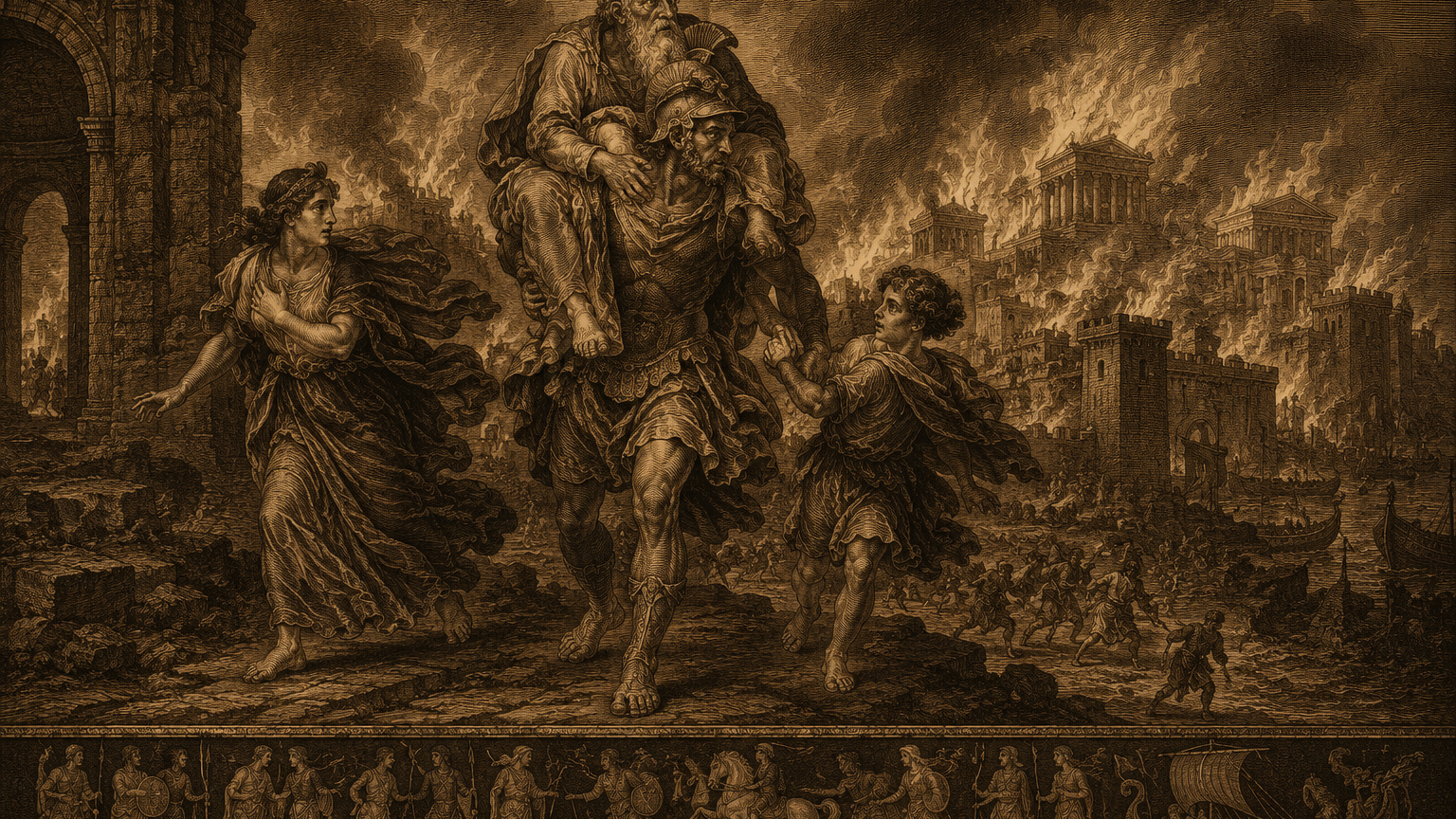
He dramatizes this same problem directly through his own hero. What do you actually do with an inherited heritage? Aeneas is not free to simply do as he pleases — he has a clearly defined mission, to refound Troy, to translate Troy into Rome. The city he's meant to build has, in a sense, already been laid out for him in advance, already planned. The same is true for Virgil himself — he isn't free to do exactly as he pleases either, since Homer has already laid down the whole epic pattern before him, the epic law, the basic plan of the form. As in the Odyssey, the poem begins in medias res (the Latin phrase itself has become standard); there's a flashback recounting earlier events, a visit to the underworld, a catalogue of heroes, and so on. For both Aeneas and Virgil alike, you already know roughly how it's going to come out before it even happens. Both carry mixed feelings about this inherited tradition: it sustains you, gives you a real sense of purpose, offers a model against which you can measure your own achievement. But it's also, at the very same time, a genuine burden — you feel constrained by it, feel the weight of having to live up to your predecessors. Aeneas carrying his father Anchises on his back captures this perfectly — carrying the weight of an entire civilization, the Father himself, the burden of tradition, the burden of the past.
For both Aeneas and Virgil, there's a strong sense of repetition running throughout. At one point Virgil and Aeneas seem to converge directly — Aeneas founding a small Ilium in miniature, Virgil founding a small Iliad in miniature. This can look, at first, like a real diminishment. But there's real hope built into the repetition too (notice one telling phrase, that this new settlement will be "better shielded from the Greeks" — Virgil clearly wants to deny, or at least minimize, Greek influence here): this time, the repetition suggests, we're going to get it right — repetition with a real difference, with genuine improvement built in. A newborn child, elsewhere in the poem, represents exactly this kind of freshness, a genuinely new beginning. Virgil's own equivocal sense of his inheritance from Homer may help explain his deliberate turn to Troy in the first place. The great founding myth of the Aeneid is that the Roman heritage is specifically Trojan — meaning that the Romans are descended from Trojans, not from Greeks. This becomes, in effect, a way of quietly hiding Rome's real cultural debt to the Greeks. Virgil didn't invent this myth from scratch — Romans had already been tracing their heritage back to Troy before him — but he's the one who really crystallized it into its lasting form. This is a totally mythical heritage, with no actual evidence whatsoever behind it — no archaeological link between Troy and Rome exists; no Trojan artifacts have ever turned up in Italy. But there is overwhelming evidence of direct Greek influence on Rome, visible absolutely everywhere you look — in buildings, statues, philosophy, literature. Virgil, in a real sense, obscures his own true debt to Homer through this myth — as if Aeneas could simply have learned the story of Troy directly from a fellow Trojan, rather than from that Greek poet Homer.
The Shield of Aeneas: History Replaces Nature
Part of the key to Virgil's real success is that imitation itself lets him comment directly on Homer. The shield of Aeneas in Book VIII is an obvious case of imitation — just as Hephaestus makes Achilles's shield, Vulcan, the equivalent Roman god, makes Aeneas's. Both shields are highly pictorial. But where Homer's shield emphasizes nature above all — the surrounding ocean and sky are the very first things Homer describes on it, since for Homer the whole context of human action is the cosmos itself — Virgil, while clearly remembering this Homeric precedent, subordinates it. Virgil's shield instead begins and ends with Roman history specifically. The historical mission of Rome supplies the whole meaning of human action here, culminating in a picture of Augustus at the Battle of Actium.
The most basic difference comes down to this: Achilles's shield embodies a real binary opposition, a city at peace against a city at war, Homer's sense of two genuinely different ways of life, heroes against ordinary human beings. This is a genuine opposition in Homer, and it's exactly why the Iliad is tragic, and needs to be supplemented by the Odyssey, which offers more of the anthropos point of view. There's no such division on Aeneas's shield. Achilles's shield tells two separate stories; Aeneas's shield tells only one — Roman history ties all of human action up into a single, unified narrative, effectively rolling the Iliad and Odyssey into one combined story. This is exactly why Virgil, unlike Homer, only needed to write one epic rather than two. The Roman Empire reconciles hero and city into a single universal community — world empire itself supplies a whole new sense of the universal. In Homer, the cosmos is the real whole; in Virgil, Rome itself becomes the whole. In Homer, there's a persistent tension between individual heroes and their community, with no real sense of a single unified human whole. Aeschylus proposes that the polis itself will provide that whole, a way of reconciling hero and community — the city, in the Oresteia, even manages to include the gods. Sophocles then shows the polis to be a false universal after all — there's a law standing above and beyond the city that the city itself cannot change. This critique gets pushed even further in Aristophanes, and in Plato — what do you mean, Athens is the whole world? It's far too small a thing to claim that. Socrates, Plato, and Aristotle all insist that nature is genuinely greater than the city, a truer whole than any single polis could be.
Rome started out as a little polis too — but it has now genuinely grown, expanding to encompass what feels like the whole world. There's nothing left outside the borders of Rome anymore, or so it seems. That isn't literally true, of course — Rome actually knew of China's existence, even traded with it — but Rome simply pretended otherwise; China doesn't appear on Roman maps. Rome conquered the Mediterranean world and then simply pretended that was the entire world. Perhaps, on this account, Rome can now finally provide the genuinely universal community the Greeks themselves never quite achieved. This is how Virgil converts heroism into patriotism. Antigone, remember, could claim to be disloyal to her city while remaining loyal to the gods above it; now, in Virgil's Rome, there's nothing left beyond Rome itself to remain loyal to — the city has simply become the whole world. In Homer, there's a real tension between war and justice; in Virgil, the two get brought together instead — it's actually said of Aeneas at one point that he combines them, a claim no one would ever dream of making about Achilles.
From Heroism to Patriotism
Virgil gives us considerably less sense of two entirely separate orders of human being than Homer does — the whole aner/anthropos contrast gets substantially softened in his hands. The figure of Aeneas himself brings hero and ordinary man together in a single person. There's still a real sense of aristocracy running through Virgil — this isn't remotely democratic (we do have a persistent modern tendency to go looking for democratic ideas wherever we possibly can find them) — but Virgil is nonetheless moving away from the strict aristocratic principle we found in Homer. Homer carries a strong sense that heroism is essentially genetic — you're simply born that way, born into an entirely different order of being. Heroism in Virgil is considerably less a pure gift of nature, and more a matter of Roman willpower and discipline — considerably closer to our own modern sense of virtue (itself derived from virtus, the Latin word for manliness — imagine saying today, flatly, "virtue is manliness"; Virgil represents a real step along the way toward converting manly excellence into something closer to moral virtue in our sense). Aeneas is not as obviously a hero purely by nature the way Achilles is — he does have a divine parent, and he is, by nature, a genuinely superior man — but Aeneas has to actively work at being a hero, has to struggle with himself, has to resist real temptations along the way. He's considerably more like Odysseus in this respect. We move, across this whole tradition, from Achilles, to Odysseus, to Aeneas — with an increasing sense that heroism is a genuine moral achievement, in something closer to our own sense of the term, which is part of why the Aeneid proved so attractive to medieval Christian readers later on. We're moving steadily toward our own idea of virtue here — virtue understood as tied to belonging within a community. Our own virtues, in large part, are precisely what enable us to live together with others.
Book V: The Funeral Games and the New Kind of Hero
This new kind of hero comes through with particular clarity in Book V, the funeral games — one of many direct imitations of Homer, with clear echoes throughout, but also many real differences. Since we already studied the funeral games in the Iliad so closely, this makes for a particularly good comparison. The Iliad's games commemorate the death of a hero, Patroclus, presided over by Achilles, the natural rather than the merely conventional ruler — chosen for his greatest strength, not his highest formal rank. The Aeneid's games instead commemorate the death of a father — a distinctly Roman emphasis, venerating age rather than simply celebrating youth (this doesn't mean the Greeks never venerated age, or that the Romans never celebrated youth — it's a real difference of emphasis rather than an absolute one). These games are also set to become an annual rite, not simply a one-time individual event — tied directly to the founding of the city, and to piety itself. Aeneas presides over them as both the natural and the conventional ruler at once — both the best warrior present and the highest-ranking figure. Virgil deliberately doesn't want to open up any real gap between the two, since this was a genuinely sensitive issue for Augustus himself, who was not, in fact, a great warrior in his own right — he didn't always personally win his battles the way, say, Mark Antony did; there's some hint of this same tension in the poem's second half, in the rivalry between Turnus and Latinus.
The galley race functions much like the earlier chariot race in Homer — the boats are even explicitly compared to chariots at one point. But the galley race is fundamentally a team sport, whereas the chariot race is fundamentally an individual achievement. Homer's focus falls on the excellence of individuals, both men and horses; Virgil, by contrast, deliberately equalizes the competitors, describing the galleys as evenly matched from the start. He imitates Homer's use of lots to determine starting positions, but loses the underlying point in the process — there's no real tension here between nature and chance, since there's no real emphasis on the individual natures of the competing heroes; the order of finish never really changes. Virgil consistently deflects emphasis away from individual heroes, placing it instead on crews and boats as collective units (something like the America's Cup, rather than an eight-cylinder engine racing a twelve-cylinder one). In Virgil, the actual technology involved becomes a real point of interest — a very Roman touch (there's also a new emphasis here on naval power specifically, appropriate for an empire, in contrast to the land-based warfare of chariots). As in Homer, the race still hinges on a decisive turn — but the underlying motive differs: Virgil stresses a distinctly Roman caution here, don't race like reckless stock-car drivers. There's none of the Greek recklessness on display, none of that insane desire to be first at any cost — you simply can't have that kind of behavior in Imperial Rome, where there's now room for only one man at the very top; the whole point is to reduce contentiousness, to get people to become team players instead. In a telling contrast, whoever behaves like a typical Greek hero here gets into real trouble (in Homer, by contrast, exactly this kind of recklessness pays off — Antilochus beats Menelaus through a clever, aggressive trick). In Virgil, it's piety that pays off instead. Virgil consistently refuses to celebrate the sheer contentiousness of the Homeric heroes, aiming instead for something considerably more moderate and accommodating. Aeneas, notably, arranges things so that everybody wins something — deliberately downplaying the differences among prizes that mattered so intensely to the Greek competitors in Homer.
In the foot race, Nisus slips on a patch of blood rather than the pile of dung Ajax slips on in Homer — a small but telling Virgilian refinement (our whole modern idea of dignified classicism, in fact, probably comes more from Virgil than from Homer). Virgil celebrates real selflessness here too, real gallantry — Nisus stops to help his friend Euryalus, celebrating a camaraderie appropriate to Roman soldiers: if you can't win yourself, you at least want someone on your own side to win instead (there's a real hint of Achilles and Patroclus here, but notice the crucial difference — Achilles would never have done anything remotely like this, even for Patroclus; he explicitly tells Patroclus not to win too much glory for himself). The imitation of Homer continues further: one competitor raises a dispute over the prizes, but Aeneas refuses to change the established order — the Romans, unlike the Greeks, stick firmly to the rules. But the situation is never quite as tense here as it is in Homer, since everyone still gets something regardless, and this isn't Menelaus against Antilochus, a great king against a rising young hero (recapitulating the original Agamemnon-versus-Achilles problem) — the supporting cast in the Aeneid is genuinely subordinate; there are no real rivals to Aeneas within the Roman camp itself.
One especially representative moment: a boxer named Dares stands up to challenge all comers — and nobody even accepts the challenge at first. In the Iliad, a challenger like this is immediately met. Here, old Entellus has to actually be goaded into fighting at all — a real contrast between the old-style hero (Entellus) and the new one (Dares), raw strength against footwork, the puncher against the boxer. There's a genuine sense of the archaic old hero here, a man who has outlived his own time. Thumos still inspires him — Entellus eventually goes into a genuine berserker rage, and here, finally, is the authentic old Homeric hero on full display; the Romans clearly did have thumos of their own — they couldn't possibly have conquered the world without it (and even Homer, remember, sees a real problem with thumos in its own right). But Virgil finds thumos genuinely problematic. Aeneas has to personally intervene to stop the raging boxer. This becomes something like the last hurrah of the old-style Homeric hero — Entellus punches out an ox in a final display of raw power, and then retires for good, marking the definitive end of that older style of heroism. (There's a surviving statue of a boxer, discovered in the Baths of Diocletian, that captures exactly this kind of figure; the Romans are still remembered in boxing to this day — think of Caesar's Palace, or fighters like Julio César Chávez and Marco Antonio Barrera.) This is a good, extended example of how meaningfully Virgil imitates Homer throughout. The original Homeric passage is considerably more complex, a real meditation on larger themes — the relationship between nature and chance, the role of the gods. Virgil simplifies all of this, focusing instead on distinctly Roman virtues (Virgil does lose some of Homer's underlying grandeur in the process — but only by the very high standard Homer himself sets).
Virgil's Structural Reversal of Homer
Virgil's rewriting of Homer is evident in the poem's larger structure too. In Homer, the Iliad precedes the Odyssey — we begin with the great war in the Iliad, leading to the fall of a city, the dissolution of a whole civilization, which in turn leads to Odysseus's long wanderings (with restoration only coming at the very end, and only after the entire heroic world has spent itself, virtually died out in the process). This is a movement from order to chaos, from civilization into outright barbarism, from an ordered city into pure wandering. This was actually observed already in antiquity: the Aeneid reverses this whole pattern. Virgil tells his own version of the Odyssey first, and his version of the Iliad second. He begins with the story of a hero's wandering away from a destroyed Troy, and ends with the foundation of an entirely new city. Books I through VI imitate the Odyssey; Books VII through XII imitate the Iliad. In Virgil, the Odyssey precedes the Iliad — history is, in effect, running in reverse. Books I through VI imitate Odysseus's own great wanderings — there's a trip to the underworld, a mention of the Cyclops, the story of the Trojan Horse (told, in the Odyssey, by the bard Demodocus), and the recurring theme of women getting in the way of the hero's homecoming (though the contrast isn't absolute — the funeral games of Book V, for instance, echo the Iliad directly). Books VII through XII give us the great battle scenes, a catalogue of heroes, a shield — Aeneas against Turnus standing in for Hector against Achilles. The whole underlying situation gets reconstituted from Homer too — Paris, the Trojan, steals Helen away from Menelaus in the Iliad's backstory; now Aeneas steals Lavinia away from Turnus instead. Characters within the poem itself draw these parallels explicitly — Turnus does, and so does Numanus (the Phrygians, in these passages, are simply another name for the Trojans). This is Virgil's own way of belittling Homer's original subject matter: here, he seems to be saying, are the real he-men — you're not fighting mere Greeks this time, you're up against Italians, so watch yourself. (You can see Virgil's underlying insecurity here — he never misses a single chance to find some basis, however small, for claiming superiority over Homer.) The real meaning of this whole reversal: the Aeneid tells the story of a civilizing process. Homer tells the story of a world coming undone; Virgil tells the story of a world being founded. History, on Virgil's account, is headed steadily in the direction of civilization — genuine progress, not decline the way it is in Homer.
Reversing the Duel: Aeneas Triumphs Over Turnus
There's one particular reversal of Homer worth dwelling on: a reversal of the heroes themselves. In the Iliad, Achilles triumphs over Hector. In the Aeneid, the Hector figure — Aeneas — triumphs over the Achilles figure, Turnus. This shows Virgil's clear preference for the more domesticated hero, a considerably tamer version of heroism. Hector, remember, is a family man, closely associated with his city, unlike Achilles. Aeneas is presented as his cousin in spirit — the two are directly compared in the text, with Aeneas emerging as even more pious than Hector (the Latin term is pietas; "piety" in Virgil doesn't quite mean simply "religious" in our sense — it means something closer to observing all the rules of one's society, religious rules included, a real combination of what we mean separately by "piety" and "patriotism"). Aeneas is genuinely restrained by fears for his family at various points — it's impossible to imagine Achilles ever saying anything like this; Achilles would never admit to being afraid, and simply doesn't care enough about his own family to worry this way. Aeneas is courageous, certainly, but he worries constantly about ordinary human concerns — his father, his son. He's always thinking about his own dynastic line, which is exactly what spurs him to do the right thing at several key moments (the dynastic line becomes especially important under an imperial system of government, for obvious reasons).
Turnus represents the exact opposite type — described explicitly as a Homeric tiger (the word "tiger" appears directly in the Latin), much like Achilles, and elsewhere associated directly with the Greeks. He's marked by real impiety, a man of pure thumos (the Latin term is ira, anger) — again, a reminder that thumos was never confined to the Greeks alone. He's the classic lone wolf, described at one point through the most overtly Homeric simile in the whole poem. In Virgil, this lone-wolf hero ultimately has to yield to the civic or civil hero instead — you're not supposed to be fighting purely for yourself; the hero gets subordinated to some larger cause. The hero, in Virgil's hands, becomes civilized and urbanized. Aeneas is not completely tamed himself, though — he's genuinely savage with Turnus in the end, finally killing him outright (Romans, after all, needed to be tough). The poem's very last lines are strikingly Homeric — exactly the way heroes fall in Homer's own battle scenes. For most of the poem, Turnus plays Achilles and Aeneas plays Hector — but in this final scene, the roles reverse: Turnus becomes Hector, and Aeneas becomes Achilles. Aeneas kills Turnus specifically when he's reminded that Turnus had earlier killed his young comrade Pallas (Gordon Braden has observed that Aeneas had buried Pallas in a robe originally woven for him by Dido — all of Aeneas's accumulated sorrows converge in this single act of killing Turnus). This closely parallels Achilles killing Hector because Hector had killed Patroclus — you need something of this Achilles element in order to be a truly great warrior. But notice, right at the start of this final passage, that Aeneas hesitates before striking — Achilles never hesitates before killing Hector, and goes on to humiliate his corpse afterward. Aeneas is more civilized than that. There remains a real difference between Aeneas and Achilles throughout — Aeneas is never quite as savage (something like halfway between Achilles and a medieval Christian knight, though actually still closer to Achilles, even while clearly moving in the other direction). A warrior needs some real savagery in him — but at least Aeneas generally remains in control of himself; he won't simply go berserk the way Turnus, or Entellus, does. He can look savage to us today — but compared directly to Achilles, or to Turnus, he comes across as genuinely civilized (which is, again, part of why medieval Christians embraced this poem so readily).
The Elegiac Cost of Empire
Roman virtue triumphs in the end — the poem has, in this sense, a happy ending. Virgil is actively trying to shape a new myth appropriate to Rome's new Imperial era, working to construct a more domesticated hero, working to get the Romans to actually accept one-man rule, reshaping their whole sense of their own history so that it leads not away from kingship but toward it. But there's a persistent note of insecurity running through all of this, which genuinely complicates the Aeneid. Virgil placed himself in service of Augustus, but that doesn't mean he was simply a pure imperialist propagandist. He wasn't exactly on Augustus's direct payroll. He may well have had real doubts about the poem himself — legend holds that he wanted it burned after his death. He did finish it, technically, but hadn't fully polished it. One of the things that makes him such a great poet, in fact, is that even while working to actively support Augustus's regime, he weaves real countercurrents into the poem throughout. This has become a real focus of contemporary criticism — though we should be careful here, since we may have let our own modern negative attitudes toward war and empire color our reading of the poem more than is warranted. Still, there's genuine textual evidence for this reading — subtle touches throughout that reveal real problems with the imperial regime. Consider what a genuine sacrifice Roman virtue actually requires — this is really the whole point of the Dido episode. Virgil gives an unusually sympathetic treatment to the Carthaginians here, Rome's own greatest historical enemy, a people who very nearly defeated Rome outright. For centuries afterward, Roman mothers frightened their children with the threat, "Hannibal will get you." When Rome finally did defeat Carthage for good, it didn't simply conquer the city — it tried to obliterate it entirely from the face of the earth, sowing salt into the fields so nothing could ever grow there again; no one ever resettled the site, which remained completely abandoned. Look at surviving Carthaginian art in museums today, the Louvre among them — it's practically a mirror image of Roman art; these were two great civilizations facing off against each other, and Carthage came remarkably close to actually winning — we might all be speaking some form of Phoenician today if it had. The Romans feared Carthage more than any other city they ever encountered, and hated it correspondingly — Cato famously ended every single speech he ever gave, regardless of the subject, with the same line: "Carthage must be destroyed." And yet Virgil creates real, deep sympathy for the Carthaginian queen Dido — a genuinely remarkable choice, not unlike Homer's own sympathetic treatment of the Trojans. The poem is not nearly as one-sided as it might first appear. We'll see something very different when we get to the Song of Roland later.
Aeneas has to learn to devote himself totally to his larger mission, like a proper Roman. He alternates throughout between longing for old Troy and longing for the new Rome he's meant to found — he has to learn to forget his old wife and accept a new one in her place. He loses a wife, a father, a lover along the way — there's a tremendous, pervasive sense of loss running through the whole poem. He has to learn: don't look back, look only to the future. He does seem to genuinely learn this lesson by the end. In a real sense, Aeneas has to actively will the fall of Troy himself, precisely so that it can be reborn as Rome — he could, in principle, have said instead, "I must return and refound Troy itself; Troy will rise again." Instead he has to actively turn his back on Troy for good. The poem feels triumphant on the surface, but is, in another sense, deeply elegiac underneath — a genuinely sad poem, with none of Homer's occasional laughter. (Lacrimae rerum — "the tears of things" — is the poem's own famous phrase for this.) Virgil shows us, throughout, the real price you have to pay for empire.
Will Rome Be Conquered by What It Conquers?
Roman discipline seems perfectly solid throughout the Aeneid — but can it actually hold over time? This appears as a real problem of empire as such. Empire looks, on the surface, like the ultimate triumph of Rome, the reward for its virtue, the very proof of its virtue — be disciplined, the poem seems to say, and the whole world will eventually be yours. Empire appears to solve every problem at once by creating a truly universal, all-embracing community. Rome absorbs every people, every culture it encounters. But will this process end up changing Rome itself in return? Changing its whole way of life? Rome appears, on the surface, to conquer the world — but will the world, in some deeper sense, end up conquering Rome instead? The Romans seemed to conquer the Greeks militarily, but in a real sense the Greeks conquered the Romans right back — Rome itself became steadily more Grecian over time. The Greeks never started building Roman-style buildings; it was the Romans who started building Greek-style ones. The Greeks never started writing Roman epics; it was the Romans who started writing Greek-style epics. Rome won the military battle decisively — but arguably lost the larger culture war.
Mark Antony as Counterexample; Orientalism
Virgil's own shining positive example, throughout the poem, is Augustus. His counterexample is Mark Antony — presented as something like Augustus's evil twin, showing us the real dark side of empire, its genuine potential for corruption (familiar to us today from Shakespeare's Antony and Cleopatra). Virgil's own orientalism runs throughout this contrast: the East, in his imagination, is barbaric, feminine. Mark Antony conquered the Orient militarily — but he was, in the process, thoroughly seduced by it, transformed into something like an oriental despot himself, not unlike Agamemnon at his worst. He was seduced by Cleopatra specifically, who serves as a clear real-world model for Dido within the poem. Cleopatra was famously seductive — she successfully seduced Julius Caesar, then Pompey's own son, then Mark Antony in turn; she tried the same approach with Octavian (the future Augustus), but he wasn't interested (he had, apparently, been reading his Symposium rather carefully). Dido, in the poem, functions as a North African seductress in exactly this same mold — the problem of being corrupted by the East, the broader problem of "going native," proves absolutely central to the whole imperialist ethic; we already saw an early version of this concern back in the Odyssey. Cleopatra is, in effect, a real-world Circe figure (compare also Medea, in Ovid). Roman discipline, on this account, depends on a genuinely tight civic focus, the old polis model — and the sheer cosmopolitanism of empire may end up undermining Roman virtue precisely by diluting that focus (notice the etymology buried in "cosmopolitan" itself — taking the whole cosmos as your polis).
This whole problem of imperial expansion shows up vividly in the poem's encounter with strange foreign gods — described as oriental, inhuman deities. This is classic orientalism at work: Western gods appear in fully human form; Eastern gods appear in bestial form instead. Western gods represent rationality and discipline; Eastern gods represent irrationality and excess. Augustus triumphs in the poem's climactic battle scene, and, symbolically, so does Apollo — the god of discipline triumphing directly over oriental excess (Apollo over Dionysus, in effect, with Dionysus cast here as an eastern god). But will the West really always triumph over the East this cleanly? There's a persistent undercurrent throughout the poem suggesting that discipline can be all too easily undermined. Virgil celebrates empire, but he's also clearly aware of how genuinely corrupt it might eventually become. Part of the underlying problem is that the Trojan heritage itself originates in the East. There's real anxiety about Trojan effeminacy voiced within the poem (going all the way back to Homer himself on this point) — a persistent fear of "going soft." The whole idea of the Orient gets closely associated with the feminine throughout. Elsewhere, Bacchus appears as a genuinely new god in the poem, essentially Dionysus under another name (much as in the Symposium, discipline risks being corrupted by eros). Virgil notably doesn't want to show Rome being corrupted from within, through civil war specifically — that remained a genuinely sensitive subject for Augustus personally — so Virgil prefers instead to present corruption as coming from foreign sources.
Turnus's Critique and the Problem of Trojan Origins
Turnus himself offers a pointed critique of Aeneas along these same lines — accusing him of being too refined, effectively effeminate. Earlier in the poem, Aeneas is directly compared to Paris ("a second Paris," though "second" isn't actually in the Latin) — a charge leveled specifically by Rome's own enemies within the poem. They may well be wrong about this in the end — but they still have a real point buried in the accusation: the oriental, Trojan heritage of Rome is genuinely problematic in its own right. Virgil's deeper fear is that Rome might end up corrupted by its own very success. He deliberately stresses Rome's humble origins at various points, drawing a sharp contrast between the primitive early army camp and the magnificent marble city Augustus himself eventually built (Rome, famously, wasn't built in a day — what we now picture as "ancient Rome" was, in large part, actually built under Augustus, specifically to help secure his own throne; he reportedly found Rome a city of mud and left it a city of marble). All the great public buildings we associate with Rome, the Colosseum included, actually date from later in the Empire — the Colosseum itself was built roughly a hundred years after the Aeneid, and wasn't even standing yet in Nero's own day; in fact it was eventually built on the ruins of Nero's own palace. Almost nothing survives at all from the earlier Republican period — four temples in the Largo Argentina, along with a handful of other scattered structures. When Rome was still a genuinely poor city, Virgil suggests, it was considerably easier to maintain real discipline. Wealth and luxury tend to make warriors lose their edge over time. Virgil consistently stresses the virtue of poverty, and the virtue of hard work (there's a real, persistent emphasis throughout on the necessity of labor in the world — a distinctly non-heroic value by Homeric standards). Virgil's single greatest fear throughout is idleness — war itself was, in a sense, needed precisely to keep idleness at bay; the threat of foreign enemies is what originally disciplined Rome in the first place. Augustus's ultimate triumph is, in this light, genuinely ominous — with no more real foreign enemies left to fight, what will keep Rome disciplined going forward? This isn't quite literally true, but it's close enough — the Pax Romana really did settle in shortly afterward. Virgil turns out to be genuinely prophetic here, anticipating the real corruption of Imperial Rome to come. It was essentially Republican virtue that actually won the empire in the first place — Republican armies conquered most of the territory that eventually made up the Roman Empire; the later Emperors added some additional territory here and there (Trajan in Britain, for instance), but they were largely engaged in an enormous holding action, simply hanging on to what the Republic had already won. The empire, in the end, ended up undermining the very republican virtue that had originally created it. It proved a remarkably short step from Augustus to Nero — Augustus died in 14 AD; Nero became emperor by 54 AD. Augustus himself was, in fact, a genuinely talented ruler, a great administrator — but very quickly afterward, Rome found itself with an outright monster on the throne. This is, in a real sense, how Rome eventually brought the whole ancient world to an end — the old polis dissolved entirely into universal empire, ending the ancient way of life built around the city-state for good.
Virgil turns out to be prophetic in one further sense too: the real danger to the ancient way of life would ultimately come from a religion out of the East. The empire itself, in effect, prepared the way for an entirely new form of universality — Christianity, embodied eventually in the Catholic Church. Christians came to admire Virgil enormously — his work proved considerably more compatible with monotheism than Homer's ever was, carrying, as it does, a genuinely providential view of history. He was even said, in the Middle Ages, to have predicted the coming of Christ in his own Fourth Eclogue — part of why Dante chooses Virgil specifically as his guide through the Divine Comedy. This whole changing context of heroism will carry us directly into the Middle Ages next. Heroism looks very different indeed once it's placed within a genuinely Christian context. Ovid, meanwhile, represents another kind of reaction to this same dissolution of the ancient world — a real sense of new fluidity taking hold, a whole world of metamorphosis opening up in its place.