
Greeks to Romans: Virgil's Aeneid
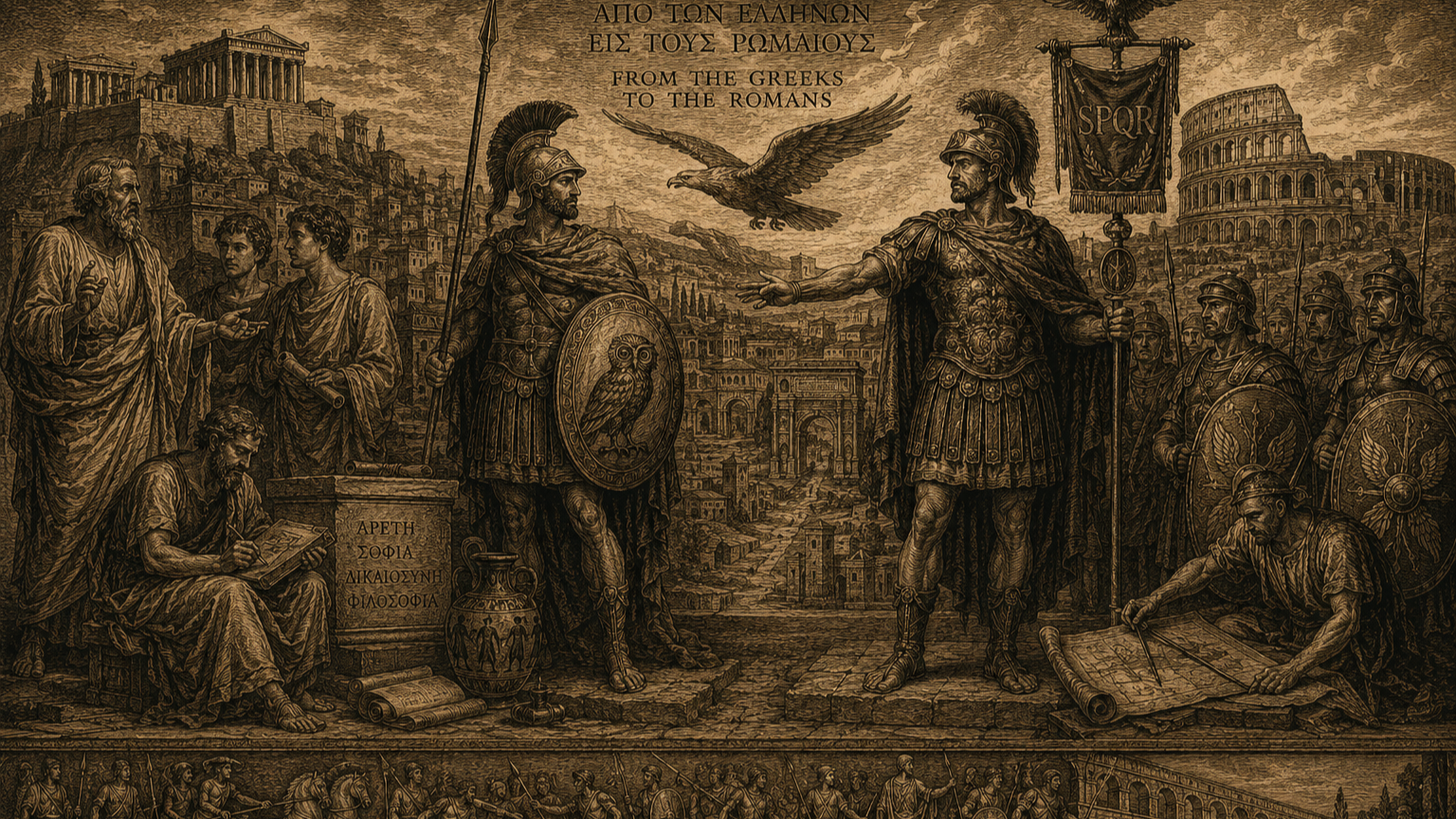
Lecture Notes · Session I
From Greeks to Romans
Paul Cantor · University of Virginia
What Is Comparative Literature?
Before moving on, it's worth pausing to reflect on what comparative literature actually is — comparing literature across time. Look at the distance we've already traveled: from the primitive world of the Iliad to the sophisticated world of Plato's Symposium, from a battle of swords to a battle of speeches. That's an incredible range for a single culture to cover. The Symposium offers a precious glimpse into Athens at the very peak of its civilization — the peak of its urbanity (a word connected to the Latin for city, urbs; real sophistication requires city life). And yet we shouldn't leave the Iliad behind — it isn't just some primitive early work; it has never been surpassed, the noblest representation of the warrior's life ever written, and remains a constant reference point throughout everything that follows. Plato himself keeps referring back to Homer — in a way, the entire comparison of Socrates with Achilles and Odysseus contains Plato's whole point. Plato presents his new kind of hero specifically in contrast with Homer's. You need Homer to understand Plato — which is really the whole point of literary history: authors often make their points through comparative literature themselves; the comparison is already built into the literature. Comparative literature, in other words, isn't just something professors do; authors themselves are constantly doing comparative literature.
Genre as a Second Axis of Comparison
Besides literary history, the other major concept in comparative literature is genre — we group works into genres just as we group them into periods. This is, to some extent, arbitrary, but genres still play an important role, since authors themselves think in terms of genre. A writer sets out to write a tragedy, or sets out to write a comedy — nobody just starts writing and later decides, "gee, this is pretty funny, I think I'll call it a comedy." You set out to write a certain kind of literature in the first place — that's really what "genre" means. Television writing works the same way today, with established genres like sitcoms and dramas, each with its own formula. Virgil set out to write an epic, and for him that meant, above all, Homer — genres come down to us through literary history. Genres provide another basis for comparison too: Aristophanes's comedy comments directly on Greek tragedy, an attempt to correct it. The Symposium comments on both tragedy and comedy at once, attempting to transcend both genres with a new kind of tragicomic hero. Even so, you still need to understand the underlying nature of tragedy and comedy in order to understand what Plato is actually doing in the Symposium. The dialogue compares tragedy and comedy directly, in the persons of Agathon and Aristophanes — once again, we could call this a work of comparative literature in its own right. It isn't just something critics do after the fact. Literature itself is already comparative literature.
From Greece to Rome: A Bigger Leap
So far we've moved through history within a single culture, moving from genre to genre. Now we're going to make an even bigger leap — from the Greeks to the Romans, from one culture to an entirely different one. Comparing the two will help us see real differences: compare Homer with Virgil, one epic against another, working within the same genre, and we can see the underlying cultural differences clearly — how different Roman epic is from Greek epic, which points, in turn, to how the Romans in general differ from the Greeks in general. And yet we'll find real continuities too — in fact, those continuities provide the actual basis for the differences, since Virgil is clearly working with Homer very much in mind. Difference, in this sense, is a function of some underlying similarity. Epic is the constant here; Greece and Rome are the variables. We'll find continuity as well as discontinuity. It's genuinely possible to move from one culture to another this way — otherwise comparative literature itself would be impossible.
Can We Really Understand a Different Culture?
That basic possibility is being challenged today, though — the notion that all cultures are utterly self-contained, that only a person from within a given culture can truly understand that culture, that only an ancient Greek could really understand ancient Greek culture. When I first described this course to a student once, they apparently assumed I must be Greek myself ("my grandfather fought at the Battle of Marathon," they said). I don't have to be Greek to teach this material. This is a characteristic error — turning a genuine difficulty into an outright impossibility. Studying comparative literature certainly shows us how difficult it is to understand a different culture, how easy it is to misread one. We don't really know exactly what thumos means, or tyrannos, or hybris — we have to be very careful. But that doesn't mean it can't be done at all; it just means we have to put a great deal of effort into it. The very difficulty of understanding a different culture actually points to the real possibility of doing it — recognizing how alien another culture is turns out to be the first step toward genuinely comprehending it. If we really were trapped entirely within our own culture, we couldn't even perceive the difference of other cultures in the first place. Consider the medieval European painters who showed snow falling on the scene of Christ's birth in Bethlehem in December — they simply didn't understand cultural difference. We can see that difference clearly now, which means we've found some kind of standpoint, at least provisionally, outside our own culture from which to see it.
What We've Learned from the Greeks
What we've seen throughout is that the Greeks are genuinely very different from us — which is exactly why we can learn so much from them. Take the issue of homosexuality: the Symposium obviously reflects a very different attitude toward it than the Judeo-Christian tradition does. But that doesn't mean it's incomprehensible to us — we recognize the issue; we know what homosexuality is. We may hold a different attitude toward it ourselves, but we shouldn't confuse understanding with approval. You can understand what Plato is showing us about homosexuality, and maybe even learn something real from it, without necessarily approving of it yourself. Juxtaposing our own culture against Greek culture helps us understand both better, highlighting the real differences between them.
What we've seen throughout is that the Greeks represent something like unimpeded striving for human excellence, heroic competitiveness — people of thumos, a concept we don't even have a single word for in English. And yet we can still understand it; it isn't utterly foreign to us. Just because you lack a single word for a concept doesn't mean you lack the concept itself — we can recognize thumos readily enough in our own soldiers and athletes. The Greeks present a strange combination of the exotic and the familiar (fifth-century Athens was already facing many of the problems we think of as peculiar to our own era — overrun with lawyers, for instance). We keep running into terms that feel familiar, and we can watch them at their very origin. Tyrannos is different from our word "tyrant," and yet it's clearly the origin of our term — we can understand our own concept better by looking closely at its original meaning.
Greekness Was Never Monolithic
Looking back over everything, "Greekness" was never some monolithic thing. Socrates himself represents a real challenge to the conventional Greek heroic ideal — philosophy, in this sense, is itself a criticism of Greekness, which is part of why Socrates was put to death. Today many people think of "Greekness" as simply one fixed set of conventions among others. And yet what the Greeks actually discovered was the very distinction between nature and convention, a search for the natural underneath the conventional — arguably the ultimate Greek achievement. They may well have been wrong about exactly where to draw that line, but at least they started the whole process. (Aristotle thought slavery was natural — we think that's a mistake, but he still condemned most of conventional Greek slavery as merely unnatural; we tend to notice only that he allowed for some limited natural form of slavery, and miss that, compared to his own contemporaries, he was genuinely challenging the whole Greek institution.) That's really what's noblest in Greek philosophy. But in a sense, there's nothing distinctively Greek about this process at all — it was simply Greek to be anti-Greek. We talk casually about "Greek philosophy," but there's nothing specifically Greek about philosophy as such.
Were the Greeks themselves Greekocentric? They certainly seem incredibly proud of their own Greekness — Greeks against barbarians, again and again. But look at Xenophon's Cyropaedia, The Education of Cyrus — Xenophon was supposed to be a fairly conventional Greek, and yet he chooses a Persian, Cyrus, as his model of the great king, a barbarian, an actual enemy of the Greeks. Consider the story in Book III of that work: a kind of miniature Socrates figure appears there, charged with corrupting the youth, defending the doctrine that people do evil only out of ignorance — essentially Plato's whole project in miniature, political authorities growing jealous of a wise man's attractiveness to the young. But all of this is happening in Armenia, not Athens. This "Armenian Socrates" shows that Xenophon, supposedly a provincial Greek, could nonetheless imagine a Socrates figure growing up entirely among barbarians. Recall Aristotle's own line: "fire burns the same way here as in Persia." Philosophy, on this view, could just as easily have sprung up in Persia — it was simply an accident of history that the Greeks happened to found it first; it remains a permanent human possibility, not a specifically Greek one. As long as people observe the genuine clash of conventions, moving back and forth between Greece and Persia, they notice that fire burns the same way in both places, even though the legal penalties for arson differ completely. If philosophy ultimately makes reference to nature, then there's no such thing as specifically "Greek" philosophy, any more than there's a specifically German physics, or English chemistry, or French biology. Xenophon's story raises a real question: who knows how many times philosophy has independently arisen throughout history, only to be stamped out before it could take root? The Armenian Socrates, after all, had no chronicler of his own — no Plato, no Xenophon to preserve him.
Universalism: Tyranny and Liberation
The Greeks developed the polis, and, alongside it, developed a real desire to go beyond the polis as well. The positive side of that desire is the impulse toward philosophy. The negative side is a drive toward universalism in the form of empire, the desire to conquer the entire world, eventually leading to Alexander the Great (who may himself have studied under Aristotle). We already saw this universalism of tyranny at work in Oedipus and in Creon — universalism as pure oppression, a point overemphasized in a lot of contemporary discussion. But the real lesson of Antigone is the opposite possibility: universalism as liberation, an appeal to universal laws that isn't merely the tool of tyranny, but potentially the only real weapon available to the oppressed, the only real way to fight tyranny in the first place. Aristotle himself reinterprets Antigone as an appeal to a genuine law of nature — an idea that gets developed much further within Greek philosophy generally, a search for the true universals as opposed to the false ones.
The Greeks as the First Literary Critics
The Greeks were the first people to develop a genuine critique of their own culture — one way of putting this is that they were the first to develop something we'd call literature, as opposed to merely sacred texts. They had no Bible, no single text that could not be challenged. Homer came closest to functioning as their Bible, but even Homer gets directly challenged by Plato. The Greeks began thinking of writing as a fundamentally human activity, rather than simply taking dictation from some sacred source — the first culture to demystify the very act of writing. In most early cultures, writing seems genuinely mysterious, something only priests are permitted to do. Homer's own invocation of the Muse carries something divine about poetry, something mystical, almost an external power speaking through the poet. Aristophanes and Plato both begin to question that claim of divine inspiration directly. What's genuinely distinctive about the Greeks isn't the mere invention of texts about the gods — every culture does that — but the first real criticism of them. Plato's criticism of Homer amounts, in effect, to the first work of literary criticism.
Rome's Cultural Inheritance from Greece
The Greeks may be gone from this course now, but they're not forgotten. The Greeks were the first to reveal certain human possibilities, both good and bad — tyranny and philosophy alike; we've already seen how closely related the two actually are, since the very same kind of soul that can develop into a tyrant (Alcibiades) can also develop into a philosopher (Socrates). These possibilities carry a distinctly Greek inflection, but they're not confined to Greece as such. We've tended to simply adopt the Greek words for these phenomena wholesale — athletics, philosophy (the Arabic word for philosophy, falasifa, is itself simply a transliteration of the Greek). This raises the real problem of the Greek heritage more broadly: how do you adapt Greek discoveries to an entirely new setting? Consider Averroes's commentary on Aristotle's Poetics — with one small problem: Averroes had never actually seen a play performed, and didn't really know what tragedy and comedy were in practice. It's a genuinely remarkable act of imaginative reconstruction on his part regardless.
This same problem of the Western heritage was most powerfully confronted by Rome. Rome conquered the Greeks militarily, but in a real sense the Greeks conquered Rome culturally in return — the Romans were thoroughly dazzled by Greek civilization, its architecture, sculpture, theater, philosophy. The Romans felt something like barbarians themselves when confronted with all of this. The Rome we usually picture in our minds is actually a fairly late Rome, one that had already started imitating the Greeks, remaking itself on Greek models. Rome was already several hundred years old by the time it first seriously encountered the Greeks. The original architectural influence on early Rome had actually been Etruscan. The Romans only began seriously interacting with the Greeks in the third century BC, and when they first encountered Athens, they were still a fairly provincial people — something like kids from the Midwest arriving in New York City for the first time. Roman architecture and sculpture were largely copied directly from Greek models (compare Julius Caesar's own well-known fascination with Alexander). This was, throughout, a process of translation. Even the Roman gods, who started out as their own native deities, were gradually remodeled on Greek gods — Jove increasingly modeled on Zeus, Juno on Hera, Minerva on Athena, Mars on Ares. We often get at Greek things today only through these Roman translations — physis becomes "nature" for us by way of the Latin natura (which also carries connotations of growing). Most surviving Greek statues actually survive only in later Roman copies.
The Problem of Translation
Sometimes translation amounts to real distortion, and we have to work hard to get back to the original meanings. Oedipus Tyrannos became Oedipus Rex in Latin, which conceals the crucial Greek distinction between tyrannos and basileus — which is exactly why we now call the play "Oedipus the King" in English; we might actually understand the play better if we called it "Oedipus the Tyrant" instead. We have to realize the real effect transmission itself has on a culture — we simply don't have direct, unmediated access to the ancient Greeks; we have to stay aware of how the very paths of transmission introduce their own distortions along the way. This is another real value of comparative literature: it exposes the sedimented quality of our own culture, layers upon layers, requiring something like real archaeological effort to dig through. Digging back down to the earliest layers of our culture actually helps us understand the later ones built on top of them.
Virgil's Task: Translating a Civilization
This whole problem of translating Greek into Roman terms is the central problem of the Aeneid — the relation of Virgil to Homer, in effect the Roman Homer, echoing our earlier Armenian Socrates. This is the problem of translating an entire heritage, and it's Aeneas's own problem within the poem as well: how do you transpose your culture into a completely new setting? He literally carries his own gods with him on his journey. Virgil's own central image captures this perfectly: Aeneas carrying his father Anchises on his back as he flees burning Troy — much like Virgil himself carrying Homer on his own back; Homer is, in a real sense, the monkey on Virgil's back, the nine-hundred-pound gorilla he has to carry throughout the whole poem. Aeneas's entire mission amounts to an extended exercise in cultural translation.
This leads directly to a common criticism of the Aeneid — that it's merely a pale imitation of Homer. That's not entirely fair, but Virgil does actively invite the comparison, copying whole episodes from both the Iliad and the Odyssey, even copying specific passages closely. Today, the Aeneid tends to be read in the shadow of Homer, treated as the lesser work. It wasn't always this way. Virgil was, for a very long stretch of Western history, extremely well known at a time when Homer was virtually unknown at all. In the Middle Ages, far more people knew Latin than knew Greek — the Roman Catholic Church made Latin the international language of the period, with a Latin Bible and a Latin Mass; Greek was really only known in the East, within the Byzantine Empire. In terms of pure literary-historical influence, the Aeneid is arguably more important than the Iliad and Odyssey combined — it's the vehicle by which the whole epic tradition actually got transported into the medieval and Renaissance worlds. Dante knew Virgil intimately but did not know Homer directly — he knew of Homer, but couldn't actually read him, which is exactly why Virgil, rather than Homer, becomes a character in the Divine Comedy. This is the actual path by which the classical heroic ideal got transported into later European civilization — and the classical ideal itself changed considerably in the process. When Homer was finally rediscovered during the Renaissance, he actually struck people as very strange, even genuinely savage. Virgil, by contrast, domesticates the Homeric hero. Virgil is writing some seven or eight hundred years after Homer — Homer already looked primitive and archaic even to fifth-century Athenians, let alone to Virgil, who was writing at the very peak of a civilization, with Rome ruling most of the known world. Virgil adapts Homer specifically for his own civilization's needs. The Homeric heroes struck him as too wild, too untamed, too emotional, too out of control, too self-centered — they simply wouldn't make good soldiers in the Roman army; they're not team players. Virgil civilizes them. One key to the whole poem is refinement — Aeneas's men, for instance, use actual napkins (the Latin specifies napkins, not towels) — something like a Holiday Inn, fresh linens every night. It's a very clean world, one no longer in direct contact with cow dung the way Homer's world constantly is. But Virgil worries, elsewhere, that there may be too much refinement on display — not exactly a good, usable Homeric sword anymore, a real fear of decadence creeping in. The world of the Aeneid is considerably more refined than Homer's — but is it perhaps overrefined? We'll see that Virgil both celebrates Rome and raises real doubts about it at the same time.
Rome's Literary Achievement, Compared to Greece
Rome's overall cultural achievement was not, by most measures, as great as Greece's — which is part of why we don't read nearly as much Roman literature in a course like this. Roman writers largely imitated Greek models directly: Seneca reworked Greek tragedy (his own versions of Agamemnon, Oedipus); Terence and Plautus imitated Menander (in fact, Menander was really only known through their imitations until well into the twentieth century). There were fine lyric poets too — Horace, Catullus — and satirists like Juvenal, and later epic poets like Statius. Just as with Greek literature, the bulk of Latin literature has also been lost to us, and we can only hope that, largely, the best of it survived. Rome's real achievement lies elsewhere — in military and political accomplishment. As Shelley once put it, "the poetry of Rome was in its institutions." Rome conquered the known world; the Romans were great administrators, great builders — their roads and aqueducts survive to this day, some still actually in use. They built things to last, since Romans genuinely expected their rule to last forever; they were a fundamentally practical people, with superior plumbing to show for it. Virgil's own vision of Rome's future — a kind of prophecy for Rome delivered within the poem — celebrates this Roman political achievement directly, in a passage explicitly aimed at the Greeks. You can feel Virgil's own real anxiety about Greek cultural achievement here — he feels genuinely small by comparison. Romans, notably, still sent their own children to Athens to learn how to argue properly in court (this happened, among others, to Ovid). The Roman attitude, in a nutshell: the Greeks make better statues, but we beat the hell out of them on the battlefield. You can feel here both a real Roman sense of superiority and a real sense of inferiority at once. To be clear, the Romans were hardly a cultural failure — they did produce great literature and sculpture, excelled at architecture (the Pantheon) and painting; it's only by direct comparison with the Greeks that they come off looking bad, since the Greeks set about as high a standard as has ever existed. Their culture was derivative from Greece — but derivative isn't the same thing as second-rate.
Historical Setting: From Republic to Empire
Virgil lived from 70 to 19 BC, right through a great turning point in Roman history — the transition from Republic to Empire. Rome began as a polis, the city of Rome itself, and remained essentially a city-state through much of its early history, over five hundred years. The era of the Republic runs roughly through the first five centuries BC, an era of constant warfare with its neighbors, eventually conquering the whole of Italy, and then the other major Mediterranean powers — Carthage above all, in the Punic Wars, with Hannibal as Rome's greatest single enemy, one who very nearly defeated Rome outright (this history explains a great deal about the Dido episode in the poem). Rome eventually defeated just about everybody, including, in the end, the Greeks themselves. The key to Roman military success was discipline — Roman soldiers never broke ranks, and were, famously, more afraid of their own officers than of the enemy in front of them. The Republic itself was marked by a rapid turnover among its great men — consuls served two at a time, for a single year each; generals had to accomplish great deeds quickly, within a very tight window, precisely so that no single man could ever become too powerful. Romans took real pride in having no king; they had originally become a republic specifically by expelling one.
The Republic went on to develop a genuine empire, continually expanding — eventually it took a full year just to travel to some of Rome's own frontiers, and this naturally led to the growth of private loyalties among far-flung armies and their commanders, loyal to the general rather than to the distant Senate. By the first century BC, this produced the Civil Wars, with great Roman generals contending directly for control of the city itself — the world of Shakespeare's Julius Caesar, Pompey against Caesar. The key to Julius Caesar's own success was that he got the common people firmly on his side — a genuinely popular aristocrat, who used his own great wealth to destroy the traditional balance of power within the Roman regime between the aristocracy and the common people. In doing so, he effectively destroyed the Republic — one man had finally become too big for the city to contain. A conspiracy assassinated him and attempted to restore the Republic in the aftermath — but the attempt failed; the city was simply too corrupt by that point, and genuinely needed one-man rule going forward. The Republic finally became an Empire under Caesar's own nephew, Octavian. In 30 BC, Octavian defeated all his remaining rivals; in 27 BC he took the title Augustus, becoming Emperor and establishing an entirely new imperial system. "Imperator" was originally a purely military rather than political title — something like calling yourself Commander-in-Chief. Augustus still needed to legitimate his own rule somehow. He never actually took the title of king outright, but he was a king in everything but name — and later rulers found it an honor simply to be called "Caesar" (the root, eventually, of both "Czar" and "Kaiser").
Augustus and the New Rome
Augustus kept most of the old Roman institutions in place — the Senate, for instance — but put them to genuinely new use. The old polis, in effect, had dissolved. There's a real, persistent ambiguity built into the very word "Rome" — it can mean the specific city, or it can mean the empire as a whole. In a real sense, Rome the city got lost inside Rome the empire — a genuinely cosmopolitan metropolis of roughly a million people, considerably larger than Athens ever was. By Virgil's own time, Rome was actively struggling to maintain any kind of distinct civic identity of its own, especially given the recent change of regime. Augustus used the arts deliberately to help legitimate his rule — architecture, sculpture, and painting, and literature too. Virgil functioned, in effect, as something like a court poet, supported by his patron Maecenas. The whole context of the Aeneid is really this emergence of the Roman Empire — the poem celebrates Roman imperialism, and yet, at the very same time, raises real doubts about it, showing us its genuine human costs.
Reworking Roman History: From Tarquins to Troy
The poem also quietly reinterprets Roman history itself. Roman history, as traditionally told, had led decisively away from kingship; now, in Virgil's own moment, it seemed to be leading straight back toward it, toward Augustus Caesar specifically. The traditional view held that the key founding event of the Republic was the expulsion of the Tarquin kings — the very word "king" was practically anathema at Rome (the Tarquins were remembered as foreign tyrants, Etruscans, and outright rapists — Tarquin the Proud was expelled specifically after raping a virtuous Roman woman). For five full centuries, Republican Romans took real pride in having no king at all. It's genuinely hard for us today to appreciate just how difficult Virgil's task actually was here. In Shakespeare's Julius Caesar, Cassius wants Marcus Brutus to live up to his own ancestor Junius Brutus, who had originally expelled the Tarquin king centuries earlier — that's how deep this anti-monarchical sentiment ran. Virgil has to remake this whole attitude from the ground up, and he does it by linking Roman history directly back to Troy. Troy, notably, had been both a monarchy and an empire in its own right — which provides a genuinely mythical heritage for Augustus, an imperial heritage rather than a republican one. For the Romans, the Greeks themselves represented democracy and republicanism; Virgil deliberately turns instead to Troy. There's even a wholly invented etymology at work in the poem, tracing a line from Ilus, to Iulus, to Julius — a totally made-up genealogy, but it's exactly how Virgil gets from Troy all the way to Rome (and, along the way, celebrates the peace Augustus brought — Rome finally ending its own internal strife, restoring something like a Golden Age).
Reversing Homer: From Chaos to Order
The Aeneid amounts to a real reversal of Homer's own basic movement. The Iliad and Odyssey together trace the dissolution of a civilization — a movement from order into chaos. Troy falls. The Greek kingdoms that conquered it fall apart in turn afterward. The heroic civilization essentially destroys itself from within; Odysseus does eventually get home, but he returns to a genuinely shattered world. The Aeneid moves in exactly the opposite direction — from chaos into order, the rebuilding of Troy in the new form of Rome. Part of what actually distinguishes Virgil from Homer here is a real sense of history as such ("history" is itself a Greek word, though it originally just means "story" or "inquiry"). The Greeks had no real sense of "History" with a capital H, no sense of any overall direction to history. In Homer, events aren't headed in any particular direction at all — there's certainly no real sense of progress; if anything, there's a persistent sense of decline. Homer was living, after all, in a genuine Dark Age, looking back at a time when things had once been better. Virgil, by contrast, is living in what felt like a Golden Age, and sees the whole of history as building up toward his own era, culminating in Augustus Caesar. Augustus, on this account, reveals the true direction of history — its actual end point, universal monarchy: all of human history builds toward the universal triumph of Rome, and the Romans genuinely expected their own rule to last forever. This produces a real sense of progress, and a genuinely linear narrative running through the Aeneid, considerably easier to follow than Homer's own narrative structure. The battle scenes themselves are easier to follow too — Virgil is less interested in individual heroic feats and more interested in whole armies moving as coherent units. Homer's world, by contrast, is considerably more chaotic (though not utterly chaotic), leaving far more room for individual heroic action. Homer gives us real polytheism, with the gods actively at war with one another, issuing contradictory commands, leaving the ultimate outcome genuinely in doubt — Zeus himself is not fully in control of events. Virgil's Jove is considerably more secure in his authority. Virgil keeps something like the shadow of polytheism intact — Juno keeps trying to thwart the Trojans' destiny throughout — but there's never any real possibility that she'll actually succeed. Jove maintains order throughout the poem, which amounts, in effect, to a running justification for kingship itself. Virgil is constantly searching for ways to make kingship look legitimate, since the Romans remained genuinely uncomfortable with the idea of a single ruler, for the first time in five hundred years. The Aeneid, in this sense, is a sustained attempt to construct a genuine myth of Roman kingship, finding justification for it in both the gods and in nature itself — the underlying orderliness of nature becomes a recurring motif. Homer's Zeus is, above all, the god of thunder; Virgil's Jove is considerably more likely to calm a storm than to raise one. There's a key early passage where Virgil is clearly searching for one single man to bring order out of chaos — Aeneas within the poem, Augustus in the world outside it. Notice, too, Virgil's characteristic use of the Homeric simile: Homer usually compares human actions to natural occurrences; Virgil, by contrast, often reverses the comparison, comparing natural occurrences to human political events instead (Homer, in this sense, remains a farm boy at heart, closer to nature; Virgil is very much a man of the city). Virgil's great underlying fear throughout is anarchy. The old republican model pictured an unruly multitude in constant turbulence, aristocrats and common people perpetually at odds, with order only ever emerging out of their ongoing struggle. In Virgil, Augustus simply steps in and ends the turmoil directly. (There's a real movement toward monotheism at work throughout the Aeneid — polytheism suits a republic, with no single ruler, while monotheism suits an empire more naturally; though this correlation is hardly universal, since there have certainly been polytheistic kingdoms and monotheistic republics too.) Virgil is genuinely searching for a vision of order, both in nature and in history, as a direct reaction to the Civil Wars — the terrible, traumatic experience of Romans killing Romans throughout the whole first century BC.
The Fall of Troy: Virgil's Nightmare Image
The great nightmare image at the heart of the poem is the Trojan apocalypse itself — the complete breakdown of a city. Virgil's imagination focuses specifically on the episode of the Trojan Horse, a logical choice, even though it isn't actually narrated anywhere in the Iliad itself (Virgil likely drew on other, now-lost sources — other Greek poems about the Trojan War, and possibly some earlier Latin epics; Virgil was not, in fact, the first to claim a Trojan heritage for Rome). The whole imaginative focus here is on the dissolution of civilization as such. The Greeks themselves become the barbarians in this account, a genuinely savage force — notice all the river imagery here, elsewhere associated in Homer specifically with Achilles; Pyrrhus, the character unleashing this violence, is Achilles's own son, which is exactly what becomes of Achilles's legacy, in Virgil's own view. Virgil is, in effect, rewriting the Iliad from the Trojan point of view, turning the tables completely on the Greeks — in this telling, it is the Greeks who are the real barbarians. Pyrrhus, Achilles's son, breaks down household thresholds, destroys the entire domestic order of Priam's palace — the Trojans here become, in effect, the barbarians' victims. This is what comes, in the end, of the Homeric hero taken to his logical extreme. The slaughter of Priam himself makes a particularly strong impression (it left a lasting mark on Shakespeare's own Hamlet later) — Homer's own Achilles, remember, had actually treated the elderly Priam with real courtesy. We also get a real dissolution of the natural order itself here, likened to an earthquake, building to a culminating simile. The great underlying fear throughout is that civilization can always break down into barbarism. In Homer, civilization and barbarism simply coexist side by side — think of the Cyclopes and the Phaeacians. Homer himself sits closer to barbarism in a sense, since real civilization had, in effect, only recently been achieved in his world; barbarism remains a genuinely living possibility throughout. For Virgil, by contrast, civilization seems like a far more secure, settled achievement — he has to actively remind his fellow Romans of the real possibility of relapsing back into barbarism. You can see this difference clearly in how each poet treats the Cyclops episode: Virgil includes it only as a kind of afterthought, a bare reminder, existing only as a memory within the poem — Virgil never actually shows us what Homer shows us directly. There are two entirely different inflections on the same incident: Homer leaves certain things out of his own account, while Virgil has, in a sense, only the leftovers of Homer's story to work with. Virgil consistently projects barbarism outward, onto Rome's own enemies instead. There's a real hint of barbarism attached to Carthage throughout — echoing Odysseus's own first anxious question upon arriving anywhere new ("barbara" appears in the Latin itself). In fact, what Aeneas actually finds when he arrives is a thoroughly civilized Carthage. And yet Virgil keeps dropping hints of barbarism regardless — Dido and cannibalism come up at one point, exactly the same rhetorical move we've seen before: projecting barbarism onto your enemy. This is, after all, an imperial poem — the enemy has to be made to seem a genuine threat to the whole imperial ethic.
The Countermovement: Civilizing, Citifying
The great fear running through the poem is the dissolution of civilization; the great countermovement running against it is civilizing, citifying. Aeneas, we might say, never met a city he didn't like. Aeneas represents a genuinely new kind of hero — one not in fundamental tension with the city, but who actively yearns for city life. There's an early vision of a city actually emerging, laying down its own boundaries and limits. Notice, too, the presence of a theater in this vision — something never found in Homer, who never actually saw a theater himself; this is a distinctly Virgilian touch, treating the arts as an essential part of civilization as such. This is exactly what the imperial Romans actually did in practice — they built theaters everywhere they went; you can still find the remains today in Israel, at Caesarea; in Sicily, at Taormina and Syracuse; all the way out to Chersonesus, in the Crimea. The Trojans, at one point, are compared to bees rather than to wild animals — social creatures rather than solitary predators (Homeric heroes, by contrast, are regularly compared to lions and wild boars). Elsewhere we get a vision of the city and its laws directly. In Homer, the shield of Achilles contrasts the warrior's way of life with the judicial life of the city — a sharp underlying contrast between the aner and the anthropos. That contrast is considerably less sharp in Virgil, where the hero is expected to be able to fit comfortably into ordinary community life. The heroic spirit and the spirit of community get joined together in Virgil: heroism itself becomes something like patriotism, love of the fatherland. In Homer, we get war set against peace as two separate, opposed conditions; Virgil's Romans, by contrast, are great at war, but equally great at peace. The heroes of the Aeneid end up functioning as civil magistrates as much as warriors. It's genuinely hard to imagine Achilles doing jury duty alongside the ordinary anthropoi — but Aeneas would do exactly that without hesitation. Next time, we'll examine Virgil's new kind of hero in much closer detail.