
Aristophanes' The Clouds
Lecture Notes
Aristophanes and the Philosopher
Featuring The Clouds
Paul Cantor · University of Virginia
The Philosopher as the Last Candidate for Hero
On our last day with the Greeks, we turn to one final subject, one last candidate for the Greek hero: the philosopher. I've been building toward this all along, stressing the real skepticism running through the ancient Greeks, how they learned to question their own heroes and their own gods. This connects directly to the Greek discovery of nature — the idea that there might be a natural order, independent of the gods, independent of human laws and decrees. We already began to see this in the Odyssey, where the word for "nature," physis, first appears — a power that could, in principle, be used against the gods themselves. We saw it in Antigone, in the sense of natural laws that contradict and override the laws of the city. We saw it in The Birds, in the sense of a city according to nature, where life is somehow more natural than it is in Athens. This is all bound up, again, with a real skepticism about the gods. It culminates in philosophy itself — the study of nature, a natural order set against a divine one.
The most famous Greek philosopher, Socrates, is genuinely hard to study, since he left no writings of his own. Aristophanes's The Clouds is the oldest piece of writing about Socrates that survives — the first full-length portrait of a philosopher we have from the ancient Greek world. We mostly know Socrates today through the writings of his own disciples, Plato and Xenophon — but they're writing a full generation after Aristophanes. "Philosopher" is another Greek word we've simply adopted directly, meaning "lover of wisdom." It's become a fully accepted category in our own world — we have entire university departments of philosophy; the state of Virginia literally pays people to be philosophers. This would have seemed very strange indeed to Socrates's own contemporaries — they killed him for it. (In his final speech at his own trial, he actually asked to be put on the public payroll of Athens in recognition of what he'd done for the city. Instead, they gave him poison to drink.) He was executed for impiety and for corrupting the youth. The city didn't like his skepticism, experienced it as a real challenge to its own authority. This can seem very strange to us today — Aristophanes can help us understand it, which is exactly why The Clouds matters so much. It gives us some real sense of what the philosopher originally looked like to ordinary people. Plato later made philosophy respectable within the human community, portraying Socrates as a hero, arguably the greatest of all Greek heroes — a genuinely strange claim at the time. Aristophanes shows us exactly why: Socrates looked, to the city, like a bum. He has none of the outward signs of nobility in Greek terms — he's ugly, poor, badly dressed, low-born. He's the exact opposite of Achilles. Whatever Socrates's own excellence may actually have consisted of, it clearly wasn't visible in his physique, in his physical appearance. Generally, among the Greeks, if you are good, you look good — but in Aristophanes, Socrates simply doesn't look good. This is not the strongest possible case for philosophy. I used to teach Plato directly at this point in the course, but there was simply too much material to cover. So The Clouds will have to serve as our one real glimpse of philosophy here — a very distorted view, admittedly, but still an important one. The philosopher becomes another candidate for Greek hero. Aristophanes remains skeptical, and subjects philosophy to a comic critique of its own — which may, in its own way, tell us a great deal about philosophy.
Before Socrates: The Pre-Socratics
Socrates was not the first philosopher. It's worth briefly looking at the developments standing behind The Clouds. Our knowledge of the Presocratics is genuinely sketchy — we have only fragments of their work. This tradition begins in the sixth century BC in Ionia (the same region that produced Homer) — Greek communities in Asia Minor, on the west coast of modern Turkey, well aware of different political regimes and different ways of life around them. They became aware, in this position, of the real difference between nature and convention — sitting at the crossroads of different civilizations, they could see clearly what was merely conventional, characteristic of one city rather than another. Thales, for instance, held that "water is the principle and origin of things" — an attempt to find some deeper unity underlying the surface diversity of phenomena. Water, ice, and steam seem like very different substances, but they're really the same thing in different states — a genuinely fundamental philosophical insight. A thing has some underlying nature that manifests itself differently at different times, contrary to mere appearance and ordinary common sense. The real question being asked is: what are things actually made of? The Greeks even developed a version of atomic theory — "atom" is itself a Greek word. These early thinkers, studying the nature of things, are properly called natural philosophers (the word "scientist" itself wasn't actually coined until the 1840s). They were trying to explain things not in terms of myth, but in terms of something like science, the underlying principles of nature. Xenophanes, for instance, held that the sun is made of ignited clouds — the sun understood as a natural phenomenon rather than a god. This gets reflected directly in The Clouds itself: the clouds are gods, and the gods are clouds. The universe, on this account, gets understood in terms of simple models drawn from natural phenomena.
This amounted to a real attack on myth, and on Homer specifically — Xenophanes directly criticizes Homer's portrayal of the gods, as Plato later will too, arguing that the gods are really just a matter of custom, human convention, human invention. This calls nomos into question in the name of physis, much as Aristotle later will in the Nicomachean Ethics. The philosopher, in this mode, scorns ordinary wisdom, carrying a real aristocratic sense of his own superiority to it. Heraclitus and others like him lived genuinely solitary lives, standing apart from the ordinary life of the city — the original solitary geniuses, in a sense, posing a real challenge to the city and its authority. The city's attitude toward philosophy is genuinely ambivalent as a result. On one hand, it scorns the philosopher as irrelevant to ordinary human concerns. At the very same time, there's a persistent suspicion that he may actually possess some secret wisdom the city itself wants access to. There are two famous anecdotes about Thales that capture this same duality perfectly — one showing him as an idealistic dreamer, the other as a shrewd practical genius. This same dual view stands directly behind The Clouds: Socrates is presented there as a fool, and yet he's also understood to have a secret teaching that men are eager to pay for.
Philosophy's Practical Offspring: Rhetoric
The greatest practical effect of early Greek philosophy was the development of rhetoric and professional rhetoricians — a real spin-off from philosophy proper. We've already seen how important lawyers and public speaking in the democratic assembly had become in fifth-century Athens. Around this time, men started arriving from all over the Greek-speaking world and setting themselves up in Athens as professional teachers of rhetoric — building directly on what they'd learned from philosophy, especially the elementary rules of logic, how a syllogism actually works ("logic" itself comes from Greek). This was a genuinely major discovery: how to actually win an argument — and naturally these teachers were most impressive precisely when they could win with the weaker side of a case. Much like legal training today, students learned to argue both sides of any case, learned how to use evidence, how to influence a jury, how to build a persuasive case regardless of the underlying facts. The best lawyer, on this view, is the one who can get a genuinely guilty man off — anybody, after all, can get an innocent man acquitted. This produced an entirely new class of professionals, who made real fortunes traveling from city to city; the most famous rhetoricians working in Athens were largely foreigners (Protagoras among them). As we've already seen, Aristophanes was deeply suspicious of these rhetoricians, also known as sophists. This gets reflected directly in the play's two great personified speeches, Just Speech and Unjust Speech — and Unjust Speech ultimately prevails, which is exactly what sophistry does for you. The Greek terms are dikaios and adikos, closely related to dike, justice. This is actually where Arrowsmith's translation goes seriously wrong — he renders the two speeches as "Philosophy" and "Sophistry," which misses the whole point: Aristophanes deliberately lumps philosophy and sophistry together in the single figure of Socrates. Just Speech, notably, is defending the old poetry — not philosophy as such.
Poets versus Philosophers: A Professional Rivalry
Aristophanes has a genuine professional interest at stake here too: the emergence of philosophers and sophists represents a real challenge to poets specifically. As we've been seeing throughout, poets held a genuinely central status among the ancient Greeks, serving as their teachers of wisdom. Consider the sheer importance of Homer, Aeschylus, and Sophocles — this is where the Greeks actually went to find out what they collectively thought. Greek wisdom, in large part, meant a proper understanding of the relationship between human beings and the gods. But where did the Greeks actually get their whole idea of the gods in the first place? From the poets. In one sense, the poets were thoroughly pious — defending the justice of the gods, teaching men to obey them, showing the real danger of failing to do so. In another sense, though, the poets effectively created the gods. This is a genuinely difficult question: is Homer simply expressing pre-existing Greek beliefs about the gods, or is he actively shaping them? Probably some mixture of both. I've been trying to show throughout this course that we tend to assume there was some fixed body of Greek myth that the poets simply shaped into poetry — but that's not really accurate; they were often actively creating the myths themselves. We just saw this most clearly in The Birds. The poets functioned as the Greeks' own pipeline to the gods, occupying a genuinely crucial cultural position. When the philosophers come along and start questioning the gods, they are, at the very same time, implicitly questioning the poets. Xenophanes questions Homer directly, and so, later, does Plato. There's a real occupational tension here between poets and philosophers. A challenge to ancestral wisdom is, in effect, a challenge to the poets themselves, who put the Greeks in touch with that ancestral wisdom in the first place (and sometimes simply invent it — notice how quickly the myths of Cloudcuckooland, in The Birds, become treated as "ancestral" within the play itself). This is exactly why poets tend to be suspicious of philosophers, as new claimants to the same cultural authority. In the Republic, Plato has Socrates speak explicitly of "the ancient quarrel between philosophy and poetry." The Clouds may well have been an opening salvo in exactly that war — who's really the smartest guy in town, the poet or the philosopher? Plato had real reason to be personally angry with Aristophanes over this, believing he had helped create the climate of opinion that eventually led to Socrates's execution, at his trial some twenty-four years later. Plato even has Socrates himself allude to this in the Apology. Socrates's eventual death hangs as a real shadow over The Clouds, in retrospect.
The Play's Production and Context
The Clouds was produced in 423 BC — earlier than The Birds. It came in third place, and Aristophanes was genuinely furious about it. He revised the play afterward; we don't actually know whether this revised version was ever staged, but it's the version whose text has survived to us. Socrates was forty-six years old at the time. Legend holds that he was actually present in the audience, and stood up so people could directly compare his face to the comic mask on stage. No actual ancient masks have survived, but we do have sculptural representations of them, so we have a rough sense of what the Socrates mask looked like — a glimpse of what philosophers actually looked like to ordinary Athenians. Strepsiades, notably, calls Socrates a "gentleman" at one point — kalos kagathos, literally "beautiful and good," a very aristocratic term suggesting good birth and real nobility. It's fairly absurd to apply that term to Socrates as Aristophanes presents him.
Just Speech versus Unjust Speech
As we already saw in The Birds, Aristophanes is deeply conservative, defending the old ways of Athens and attacking its newer innovations. This gets focused directly in the formal debate between Just Speech and Unjust Speech: Just Speech stands for the old Athens, Unjust Speech for the new. Notice that Just Speech is emphatically not defending philosophy as such — he's defending the old poetry instead, showing real respect for the old, the ancestral. Unjust Speech, by contrast, genuinely speaks for the sophists, standing for everything new, willing to manipulate inherited myths freely to suit its own purposes. This exposes the perennial weak point of pagan religion generally: the gods themselves don't always behave morally. This is exactly what the later Christians would complain about, and even Plato complains about it. If you don't genuinely believe in the gods, you can freely use them for purely rhetorical purposes instead — which is precisely what worries Aristophanes here.
Strepsiades is the key figure at the center of the play — a man of the "farm bloc," rural, from outside Athens proper (though remember that Athens, properly speaking, meant the whole of Attica, city plus surrounding countryside together). These gentleman farmers were supposed to represent the bedrock of the old order. But Strepsiades himself is already corrupted. He married above his own rank, an aristocratic woman from a genuinely noble family (the same family, in fact, as Alcibiades), and now has an aristocratic son who is ruining him economically, spending all his money on horses. We can already see that Socrates is not solely to blame for the corruption on display here — Athenian war policy has itself already undermined authority throughout the city. Athenian strategy called for retreating behind the Long Walls and letting Sparta ravage the surrounding countryside, destroying farms in the process; overcrowding within the city walls even helped spread a devastating plague. In particular, the war forced rural farmers inside the city walls, where they picked up some genuinely bad habits — the farmer's own secret vice turns out to be love of money. Strepsiades wants to fight off his creditors in court, wants to learn how to talk his way out of his debts, and turns to Socrates specifically as a rhetorician, treating him essentially as though he were a sophist. Aristophanes doesn't lay all the blame on Socrates here — Strepsiades seeks him out precisely because he's already been corrupted by the city beforehand.
Is This Really Socrates?
An immediate question arises: is this actually Socrates? He doesn't much resemble the Socrates we know from Plato. One common way out, taken by many scholars, is to say this isn't really Socrates at all, but rather a generalized portrait of the whole class of intellectuals active in Aristophanes's Athens — philosophers, sophists, and rhetoricians together — with Aristophanes simply borrowing the most famous intellectual name in Athens to stand in for the type generally. This figure certainly looks more like an average sophist than like the Socrates we know. The historical Socrates famously didn't take money, and didn't particularly study the heavens. Aristophanes essentially portrays Socrates as a Presocratic. This reading conveniently avoids the whole issue — if this doesn't match our picture of Socrates, we simply declare that it isn't really Socrates. But why should we believe Plato over Aristophanes here? Plato, after all, was hardly a neutral witness — he was strongly biased on behalf of his own teacher. Looking more carefully: Aristophanes actually never shows Socrates directly asking for money; Strepsiades simply keeps offering it unprompted. And in one of Plato's own dialogues, the Phaedo, Socrates himself says that in his youth he had studied "heavenly things," before later turning his attention to human affairs instead. Perhaps Aristophanes is genuinely showing us the young Socrates — the pre-Socratic Socrates, so to speak. We shouldn't simply discard the play's evidence about Socrates out of hand. This may well be how Socrates actually looked to ordinary Athens at the time. We can't expect the average citizen to have understood him fully, in all his real profundity. This would certainly help explain why Athens indicted him in 399 BC. Perhaps Aristophanes was genuinely trying to teach Socrates a lesson — and perhaps, in some sense, he actually learned it. The Socrates we see later in Plato may well have cleaned up his act, at least in part, in response to Aristophanes's criticism; Plato's Socrates doesn't seem to make the same mistakes Aristophanes's version does, and is considerably more careful about whom he accepts as a pupil. In Plato, you never actually hear Socrates questioning the existence of the gods outright — he simply says that Homer may not be portraying them accurately, that the gods are, in reality, much better behaved than Homer suggests, and even claims that Homer himself is the genuinely impious one, for showing the gods behaving so indecently. This remains a genuinely complicated question — the real relationship between Aristophanes's Socrates and the historical Socrates. We have no fully independent accounts, and no words directly from Socrates himself. I can't settle the question for you definitively. I just want you to take Aristophanes's account seriously — it may tell us something real about the historical Socrates, precisely in the very act of criticizing him.
Aristophanes's Critique of Philosophy
What exactly is Aristophanes's critique of philosophy here? At bottom, philosophy loses sight of the human things — the human perspective, the citizen's perspective. Preoccupied with nature, it looks away from the city entirely. It looks at things above and things below, but fails to see things at the ordinary human level in between — operating at the wrong scale, either far too big or far too small. Socrates looks through a microscope or a telescope, and loses sight of the middle in the process (closely connected, in Aristophanes's mind, to losing sight of moderation generally). He studies how fleas jump, and the anatomy of a gnat. Or else he studies the heavenly bodies instead — a comic variation on the old Thales anecdote, where a lizard defecates on him while he's staring up at the stars. Philosophy, on this account, is fundamentally impractical. Socrates loses sight of the polis entirely, too preoccupied with the cosmic whole to notice the politically relevant parts right in front of him. Socrates is shown standing above even the Athens/Sparta distinction — arguably the single most politically relevant distinction for any Athenian at the time. Socrates literally has his head in the clouds — he's an airhead, quite literally. He isn't political, isn't prudent; he simply blurts out his teaching to anyone at all, including a genuine idiot like Strepsiades, without any real reflection on the real differences among human beings and how his teaching might land on each of them.
Contempt for Convention
This preoccupation with nature makes Socrates scorn convention generally. He doesn't respect ordinary language as such, wanting instead to rationalize it, clean up its messy inherited distinctions — insisting, for instance, that masculine words ought to have properly masculine endings (something genuinely difficult to convey well in English translation). Our own language is often thoroughly unscientific in exactly this way — we casually say "the dolphin is a fish," and then a scientist comes along and informs us that the dolphin is actually a mammal. He's being something of a wise guy in the process — and that's exactly what Aristophanes is showing us about Socrates ("wise guy" is more or less the literal meaning of "sophist"). Or consider the proposed calendar reform in the play — conventional, civic time has drifted out of sync with genuinely natural time (compare our own modern debates over Daylight Saving Time, sometimes criticized as "unnatural," not "God's own time"). The scientist wants to remake the whole conventional order to bring it into closer accord with nature — which inevitably leads him to challenge the city's entire established way of life. This is really what it means to be an expert in this new sense. What's emerging here is something like government by experts, rather than by tribal chieftain or greatest warrior — scientific expertise itself now supposedly entitles you to rule. Aristophanes has real, serious doubts about that whole proposition.
The Deepest Problem: Scorn for the Gods
The deepest problem of all is Socrates's scorn for the gods themselves. Socrates teaches, quite openly, that Zeus does not exist — a genuinely bold statement to make on stage, during a religious festival no less: "there is no Zeus." Zeus is replaced instead by Vortex (what Arrowsmith renders as "Convection," the Greek being Dinos) — a natural phenomenon quietly substituted for the old myth. Thunder, on this account, has a perfectly natural explanation: it's caused by clouds colliding, more or less exactly what we'd say today. Socrates has a perfectly natural explanation ready, complete with an earthy analogy — thunder is essentially just like farting. It isn't Zeus punishing wrongdoers at all. You can see clearly here how Socrates undermines authority throughout the city: nature simply doesn't support the laws of the city the way Zeus was traditionally supposed to. Socrates's own wisdom ends up quietly undermining the laws themselves. Strepsiades immediately starts spreading this news around (notice, tellingly, that he ends up mythologizing it himself in the process — Dinos has simply replaced Zeus, a new god named Dinos standing in for the old god named Zeus). He simply blurts all of this out, with no thought at all about who might overhear it — which can very easily get a person into serious trouble.
I noted earlier that religious belief mattered less to the ancient Greeks than it does to Christians — there was no regular profession of faith in the ancient world, no regular formal inquiry into private religious belief, no catechism, no inquisition (we'll encounter something like that later, in Don Quixote). Even so, you genuinely couldn't go around publicly declaring that the gods don't exist — there were real laws against blasphemy on the books. Athens actually passed a law against denying the gods in the mid-fifth century, during Pericles's own political ascendancy, originally aimed at an attack on his friend Anaxagoras (later actually prosecuted under this same law). This becomes one of the formal charges eventually brought against Socrates himself, and one of the general charges leveled against the early philosophers as a class. This is a major concern for Aristophanes throughout the play.
The Practical Payoff of Philosophy
So why does Strepsiades blurt all this out so readily? We can already see its real practical usefulness to him — this is where we start to see how philosophy can have genuine practical use after all. He uses it specifically to get out of oaths, to get out of debts, fast-talking his way past his creditors, quibbling endlessly about exact due dates. His son Pheidippides gets pulled into this too. Philosophy, on this account, makes you a genuinely skilled rhetorician — you can use elaborate logical arguments to confuse a creditor, raise doubts about the very reality of his claim against you. Strepsiades even claims to stand above his ordinary obligations altogether — his newfound wisdom, he believes, exempts him from the ordinary laws of the city. He argues, for instance, that charging interest isn't actually natural — the very same argument Aristotle later makes seriously in Book I of the Politics.
Parricide, Incest, and the Limits of Strepsiades's Rebellion
The real problem is that Strepsiades wants to be the sole exception to the rules — he still wants everyone else to keep obeying the law as before. The deeper problem turns out to involve his own son directly. Strepsiades has undermined authority generally, and ends up thereby undermining his own authority over his own son in the process. Pheidippides eventually brings a formal lawsuit against his own father, and even starts physically beating him — a kind of symbolic parricide. Pheidippides has learned all of this directly from Unjust Speech, who uses inherited myth itself to justify open rebellion against one's own father. Even worse, Pheidippides goes on to threaten beating his own mother too — arguably an even worse crime, invoking, with heavy irony, the "modern wisdom" of Euripides (compare Oedipus, and his own riddles, and Jocasta, who is, in a real sense, the same woman both old and young at once). The two crimes of Oedipus, remember, are precisely parricide and incest. Strepsiades is perfectly happy to see the city's own authority undermined — but he draws the line the moment he sees the authority of the family itself being undermined in turn. He suddenly realizes: question the gods, and you eventually end up questioning the family too, questioning the authority of the father as such. He turns against Socrates at exactly this point — precisely what Athens itself would do, some twenty-four years later.
The Meaning of the Clouds
What is Aristophanes's actual answer here? Look closely at the brilliant central image of the clouds themselves. At first glance, the clouds represent what nature looks like from the city's own point of view — ever-changing, unstable, pure mutability. For philosophy, nature is the unchanging constant, while human laws are what's genuinely variable, differing from city to city, and shifting moment to moment even within a single city. To the average citizen, it looks exactly the other way around: the laws are the bedrock of his entire life, one real source of continuity over time, while nature itself always seems to be in flux, unpredictable. He simply doesn't understand the deeper order of nature and the laws by which it actually operates — what we'd now call the laws of nature. Nature looks chaotic to him. He takes his own bearings from the city's laws instead, not from nature's.
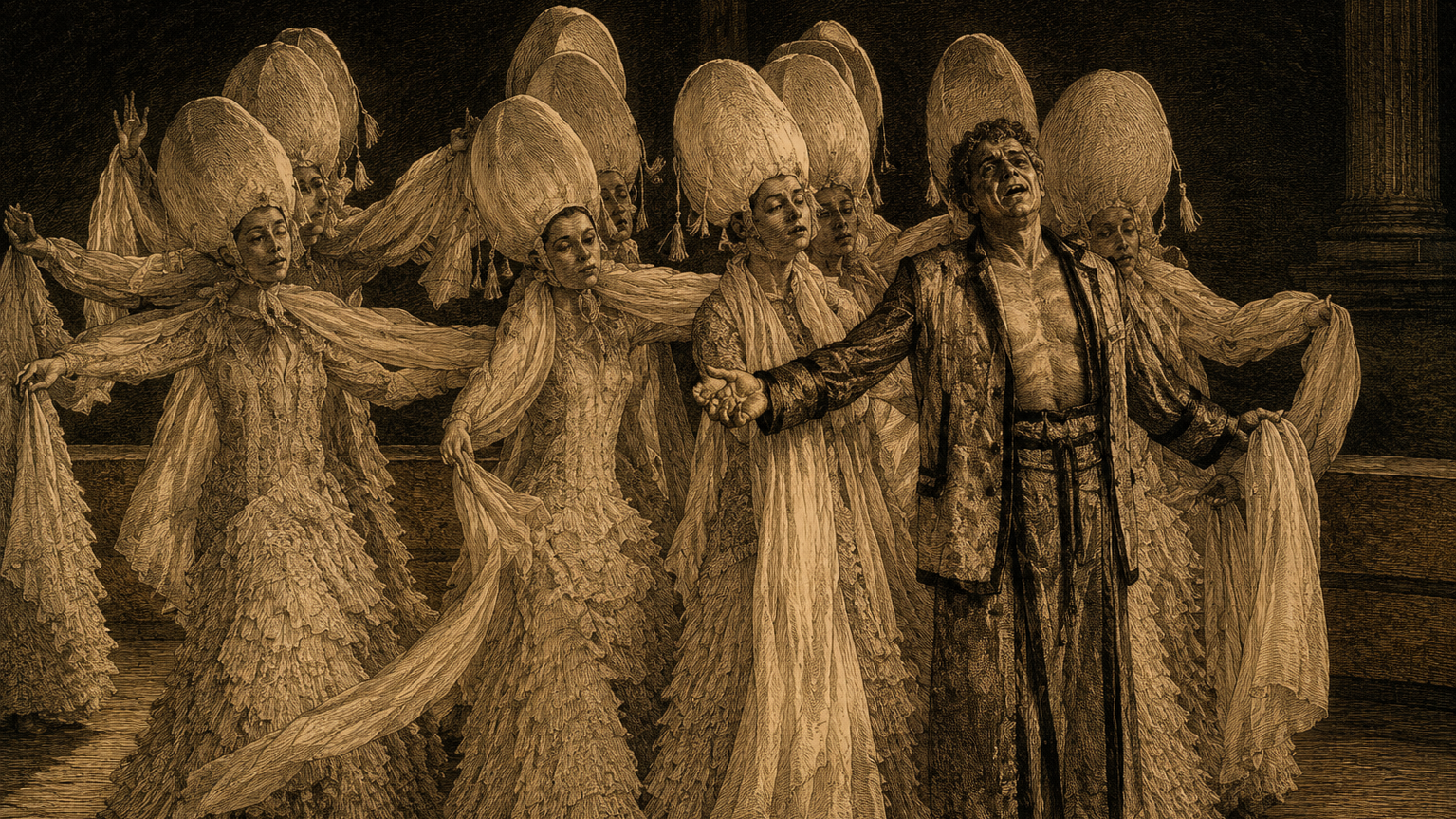
What is Aristophanes actually doing with all of this? Look at the deeper sense of the clouds themselves — what do they actually do in the play? They imitate the shapes of things, much like a poet does. In fact, in the play's parabasis, one of the clouds effectively turns out to be Aristophanes himself, addressing the audience directly — the only time this happens anywhere in the surviving corpus of Greek comedy; a chorus regularly speaks for the poet, but not usually explicitly as the poet in his own voice. The clouds educate, in the end, by staging a whole drama of their own — pretending to be in league with Socrates specifically in order to teach Strepsiades a real lesson about him. This turns out to be a considerably more effective form of teaching than Socrates's own — not abstract and purely theoretical the way his teaching is. Strepsiades will genuinely remember this lesson. This shows the real superiority of the poet over the philosopher, on Aristophanes's own account: he understands the human things better, understands the perspective of the polis more fully. He is, in this sense, the true benefactor of the city. Aristophanes possesses a superior wisdom of his own — he knows how to disguise himself effectively, precisely what Socrates fails to understand: Socrates is simply too open with everybody, too exposed to public scrutiny.
Aristophanes's Own Radicalism
Notice an odd fact here: the clouds are not, themselves, traditional gods. Aristophanes is effectively introducing new gods into the city — doing exactly what he accuses Socrates of doing. He is conservative as a moralist, but genuinely radical as a dramatist. A purely traditional poet simply repeats traditional songs, with no real variation. Aristophanes, by contrast, is a genuine innovator, and takes real pride in his own novelty, boasting at one point (in a better rendering of the Greek than the standard translation) that he "always sophisticates by bringing in novel forms" — sophizomai, "to play subtle tricks," "to use sophistical arguments." Notice the real etymological connection between "sophist" and "sophisticate." Aristophanes essentially admits here that he really is a kind of sophist himself — just a better one, with deeper wisdom and greater sophistication. A purely conservative figure couldn't actually defend the city effectively. In a genuinely corrupt society, the poet has to understand that corruption, and to some real degree share in it, in order to combat it. Aristophanes has to know Socrates intimately in order to defend the city against him effectively. In Plato's own Symposium, notably, Aristophanes is shown hanging out with Socrates as a genuine friend.
Plato's Answer to Aristophanes
What is Plato's own answer to Aristophanes here? Very briefly: the poet remains too bound by the horizon of the city. The clouds themselves want to be worshipped by the city, claiming to provide all sorts of benefits in return, ultimately serving the city's own interests. This exposes a real problem already visible with the gods generally: they claim to stand above the city, and yet they need the city to exist at all — we already saw exactly this in The Birds, where the gods would literally starve without human sacrifices. The gods, in this sense, end up catering to human beings rather than the reverse. The same turns out to be true of poets. Aristophanes claims to be a teacher of wisdom to the city, and in that sense to stand above it — but he still has to pander to his audience, still wants to win first prize in the competition. His willingness to revise the play afterward shows a real willingness to meet the audience halfway. He claims, at one point, that his play contains no real vulgarity — and yet the play is absolutely full of obscene material (Arrowsmith himself points out that the actors literally wore phalluses on stage). The comedian, in the end, gives the audience exactly what it wants, dirty jokes included — he needs the audience to actually laugh, and remains genuinely dependent on their existing prejudices; they laugh at whatever strikes them as ridiculous, laugh at whatever seems unfamiliar to them, including the philosopher, including Socrates himself. Aristophanes plays directly to his audience's own prejudice against anyone smarter than they are.
Aristophanes may well be right about the sophists specifically. But what if the genuine philosopher is actually a higher kind of human being altogether? This is precisely what Plato claims about Socrates. Socrates possessed a genuinely peculiar form of wisdom — what he himself called knowledge of his own ignorance. The Delphic Oracle had once told Socrates he was the wisest man among all the Greeks; unable to make sense of this, he went around questioning all the reputed Greek wise men in turn, poets included. What he ultimately realized was that they all genuinely lacked true wisdom, while nonetheless believing themselves wise. Socrates alone was the one man who wasn't wise and openly admitted it. He was, in this precise sense, emphatically not a "wise guy." His wisdom consisted entirely in his own knowledge of his own ignorance. That's really the whole difference between the philosopher and the sophist: the sophist claims to already be wise. The "philosopher," properly speaking, loves wisdom precisely because he knows he lacks it — you only really love what you actually lack. Plato, on this basis, makes a genuinely strong case for Socrates.
Comedy's Debunking Spirit, and the Question of Integrity
The Clouds shows us the same debunking, deidealizing spirit of comedy we already saw in The Birds — showing us that people we might otherwise take to be heroes are really just quite ordinary people underneath. People who think they stand above, or beyond, the city inevitably get their comeuppance. Strepsiades learns from Socrates to think he stands above the law himself, which would lead straight to disaster — he eventually has to recognize that this would end up undermining his own authority as well. But Plato would respond: the real problem here is that Socrates himself gets punished too, in the end — possibly even killed by an angry citizenry, exactly as would actually happen years later. Aristophanes, on this view, has sold out to the crowd, trashing a genuinely great man, Socrates, purely to get some cheap laughs. Aristophanes, in this sense, lacks real integrity — lacks precisely the integrity Socrates himself showed in openly scorning the city's opinion of him. In the Apology, Socrates actually challenges Athens to sentence him to death at his own trial; once convicted, and asked to propose his own penalty, he proposed instead being put on a lifetime civic pension — the jury had clearly been hoping he'd propose a simple fine. He effectively forced them into sentencing him to death, rather than beg the city for mercy, rather than surrender his own integrity. Aristophanes, by contrast, is genuinely malleable — much like his own clouds, willing to take on whatever shape the city itself wants of him, ultimately too flexible. He remains, in the end, a genuinely comic figure, willing to do almost anything in order to survive, in order to win. Socrates, by contrast, simply would not bend — a genuinely tragic figure in the end, one Plato explicitly compares to Achilles: a true hero, entirely unafraid of death.