
Aristophanes & Greek Comedy
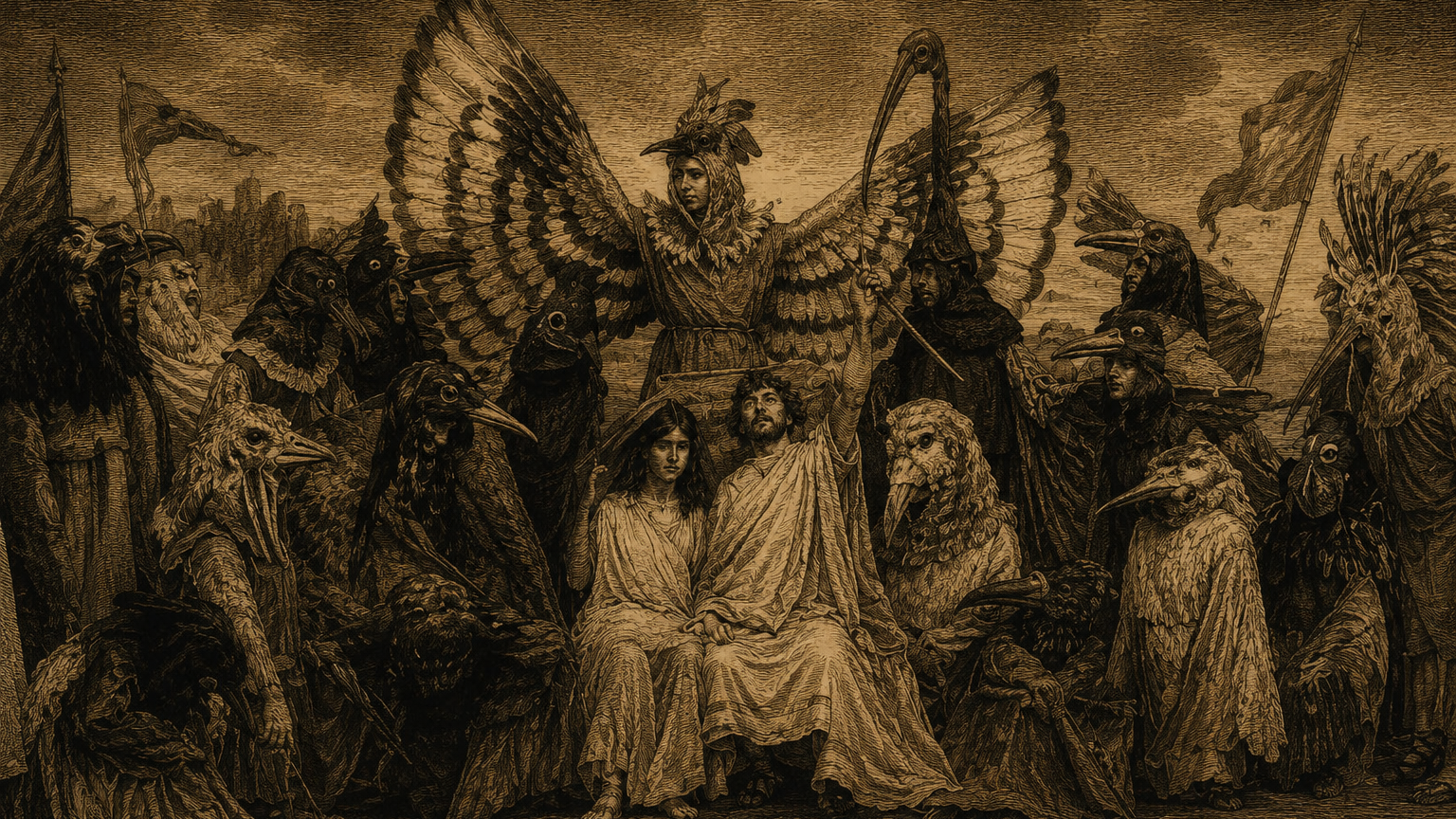
Lecture Notes
Aristophanes and the Birth of Greek Comedy
Featuring The Birds
Paul Cantor · University of Virginia
Comedy and Philosophy: New Subjects
Last week we were still on the Greek tragedians; this week the aim is to fill out the picture, to give a real sense of the variety of Greek literature, by turning to two new subjects: comedy and philosophy, and to see how the two are actually related. Both continue the ongoing Greek critique of the tyrant — embodied, in real life, in the person of Alcibiades, perhaps the single most remarkable man in the ancient Greek world. Aristophanes's The Birds offers a comic critique of the tyrant; his Clouds offers a comic critique of the philosopher. Plato, in turn, offers a philosophic critique of the tyrant. These are bizarre works in their own right, and they show off the sheer wildness of the Greek imagination. We've spent a great deal of time on the polis as a tight-knit community; now we're going beyond the city limits altogether. The polis is, among other things, a constraining force, one that tries to force people into set molds — and here we watch an explosion, people breaking out of those political molds entirely. In The Birds, we finally see the old Greek dream fulfilled: a man actually becomes a god — though only within a genuinely crazy, fantastical world. The Greeks were not always sober and restrained; think of Plato's Symposium, essentially a drunken party (there's a real Dionysian side to all of this). The classics are, in this sense, thoroughly unconventional. This is genuinely difficult material — I don't expect you to understand these works completely; I certainly don't claim to myself.
Aristophanes and Old Comedy
Aristophanes was born around the middle of the fifth century, roughly 444 BC — a generation after Euripides, and so working later than the great tragedians, responding directly to tragedy. We actually know even less about ancient comedy than we do about tragedy. Of the fifth-century comic playwrights, only Aristophanes survives at all — eleven plays out of perhaps forty he actually wrote. Menander, writing in the fourth century, along with his later Roman imitators, represents a different and later kind of comedy entirely — romantic comedy, a young man and woman outwitting their parents, considerably closer to what we're used to today, known as New Comedy. Aristophanes belongs instead to Old Comedy — far more satiric, focused on political subjects. Our biggest single problem here is that Book II of Aristotle's Poetics, the book specifically on comedy, has been lost entirely — it would have explained a great deal. Most of what we know about Greek tragedy comes from Aristotle's surviving Book I; we have nothing comparable for comedy. All we really have of Old Comedy is Aristophanes himself — probably the greatest comic genius Athens ever produced, one of the great comic geniuses of any era. It's genuinely remarkable that he's still regularly staged today. Comedy generally has a much harder time surviving across centuries than tragedy does, since it's always filled with topical allusions that lose their point over time — you need elaborate footnotes just to explain the contemporary references. Aristophanes is also incredibly obscene, and a great deal of that gets lost in translation — he loves obscene puns, and there's a strong element of pure anatomical humor throughout, plenty of butt jokes. There's a real element of universal humor buried in this too, since we all share a common human body, we all have butts. In some ways Aristophanes is actually further from us than the tragedians, since he's so focused on the fine details of Athenian politics; in other ways he's closer to us than they are, since he's so focused on the human body — something we share directly with him regardless of era.
Don't Underrate Comedy
A word of caution here: don't underrate comedy as a form. There's a natural tendency to assume tragedy is somehow higher than comedy — tragedy is serious, comedy is frivolous. This is usually true, but not necessarily. Some of the most profound literature ever written is comic — Rabelais and Cervantes among them. Shakespeare was a comedian as well as a tragedian. (We'll cover Molière in the spring; Britain, for its part, produced a great many great comic writers too — Chaucer, Ben Jonson, Swift, Dickens.) Aristophanes shows a genuinely profound understanding of the polis — arguably more profound, in certain respects, than Aeschylus or Sophocles. I realize that's close to blasphemy to say. But perhaps he's more profound precisely because he doesn't take the polis quite as seriously as they do — he can laugh at its pretensions, is less taken in by its own claims about itself, and is therefore better able to make us aware of its real limits. In tragedy, the fundamental emotion is awe; in comedy, it's laughter. Aristotle himself observes that tragedy presents men as better than they actually are, while comedy presents them as worse. Awe is a fundamentally uncritical attitude — you look up to heroes, admire their virtues. Laughter is fundamentally critical — you look down on characters, remain fully aware of their faults and failings. There's a real element of skepticism built into comedy as such. Every people stands in awe of its own gods and heroes; people generally define themselves by what they look up to. The Greeks did this too — but what's genuinely distinctive about the Greeks is their skepticism about their own gods and heroes, their willingness to learn to question them. There's an amazing treatment of the gods and religious ritual in The Birds — the gods are brought right on stage and made to look genuinely ridiculous, and Aristophanes exposes the actual origins of gods and rituals, showing us plainly that they've simply been made up. The very highest things are treated comically here. We tend to think of the Greeks as fundamentally tragic — the sixth and fifth centuries are commonly called the Tragic Age of Greece. But perhaps it should be called the Comic Age of Greece instead — comedy may actually bring us closer to the real spirit of the Greeks than tragedy does.
Tragedy, Comedy, and the Iliad/Odyssey Divide
Here's another way to look at it: the contrast between tragedy and comedy is closely related to the contrast we already drew between the Iliad and the Odyssey. The Iliad is more tragic than the Odyssey — the Odyssey ends comically, with a happy ending, a real sense of restoration. As we've already seen, this doesn't mean the Iliad is somehow more profound than the Odyssey — quite the contrary. The Odyssey actually has a fuller understanding of the human condition, of the anthropos and not merely the aner. The Iliad focuses intensely on the tragic concerns of heroes at war; the Odyssey takes a broader view, encompassing more universal human concerns — home, family, husband and wife, parents and children. This is a real clue to the underlying difference between tragedy and comedy generally: perhaps comedy can actually be more universal than tragedy. At the very least, we always need comedy as a necessary supplement to tragedy, to fill out our view of human life as a whole. This is part of why Shakespeare counts as the most comprehensive author of all — he wrote comedies as well as tragedies. Neither tragedy nor comedy, taken alone, tells the whole truth about life; both are necessarily abstractions. Life isn't as tragic as tragedies suggest — otherwise we'd all simply kill ourselves; tragedy dramatizes the extreme case, not the ordinary norm. Life isn't as comic as comedies suggest either — comedy tends to ignore the extreme cases, taking comfort instead in the ordinary norm. Real life is a mixture of comedy and tragedy together. Always remember: life itself is more complex than any single attempt to represent it in literature.
One aim for this week is to pair The Birds with Plato's Symposium, and to suggest a real affinity between them — the Platonic philosophic dialogue actually has more in common with Aristophanic comedy than it does with Greek tragedy. It shares the same underlying skeptical spirit.
The Birds: Aristophanes's Masterpiece
The Birds is generally considered Aristophanes's masterpiece — his most imaginative and inventive work. The costumes must have been genuinely fantastic, especially for the chorus, birds pecking around the stage. It was produced in 414 BC at the Dionysia, forty-four years after the Oresteia — and it actually came in second place. First prize that year went to The Revellers, by Ameipsias — much like the Oscars, the best play didn't always actually win. You can see how concerned these playwrights were with winning, since direct appeals to the judges were a real convention within Greek comedy, visible in the play itself. Part of why The Birds may have lost has to do with the political moment: Athens was in the middle of the Peloponnesian War, at the very height of its power — in 415 BC it had just sent off the greatest Greek fleet ever assembled, to conquer Sicily, gain control of the Mediterranean, outflank Sparta, and tip the whole balance of power decisively in Athens's favor. In 413 BC, the year after The Birds, that expedition turned out to be a total disaster — the fleet was lost, and with it, eventually, the war. Aristophanes was opposed to the war throughout, which may partly explain the loss. There may well have been real politics involved — the play could easily have struck contemporaries as unpatriotic. Aristophanes viciously satirized the leaders of Athens, Cleon especially, an earlier leader of the war party, who had actually tried to strip Aristophanes of his citizenship (he may not have been born in Athens). Political opposition to Aristophanes isn't remarkable in itself — what is remarkable is that his plays were produced at official civic functions in Athens, castigating the city for its faults and follies right to its own face. It's something like a comedian doing a genuinely vicious routine about the sitting president at the White House itself.
What Has Happened to Athens?
The basic thrust of nearly all of Aristophanes's plays is this same question: what the hell has happened to Athens? What has happened to the Athens of Aeschylus and the Oresteia? Contrast the Athens of the Oresteia with the Athens of The Birds. In the Oresteia, the law carries real majesty, and the gods themselves participate directly in legal proceedings — it presents the ideal of the polis as a genuinely civilizing institution. The Birds shows us instead the polis's actual reality, its legal institutions as they actually function in practice. The Oresteia gives us an idealized situation, law without lawyers; now fast-talking lawyers are everywhere. The polis has degenerated with remarkable speed. The polis is supposed to be a source of moderation, of sobriety and restraint — but for Aristophanes, Athens has gone genuinely crazy, lost all real control, lost all sense of moderation, let its own power go straight to its head, a city drunk on power, visible in both its foreign and domestic policy alike. In foreign policy, Athens has become straightforwardly imperialistic: at the start of the fifth century, Athens was just one of many Greek cities, but it became preeminent at the Battle of Marathon, leading the other Greek cities against the Persian invasion — and has now become an empire in its own right, still nominally a democracy, but an empire regardless. Other cities had actually taken to calling Athens the "tyrant" of Greece. Athens used its power to rule directly over other Greek cities, confirming Aeschylus's own worst fears — Athens had begun acting exactly like the barbarians it had originally defeated. Athens was constantly scheming to bring other cities under its control, using its navy and its command of the seas — all of which culminated in a genuinely hare-brained scheme to conquer Sicily, or perhaps I should say bird-brained.
The domestic scene was no better — no real peace there either, the city in constant turmoil, overrun with lawyers, everyone constantly suing everyone else. Lawyers, in effect, came into existence as a profession in fifth-century Athens specifically, one of the many new professions the city itself made possible, making money by winning legal judgments (Sophocles's own son, Iophon, actually hauled his elderly father into court on a charge of mental incompetency — Sophocles was over ninety at the time, and won the case simply by reciting lines from Oedipus at Colonus, perhaps the greatest play ever written by a ninety-year-old). Athens was probably the most litigious community that had ever existed up to that point. Democratic politics generally was incredibly chaotic, topsy-turvy, with constant turnover among its leaders; persuasion mattered enormously within a democracy, and public speaking became correspondingly important, with professionals now offering to teach people how to win public arguments — the sophists and rhetoricians, whom we'll meet directly in The Clouds, the original spin doctors. Education itself was no longer education in virtue, but rather education in how to get as much as possible for yourself — learning sophistry rather than virtue. Aristophanes was genuinely appalled by what was happening in Athens; he was, at bottom, a conservative, wanting to return to a simpler, more virtuous Athens. He saw the city being actively corrupted by democratic forces, by these new professional classes, with no remaining sense of the public good. He defended the old way of life throughout — defending Aeschylus explicitly in The Frogs, while attacking avant-garde poets like Euripides for the way Euripides had supported all of Athens's new-fangled ways, chasing after fashion.
The City of Birds: Escape and Mirror
The Birds is Aristophanes's most comprehensive critique of Athens as a whole. His city of birds functions in two directions at once — as a contrast to Athens, and as a mirror of Athens simultaneously. On one hand, it shows us what people are actually trying to escape to, a more natural community, free of Athens's own faults — part of why Aristophanes turns to birds specifically, since there's a real sense that animals are more natural than human beings, free of specifically human corruption; the birds live the life of nature itself, part of a broader Greek critique of convention conducted in the name of nature. We get to see what a city genuinely according to nature might actually look like — there's something genuinely philosophical about Aristophanes in this respect. At the very same time, though, the city of birds becomes an image of Athens itself — Athens on steroids, Athens gone completely crazy, with all of Athens's own worst tendencies turned fully loose. It functions as a mirror for the city even as it appears to escape it.
Pisthetairos's Plan
The basic premise: two Athenian citizens, Euelpides and Pisthetairos, are fed up — they simply can't stand Athens anymore, can't stand all their constant legal troubles, being hauled into court again and again. There's simply too much commotion in Athens, and they want to find some real peace and quiet, so they journey out to the birds, who have a bird's-eye view of the whole world and should therefore know the best place to actually live. They come to Tereus, once human himself, now transformed into a bird, who ought to be able to help them. Tereus asks them what they actually want. All they want, it turns out, are simple pleasures — the ability to satisfy their basic appetites, food and sex. This is Aristophanes's own sense of what a genuinely natural life would actually look like: natural appetites, sex above all. There's a real, sustained emphasis on eros throughout the play (something similar shows up in the Symposium), rather than thumos, which is more characteristic of tragedy. There's a real connection between eros and comedy as such. Sex is a universal desire, shared by all human beings alike; thumos, by contrast, is more distinctive, what makes certain particular men into heroes — thumos is the desire to be self-sufficient, which is exactly why we look up to heroes in the first place. Eros, by contrast, reflects a basic lack, a need for other human beings — it shows weakness, our common humanity, and makes us laughable. Show the greatest hero naked and having intercourse, and he instantly becomes laughable (think of Ares and Aphrodite in Book I of the Iliad — even the gods become laughable once caught having sex). This suggests a real, underlying connection between eros and comedy generally — not a strict rule, since you can certainly find eros in tragedy and thumos in comedy, but a real tendency nonetheless.
Euelpides and Pisthetairos seem, at first, like simple characters who just want to enjoy life, wanting none of the complications the city has introduced into human life. But these are Athenian characters through and through — they try to escape the city, and end up bringing it right along with them. You can take the Athenian out of Athens, but you can't take Athens out of the Athenian. Pisthetairos hasn't even been among the birds for more than a few minutes before he's already concocting an elaborate scheme to conquer the entire universe. That's the Athenians for you, Aristophanes suggests — their restless, enterprising, conquering spirit, always dreaming up new schemes, with no real limit to their own ambition. It's exactly what makes them great, and it's also exactly what makes them crazy. The plan itself: found a city of birds, occupying the air between the gods and human beings, intercepting all communications between gods and humans, and in particular intercepting the sacrifices rising up to the gods — starving the gods into submission, forcing both men and gods alike to submit to the birds. This is a genuinely fantastic scheme, showing off Aristophanes's own imaginative power, but it's actually anchored in real facts of Athenian history, full of contemporary references. The key to the plan involves building enormous walls in the sky, carefully described in the text — a clear reference to a great real achievement of fifth-century Athens under Pericles, the Long Walls, running from the city proper down to its harbor at Piraeus, guaranteeing Athens's access to the sea and to its fleet (everything really did hinge on the fleet — during the Persian War, the entire city had literally taken to the sea, letting its own buildings, including the Acropolis, be destroyed rather than lose the fleet; when Sparta eventually conquered Athens, it ordered these walls torn down, and only small portions survive today).
There's an even more pointed reference buried in the plan to blockade the gods: it recalls Athens's real treatment of Melos, a neutral island in the Aegean leaning toward Sparta. Athens and Sparta had by this point become leaders of rival leagues of cities, and you were effectively forced to be either with them or against them. In 416 BC, Athens blockaded the island — exactly the way it typically controlled other cities, through the greatest navy in Greece and total control of the seas — and starved the Melians into submission. This is an important episode in Thucydides, the Melian Dialogue: the Melians come to plead for their city, and mercy is flatly refused. The Athenians wanted to teach any potential enemies a harsh lesson — they killed all the men and sold the women and children into slavery. This stands as one of the darkest moments in Athenian history, showing just how brutal an imperial power Athens could be; Thucydides presents it as the very height of Athenian hybris, practically a Greek tragedy in its own right, directly leading to the Sicilian expedition and its eventual disaster. Aristophanes calls direct attention to this incident in the play — a perfect example of contemporary reference, coming only two years after the actual event, reminding the Athenian audience of exactly how badly they had behaved. This may be another real reason the play lost the competition.
The Power of Persuasion: Alcibiades
Pisthetairos's plan reflects the whole Athenian imperialistic spirit, especially its universalism — conquering not just the whole world, but the entire universe. There's no limit at all to the city's ambition for power, imposing its will on everyone, gods and human beings alike. In the Oresteia, the gods are merely brought within an Athenian courtroom; here, the birds control the very movement of the gods — they'll need passports just to go anywhere at all. The city's authority becomes fully universal. And look at Pisthetairos's own universality: he simply wanders into a foreign place, and the next thing you know, he's running it. Even more remarkable, he manages to get his own natural enemies to follow his orders — the text makes clear there's an ancient enmity between birds and men, since there are far too many bird-catchers among human beings; the birds initially want to attack Pisthetairos and Euelpides outright, but Pisthetairos persuades them instead to adopt his fantastic scheme, promising them real power in return. Pisthetairos is, in this sense, a kind of tyrant — a self-made man, coming to power in a foreign country purely through his own skill, much like Oedipus, but arguably even more impressively: Oedipus at least comes from one Greek city, Corinth, and convinces another Greek city, Thebes, to let him rule; Pisthetairos convinces his own natural enemies to accept him, convinces beings of an entirely different species to accept his rule. He outdoes Oedipus in every respect — by the end of the play he's actually dining on birds, which, within the context of a city of birds, amounts to cannibalism. Oedipus commits incest and parricide and is punished for it; Pisthetairos commits cannibalism and is rewarded for it instead. Pisthetairos is explicitly called a tyrannos in the Greek at multiple points in the play.
How is any of this actually possible? We're watching the real power of persuasion at work in this new world — a genuinely democratic virtue, the ability to talk people into essentially anything. Aristophanes likely had Alcibiades specifically in mind — a great Athenian noble, from one of the very best and richest families in Athens (related to Pericles himself), incredibly handsome and charismatic (he appears as a character in the Symposium). Alcibiades had personally persuaded the Athenians to undertake the Sicilian expedition, over many objections, including from his own more conservative fellow generals — a campaign that could, in principle, have given Athens control of the whole Mediterranean. Alcibiades was a genuinely remarkable leader; if he'd been left in command, Athens might well have actually conquered Sicily — but he was recalled from the campaign over an incident of alleged impiety. He was a bold, daring general; the man left in command afterward was extremely cautious, and failed to prosecute the war in Sicily with anything like sufficient aggression. Had Alcibiades remained in charge, he probably would have taken Syracuse — but he never got the chance. Many in Athens deeply distrusted him, suspecting he wanted to become a tyrant himself (this is essentially what Plato suggests as well). What Aristophanes couldn't have known at the time is that Alcibiades would go on to surpass even Aristophanes's own wildest comic fantasies (you can read the full story in Thucydides and Plutarch). He got into serious trouble in Athens, defected to Sparta, and actually convinced the Spartans to let him run their military — after he had personally defeated them on the battlefield — and promptly started winning battles against Athens instead. He was simply a great general: when he fought for Athens, Athens won; when he fought for Sparta, Sparta won. He genuinely seemed to make the decisive difference. He got into trouble again, returned to Athens, and convinced them to make him general once more — despite having been, by any reasonable definition, a traitor, they took him back regardless. He got into trouble yet again, and was apparently on the verge of defecting to the Persians when he was finally assassinated. It's an almost unbelievable political career, one that shows off the genuinely new power of persuasion in this world, and the whole underlying dream of universalism — the idea that you could rule essentially anywhere, simply walking into any city and taking it over through the sheer power of persuasion, exactly like Aristophanes's own Pisthetairos. Alcibiades's actual life is more fantastic than anything found in literature — you wouldn't believe it if you saw it staged, and yet it really happened (this may be part of why no one has ever successfully dramatized his story on stage — even Shakespeare tried, in Timon of Athens, and gave up. Alcibiades may well have served as a real model for Alexander the Great, whose empire was the first real attempt at true universal empire, not based in any single native country — Alexander wanted to rule the world not simply as a Macedonian, but as Alexander himself. In Plato's own dialogue named for him, Socrates approaches the young Alcibiades and tells him directly that he wants to rule the world). Characters like this in Greek literature may seem simply unbelievable on their face — but there was, in fact, a great deal of real historical basis behind them.
Sophistry and the Art of Persuasion
The key to this whole new kind of political power is the sheer ability to talk, and to talk fast. Pisthetairos is a fast-talking Athenian who can convince the birds to do absolutely anything — they're portrayed as a little dim-witted, genuinely bird-brained (Aristophanes is not remotely kind to the democratic public of Athens here). Pisthetairos deploys every single trick developed by the sophists and rhetoricians of his day, with no real concern for truth as such — teaching how to twist logic in order to win public arguments, how to persuade an audience through pure sophistry. Consider, for instance, his use of myth: how do you persuade the birds to go to war against the gods in the first place? You persuade them that the gods originally usurped power from the birds themselves — a myth of origins claiming the birds were actually there first, the oldest beings in the entire universe. There's no real mythological basis for any of this; Pisthetairos simply invents the myth on the spot, whatever will actually persuade his audience (notice the real irony here: to support his brand-new scheme, he reaches all the way back to the very beginning of time — the most recent scheme masquerading as the most ancient truth). He concocts a false authority for his whole plan out of nothing. This is exactly what the sophists actually taught: myths are plastic, malleable, not some fixed body of settled belief — you simply make up your myths as you go along, as needed. If anyone questions how the birds could possibly be related to the gods, he simply points out that several gods have wings too — Hermes, Iris — anything at all to win the argument in the moment. Aristophanes is every bit as clever as any sophist or rhetorician in Athens — but he's satirizing the whole practice even as he demonstrates total mastery of it, exaggerating what was really happening throughout Athens: an uncontrolled, unprincipled use of rhetoric, verbal skill being thoroughly prostituted, put entirely in the service of a naked will to power. Men were exploiting this new power of argument specifically to gain public office and exercise real power over others. The very highest Greek intellectual virtues were now being placed in service of the very lowest aims, mere material gain. The sophists, notably, took money for their teaching — considered a genuinely disgraceful action at the time. Socrates famously did not take money for his own teaching, which is precisely how he distinguished himself from the sophists.
A City Founded on Imperialism
This whole city is founded on naked imperialism — a plan to conquer the entire universe — and this same obsession with power shows up reflected in every aspect of the new city's daily life. Everybody starts showing up the moment they hear a new city has been founded, all wanting to see what's in it for them personally; everybody is on the make, and everybody is on the take. A poet shows up, for instance — we might expect something noble from a poet, something like Homer — but this particular poet turns out to be a pure money-grubber, claiming to have already been praising the new city for a long time, even though it's only been founded a few minutes earlier. It's all purely for material gain in the end; he settles, in this case, for a bit of free clothing. The same goes for every other new professional who shows up — prophets, inspectors, legislators, everyone simply out to make a buck. Most of these professions actually came into existence, as recognizable professions, in fifth-century Athens specifically. This is essentially what Aristotle suggests about the city more broadly: it comes into existence to provide the basic necessities of life, and only then allows all sorts of luxuries and entirely new ways of life to develop. Law founds the city, and only then do lawyers themselves come into existence — you genuinely can't conceive of lawyers existing without a city first; it's a purely urban phenomenon (they're essentially the original yuppies — there are no lawyers in any state of nature). Lawyers are, in this sense, a luxury the city makes possible — once you have enough people reliably providing food, clothing, and shelter, a whole additional class of people can simply stand around suing each other for a living. Aristophanes is particularly making fun here of the long arm of Athenian law, itself another expression of the same drive toward universalism. Athens made its own laws apply across all its colonies and satellite states, effectively forcing democracy onto non-democratic cities that had no particular wish for it. There's a real hint of this in the play too — Athens seems to be forcing its own ways even onto the gods themselves; even the gods, in the play, will now be elected, with the birds actively campaigning against the Olympians. Athens wants its own particular way of life and laws, its own constitution, its own regime, to apply absolutely everywhere. An Athenian citizen could sue a foreigner from virtually any country under Athenian control, in an Athenian court, before a hometown jury — a tremendous opportunity for pure exploitation, winning favorable legal judgments against foreigners almost automatically. What the informer character actually wants from the birds is precisely the ability to fly freely from one legal jurisdiction to another — wings will supply him with a kind of legal universality. The culminating image of corrupted Athens comes in the young man who shows up wanting to beat his own father — Aristophanes sees all authority in Athens breaking down at every level; the young no longer respect their elders. He's a kind of junior Oedipus, wanting to triumph directly over his own father. We'll see this same theme again in The Clouds.
The Deepest Critique: Polis Inflames Rather Than Moderates Passion
This is a genuinely broad-based critique of Athens, not merely a catalogue of isolated abuses — Aristophanes sees one single, unified theme running through all of it. And it isn't only a critique of specifically Athenian problems. At the very deepest level of Aristophanes's analysis lies a critique of the polis as such: the polis has not actually moderated Greek passions the way Aeschylus once promised it would; instead, the polis has inflamed them further, becoming a new vehicle for exactly those same passions. We can see the very same underlying Greek striving, the very same competitiveness, that we already saw in Homer — everyone constantly trying to outdo everyone else. At its very worst, Athens has simply commercialized the old heroic spirit, striving now for material gain rather than for honor (this wasn't true of the Homeric heroes themselves — when they argue over material things, it's really because those things represent honor to them). But even at its best, we still see in Athens that same insane Greek desire to excel, to become like a god. The Birds is, in this sense, the culmination of everything we've traced since the Iliad — a portrait of what happens in a culture where becoming a god remains a genuinely live, legitimate possibility, not foreclosed the way it is in ours (in our own tradition, the job is already taken; nobody need apply). In The Birds, Aristophanes offers us a comic version of this old Greek dream, showing us what it would actually be like to become a god in practice: storming the heavens, an open revolt against the gods, displacing their authority outright (with clear reference to traditional myth — Prometheus, the Titans' own revolt). The goal itself is genuinely titanic: universal recognition, worshipped by gods, human beings, and birds all at once. Notice how thoroughly Pisthetairos breaks down binary oppositions and hierarchy throughout — we've seen a strict sense of hierarchy running through this whole tradition: human beings above beasts, gods above human beings; Pisthetairos overturns all of it, with the birds set to rule over everyone. The underlying categories themselves break down too — Pisthetairos and Euelpides literally become birds, and other humans start showing up to get wings of their own, much like Oedipus, a real case of boundary-crossing, category-breaking. Tereus the Hoopoe offers a close parallel to Tiresias: Tiresias had been turned into a woman for a time, the only human being to experience life as both male and female; Tereus, transformed into a hoopoe, has similarly been both man and bird. Tiresias overcomes the boundary between the sexes; Tereus overcomes the boundary between species. Pisthetairos overcomes ordinary human limits altogether — by the end of the play he is actually being deified, perhaps even placed above the gods themselves, given a goddess to marry, Basileia (meaning something like "empire" or "sovereignty" — our translator renders her, inaccurately but rather brilliantly, as "Miss Universe"). This reverses the whole underlying movement we traced in Homer: in Homer, intercourse between gods and humans is common at first, a genuinely fluid boundary, with the gods gradually withdrawing until we end up, by the end of the Odyssey, in a basically fully human world. The Birds takes us straight back to the old world of heroes, where humans intermarry freely with gods. Pisthetairos achieves everything every hero we've encountered so far has secretly dreamed of — he actually outdoes the gods themselves. But it comes in comic form here — burlesque, travesty. Notice, too, that he achieves all of this precisely because of his own sheer flexibility. He is emphatically not a tragic hero, not a man of fixed principle — he simply goes with the flow, deserting his own native city without a second thought (in tragedy, this would make him a traitor, much like Alcibiades). He betrays his own species outright, ending up leading the birds instead. He'll become absolutely anything the moment requires. He has no real integrity at all.
Ortega on Tragedy and Comedy
What is Aristophanes actually getting at here? It comes back to the underlying relation between comedy and tragedy. José Ortega y Gasset — another philosopher with a genuinely great theory of tragedy — puts it this way: tragedy shows us men striving to become gods; comedy shows us men who already believe they are gods. Men straining beyond ordinary human limits, against men who already imagine themselves raised above those limits entirely. As Ortega writes in Meditations on Quixote: "The distance between the tragic and the comic is the same as that which exists between wishing to be and believing that one already is. This is the step from the sublime to the ridiculous. … The mirage appears as nothing but a mirage." This gives us one useful formula for comedy — applying especially well to Aristophanes, though certainly not to all comedy everywhere. The comic, on this account, is the ridiculous counterpart of the tragic. The tragic hero tries to become a god, and fails — but fails nobly. The comic hero thinks he already is a god, and thereby makes an utter fool of himself. Tragedy inflates the hero; comedy deflates him. This connects directly back to Aristotle's own formula: tragedy shows men as better than they actually are; comedy shows them as worse. Aristophanes, in this sense, is directly reacting to Greek tragedy — taking essentially tragic material and treating it comically instead.
Comedy as a More Effective Force for Moderation
Look at it this way: Greek tragedy generally presents a real message of caution, warning against going beyond ordinary human limits, showing the catastrophic results that follow. The chorus teaches a lesson in moderation — a life of excess is dangerous; try to become divine, and the gods will strike you down. But at the very same time, tragedy also makes the hero's own life genuinely attractive, precisely because it makes that life seem heroic. The hero dies, yes — but he dies nobly. He may be dead, but at least he was a hero; he was never merely ordinary. He maintains his own dignity even amid catastrophe, maintains his integrity right through his own death (Achilles's choice, all over again). Oedipus is still proud even at the very end — "I have a horrible destiny, yes, but it's my own unique destiny, and it will make me famous forever." So, at the end of a Greek tragedy: which would you actually rather be — the mediocre chorus, or the extraordinary hero? It's a genuinely difficult choice. In practice, in the real world, most of us would probably do the sensible, prudent thing and act moderately, quietly taking our place in the chorus. But we still secretly fantasize about being heroes; we secretly identify with the hero anyway. Tragedy is supposed to moderate the passions, but it could just as easily inflame them instead — this is exactly the point behind Plato's own critique of poetry in the Republic: tragedy makes the passionate, excessive life seem genuinely attractive (perhaps this is part of why Aristotle came up with his own theory of catharsis, the idea that tragedy purges the passions rather than inflaming them). We'd honestly rather die alongside the heroic Antigone than live on quietly with the merely ordinary Ismene. Aristophanes suggests that comedy may actually be a more effective force for genuine moderation than tragedy is. If you actually want to get people to give up some way of life, don't glorify it as heroic — ridicule it instead. Laughter is a far more corrosive power than tragic awe. Show a man striving to become a god, and we admire the sheer striving, the effort involved — it's exactly what distinguishes the hero, and we remain aware of how close he actually came to real divinity. Show a man who already thinks he is a god, and we become aware instead of how genuinely ridiculous he is — self-satisfied, holding far too high an opinion of himself — and we become fully aware of how far short he actually falls of true divinity. Both tragedy and comedy, in the end, deal with the underlying limits of humanity. Tragedy pushes its hero right up to those limits until he breaks, testing his own tensile strength; he ultimately fails, but he goes further than anyone else manages to, which is exactly why he counts as heroic — he's made of stronger stuff than the rest of us. Comedy instead builds a pure fantasy world, dreaming up a situation entirely beyond the normal limits of humanity, placing its hero in a godlike situation that only makes us aware of how absurd his actual position really is. A man striving to become a god and failing seems genuinely noble; a man who simply believes he already is one seems merely silly. That's essentially the whole difference between Oedipus and Pisthetairos.
Debunking Athenian Heroism
Aristophanes debunks the whole heroism of Athens by portraying it in the thoroughly debased form of Pisthetairos. There's nothing genuinely special about the Aristophanic hero — he's just a man off the street, a sausage-seller in another of Aristophanes's plays; you could pull essentially any man off the streets of Athens and turn him into a hero simply by getting enough people to treat him like a god. Alcibiades himself seems so impressive precisely because he gets up in front of the whole city, starts speaking, and the next thing you know, the entire city is willing to follow him into battle. Aristophanes directly parodies exactly this: when you get right down to it, this is no different from getting up in front of a bunch of bird-brains and convincing them to follow your own orders. This gives us a real formula for Aristophanes generally: the comic hero functions as a direct parody of the tragic hero. Comedy, in this sense, actually feeds directly off tragedy — the play is full of direct quotations from Aeschylus, Sophocles, Euripides, and others. Pisthetairos is, in effect, the comic version of the tyrant, whether we're talking about the mythical Oedipus or the very real, historical Alcibiades. This is exactly the way in which comedy can end up being more genuinely profound than tragedy — more philosophical, in its own way. Tragedy takes the city very seriously, takes its heroes very seriously; it may show us their real errors, but it remains, at bottom, in real awe of them. Aristophanic comedy debunks its heroes outright, showing us that they all have feet of clay, that they're really quite ordinary men underneath it all, only puffed up by particular circumstances. Pisthetairos is acting like an outright coward right up until the moment the birds become genuinely fascinated by his scheme. The hero turns out, on inspection, to be quite an ordinary man after all, with entirely ordinary human concerns — principally food and sex. The hero is no longer a fundamentally different order of human being; the whole aner/anthropos distinction essentially collapses. The real enemy of comedy is pretension as such — any man who merely thinks he's different from, and better than, his fellow human beings. To be clear, though: Aristophanes himself is not remotely democratic, nor is he simply anti-aristocratic — he still genuinely believes in nobility, in real nobility, the old kind of nobility. His whole point is that the new democratic city generates false heroes of its own, actively manufactures them; the new heroes are really demagogues, men who can simply talk a democratic city into following them wherever they lead. If anything, Aristophanes is fundamentally anti-democratic in outlook. His real aim is to debunk the false heroes thrown up by the democratic city specifically. Aristophanes wants a more moderate life instead — still noble, still genuinely heroic, but without these insane, excessive heroic virtues run wild. He wants the Athens of the Battle of Marathon, not the Athens of the Sicilian expedition — a defensive Athens, not an offensive one, fighting for its own liberty rather than trying to strip away the liberty of others. Aristophanes, in short, is against war and against empire alike — which might sound like it should place him firmly on the political left, but he's actually a genuine conservative: this amounts to a conservative critique of democratic extremism, not a progressive one.
The Paradox of Aristophanes
Having made the case for Aristophanes's genuinely subtle view of the polis, it's worth now raising some real problems with it, which will lead us directly into Plato's own critique. There's a real paradox at the heart of Aristophanes's whole enterprise: he offers a genuinely sophisticated defense of a deliberate lack of sophistication. He'd clearly prefer a simpler Athens — a kinder, more foolish Athens, the way things supposedly were before all these city slickers took over. His real ideal is something like the old farm bloc, the gentleman farmers living out in the Athenian countryside, more virtuous, less corrupted — an almost Jeffersonian ideal of agrarian virtue, independent men of real means, genuinely difficult to corrupt, living directly off the land, fully self-sufficient. He's trying to defend them against the corrupting influence of the new professional and intellectual classes springing up in the city — defending rural Athens against urban Athens, farmers against yuppies (Athens, remember, was really the city plus its surrounding farmland together). He writes his plays specifically to expose the real danger in these new urban attitudes. Aristophanes is, in his stated opinions, deeply conservative — and yet he's an incredibly revolutionary figure as a playwright, writing some of the wildest, most imaginative plays ever staged. The very people he claims to admire couldn't possibly have written his plays themselves. Sometimes they didn't even particularly like them. Aristophanes has clearly learned a great deal from the very city slickers he criticizes — he's mastered every art of rhetoric himself, and can beat the sophists at their own game ("you want sophistry? I'll give you sophistry"). He has to be cleverer than all those city slickers put together. He would, frankly, have made an excellent lawyer himself. Here's the deepest paradox of all: he defends traditional piety, and yet he writes an incredibly blasphemous play in the process, one that raises real doubts about the gods themselves — they end up seeming genuinely dependent on human beings, rather than the other way around. They need sacrifices; they're nothing at all without their own worshippers. They need poets; they need mythmakers. Perhaps the poet, on this account, is the real intermediary between the gods and humanity, not the priest. Aristophanes himself, not the birds, ultimately controls the gods in this play — he's the one who hands out their passports; they're not going anywhere at all without his leave. There's a strong suggestion throughout that the gods are, in the end, simply the creations of poets. There's no greater demonstration anywhere of the sheer freedom of the Greek mythic imagination — and this was performed as part of an official religious festival.
In order to defend the old-fashioned ways of the city, Aristophanes himself cannot really be old-fashioned — he has to see straight through the city in order to defend its older conventions; to defend convention, he himself has to be genuinely unconventional. He admires the world of the gentleman farmer, but he himself works in the theater, the single most sophisticated part of Athens, itself the most sophisticated city in all of Greece (notice the real connection between "sophist" and "sophisticated"). This is precisely the paradox Plato explores in the Symposium — Aristophanes there serves as spokesman for the good old moral virtues of Athens, and yet he's shown hanging around with the theater crowd (something like a drunken, aggressively unconventional after-party — a bit like Jerry Falwell unexpectedly showing up at the MTV Music Awards). Where do Aristophanes's real allegiances actually lie? Is he glorifying a city that would ultimately have no real room for someone like Aristophanes himself? Does he fully understand the actual basis of his own art? Does he understand how he himself is genuinely special, raised above the ordinary city? He clearly sees straight through the illusions of the city himself, sees exactly how false its claims to universality really are. That's precisely the sense in which Aristophanes is himself philosophical — he questions nomos in the name of physis. But is he really the only one in the play who does this?
Look at the treatment of Meton, the astronomer who shows up partway through — he too is genuinely interested in nature, arrives with his own working model of the cosmos. His interest in the city of birds seems to be purely theoretical, unlike everyone else who shows up — he has no ulterior motive the way the others do; he isn't asking for money, isn't trying to take advantage of the birds in any way. He simply wants to explain the underlying order of nature to the new city. He seems genuinely different from the prophet, the legislator, the informer, even the poet. And yet Pisthetairos drives him out with outright threats regardless. Aristophanes, apparently, has no real sympathy for philosophers and scientists as such — he doesn't seem to want anybody else criticizing the city, even on purely theoretical grounds. You can see this same suspicion in the play's jokes about Socrates too, making fun of the philosopher and his students, Chaerophon especially — Aristophanes went on to write an entire play specifically attacking Socrates, The Clouds (according to legend, Socrates himself was actually present at that performance, and reportedly stood up in the audience so people could directly compare his own face to the comic mask on stage). Plato's own charge is that Aristophanes helped create exactly the climate that eventually led Athens, years later, to put Socrates on trial and execute him for impiety. Aristophanes helped feed the city's underlying suspicion of any man who dared question its established way of life — the real downside of his own conservatism. He lumped Socrates together indiscriminately with the sophists, the city slickers, the wiseguys of Athens. But these city slickers, however smart and unconventional they might seem, remain fundamentally bound by the city's own horizon — they still want exactly the same rewards everyone else in the city wants, which is precisely why they take money for their teaching. Socrates did not. He was, in this sense, considerably more unconventional than they were, considerably freer of the city's own horizon altogether — a genuinely new type of hero, the most independent of all, openly scorning what the city itself values.
This is precisely what Plato shows us in the Symposium: the true philosopher is the true hero. Who, in the end, is actually better able to see beyond the limits of the city — the philosopher, or the poet? The Symposium itself stages an episode in what Plato elsewhere calls the ancient quarrel between philosophy and poetry, and both Socrates and Aristophanes appear together as characters within it. Plato ultimately makes the case for Socrates as the very best of the Greeks. There is, on Plato's account, a true hero capable of genuinely going beyond the limits of the city — Aristophanes simply doesn't manage to see him. It's Socrates. The philosopher.