The Iliad Lecture 1
Lecture Notes · Session I
On Homer's Iliad
Paul Cantor · University of Virginia
Authorship: Was There a Homer?
Is the Iliad a great book? No — it's great, but it's not a book. What you hold in your hands is, as a physical artifact, very remote from what Homer actually composed. We cannot avoid the scholarly questions this raises.
Was there a Homer? Yes — there was, and he composed both poems. There were few doubters in the ancient world; nearly everyone believed Homer composed both the Iliad and the Odyssey, and the poems were studied carefully on that assumption. This wasn't seriously questioned until the eighteenth century, with Vico, then Robert Wood (the first in English, in 1769), then Wolf in 1795 — the beginning of modern classical scholarship. That scholarship was not disinterested; it aimed, in part, to undermine the prestige of classical literature, and it developed alongside the parallel "Higher Criticism" of the Bible. The impulse was to cut Homer down to size — to cut Homer up.
We should be skeptical of this strand of modern scholarship. The ancient Greeks knew ancient Greek a great deal better than we do, and neither Plato nor Aristotle ever questioned that Homer composed these poems. The real question is not authorship as such but how we ought to read the Homeric poems: as great works of art, or as historical hodge-podges?
The Case Against "Disintegrating" Homer
One influential line of scholarship tried to "disintegrate" Homer — finding separate historical layers within the poems and denying them any real artistic unity. There have been many theories of multiple authorship; Samuel Butler, for instance, argued that the Odyssey must have been written by a woman, since it tells its story from something like a woman's point of view.
The most influential modern theory is the Parry-Lord theory of oral-formulaic composition, based on fieldwork studying Yugoslav bards (recorded in The Singer of Tales). This is oral poetry with no written texts: poets compose as they go, and no two performances are ever quite the same. What's remarkable is the persistence of memory involved — these poems can run to twenty thousand lines, longer than the Iliad or Odyssey, and singers can recount events like the medieval Battle of Kosovo with real fidelity to detail, centuries later.
Formulae make this kind of oral performance possible: set phrases and repetitions that fit the meter and buy the poet time to think — essentially templates, not unlike an answering machine message ("You have reached the answering machine of ___"), where you fill in the blanks. Homer has a set formula for introducing a hero: give his name, his father's name, where he's from, and a description of his best weapon. The poet doesn't have to reinvent this process every time a new hero appears.
(There is some counter-evidence worth noting: translations of Latin poetry into Anglo-Saxon show roughly the same percentage of formulaic language, which complicates any simple argument from formula-density to oral-traditional origin — a point made by the scholar Larry Benson.)
There is no real doubt that an oral tradition stands behind these poems — but how far can we push that theory, and can it be applied mechanically? Suppose a truly great poet came along and took the tools of oral composition and used them for new artistic purposes. Repetition can get monotonous in the Yugoslav epics, but in Homer it becomes artful — notice, for instance, how Homer makes a real point out of the difference between Agamemnon's and Odysseus's speeches to Achilles: Odysseus simply knows better than Agamemnon how to speak to Achilles, what will actually work rhetorically.
If you start out assuming a poem has no unity, you certainly won't find any. It's the safer methodological principle to assume unity from the outset. The Iliad and Odyssey are like other oral epics in some ways, but also unlike them in a crucial respect: they are still remembered, while so many other epics from the same tradition have been forgotten. There may be something arbitrary about which poems survive — but intrinsic merit is probably part of the story too.
It is hard to believe that one person wrote poetry this great so long ago — and even harder to believe that one single person wrote both poems. But it is harder still to believe that a committee wrote them. Genius of this kind resists full explanation (compare Shakespeare — how did one man write thirty-seven plays?).
For convenience, this course will keep using the name "Homer," a term that has come back into fashion in contemporary scholarship even among those skeptical of single authorship. In any case, it's clear that the Odyssey was composed with the Iliad specifically in mind. Consider Munro's Law: no incident narrated in the Iliad is ever narrated again in the Odyssey — the story of the Trojan Horse, for instance, doesn't appear in the Iliad at all, only in the Odyssey. Some have taken this as evidence of different authorship, but it really suggests the opposite: the author of the Odyssey studiously avoids repeating the Iliad. The Odyssey comments on the Iliad, and the two poems profit enormously from being read together — the Odyssey corrects the Iliad, completes it, complements it, offering a fuller vision of human life. Butler was right that the Iliad is a very masculine poem, with very little of a woman's point of view, and that the Odyssey offers much more of one — but that observation doesn't actually settle anything about authorship.
Who Was Homer? Date, Origin, and Setting
Herodotus places Homer around 850 BC; modern estimates often favor something closer to 750 BC. He likely came from Asia Minor, from Ionia, one of the Greek colonies — this can be inferred from his dialect — perhaps from Chios or Smyrna.
It's worth remembering that the ancient Greek world doesn't correspond neatly to the modern nation of Greece. The Greek world was wherever Greek was spoken — a great many islands, since the Greeks were fundamentally a seafaring people, with their world extending wherever their ships could reach: southern Italy, Sicily, North Africa, as far as the Black Sea. Parts of what is now Greece were not considered part of the Greek world in antiquity (in the north, Thrace was regarded by the Greeks as barbarian territory), while parts of the ancient Greek world are not part of modern Greece at all (Sicily, the west coast of Turkey).
Homer may well have been illiterate. The earliest known Greek writing dates to around 700 BC, though even that is now being questioned, and Homer may have been literate after all. One theory holds that the Greeks developed writing specifically in order to write down the Homeric poems. The poems were recited by rhapsodes, typically in excerpts (see Plato's Ion) — this was serious, large-scale entertainment, drawing big crowds with a real cultural impact, something like a rock concert; the rhapsodes were, in a sense, the first rap artists. The poems were probably written down around 550 BC in Athens, by order of the tyrant Pisistratus, as part of an effort to promote Athens through an international festival — and a real effort was likely made to assemble the best available text. Whoever actually wrote the poems down may be the genius we are really looking for.
Gregory Nagy's Theory: Poems That Improve Over Time
Gregory Nagy has proposed a theory showing how these poems could have been orally composed and yet gradually shaped into genuine artistic masterpieces. Most older oral theories assume the poem "decomposes" over time — that retelling introduces contradictions and breaks up whatever artistic unity it once had. Even older, more Romantic theories look for an original, authentic version buried somewhere beneath centuries of accretion, on the premise that the earliest version must be the best — a kind of folk-genius theory.
Nagy's theory reverses this: the poems evolve over time and actually get better. Songs about the Trojan War likely began circulating right after the war itself, and the story kept developing from there. Around 750 BC, two great story cycles began to crystallize within the oral tradition — stories of Achilles and the Trojan War, which become the Iliad, and stories of Odysseus and his homecoming, which become the Odyssey. This is survival of the fittest, essentially Darwinian: there were also songs about Ajax, Agamemnon, and Diomedes, but audiences gradually settled on the stories of Achilles and Odysseus above the rest. A rhapsode announcing "I'm about to sing a song about Agamemnon" would get booed — the crowd wanted Achilles.
Between roughly 750 and 550 BC, Homeric stories were sung all across the Greek world by rhapsodes, often at large centralized festivals, where rhapsodes from all over the Greek world competed to tell the best version of a given tale — the best version of the Cyclops story, say, or the best version of Hector's death. They did not recite the whole Iliad or Odyssey in one sitting. Over time, the order in which these tales were told also became established, and the larger epic structure gradually emerged. This competitive environment is exactly why the poems improved rather than degraded: rhapsodes heard each other's versions at these festivals and brought the better versions home with them. This is what a living oral tradition really means — much like cover versions of a song introducing variations, or a comedy festival where comedians borrow one another's best jokes and work them into their own acts back home. Without written texts, and above all without cheaply available printed texts, people were free to improvise.
One resulting possibility (though not quite Nagy's own formulation) is that, eventually, around 550 BC in Athens, the best versions of all the various parts of both poems were finally written down, giving us something close to the Iliad and Odyssey we now have — with some nameless Athenian editor (candidates include Onomakritos or Kynaithos) doing his best to shape the material into a coherent artistic whole. The result isn't entirely seamless; some traces of the poems' compositional history remain. For instance, the poems are not composed in the Athenian dialect of Greek but in an Aeolic-Ionic dialect, reflecting an earlier stage of composition — even a reader fluent in Athenian Greek finds Homeric Greek difficult. Whoever wrote the poems down evidently preserved this archaic dialect, probably because audiences were simply used to hearing it by then. Still, real effort clearly went into shaping the poems and fixing their wording — which is a large part of why we end up with poetry this good. What Nagy adds to the oral-composition theory is the idea of great central festivals functioning as a kind of collaborative workshop, where competing singers effectively worked together to improve the poem rather than degrade it.
Even once an Athenian text of Homer existed, it still took a few more centuries to become fully established. In the second century BC, scholars in Alexandria worked to establish a definitive text and introduced the book divisions we still use today — divisions that are fairly logical, but comparatively late, likely reflecting the length of individual papyrus scrolls. The texts we now have are probably quite good; Homer was venerated in the ancient world nearly the way scripture is venerated (and the biblical text, for comparison, is known to have been remarkably well preserved, as confirmed by the Dead Sea Scrolls). There are some real problems — ancient authors quoting Homer sometimes give wording slightly different from our received texts, a word here or there — but even so, the Homeric text is probably in better shape than the text of Shakespeare. The two best and earliest surviving manuscripts date only from the tenth century AD, from Constantinople — a long way removed from the original. It's worth remembering that no copies of the Iliad or Odyssey were ever printed in antiquity; there was no printing at all. That the poems survived at all is something of a miracle, and it tells you a great deal about how deeply they were venerated.
In sum, "Homer" functions almost like a brand name. In the ancient world, a great many singers probably called themselves "Homer," and the name eventually became a kind of generic term — shorthand for all the singers across this long oral tradition who gradually shaped these poems into what we now have. And at some specific point, we know the poems were finally written down — whoever did that may, in the end, be our best candidate for "Homer."
Was There a Trojan War?
Was there really a Trojan War? This has long been debated. Thucydides believed a war took place, though he was skeptical of its scale and grandeur as Homer describes it. For a long time the war was assumed to be pure myth, until Troy itself was uncovered in the nineteenth century by Heinrich Schliemann at Hisarlik in Turkey, near the Dardanelles — more or less where ancient tradition placed Troy. Identifying the "right" archaeological layer at the site has proven complicated; Schliemann himself got it wrong, misidentifying an earlier settlement as Homer's Troy in his eagerness to find gold. Still, there are some fascinating correspondences with the poem: city walls and gates, the banked base of the walls that Patroclus tries to climb in Book XVI, a great tower, and one notably weak spot in the wall, corresponding to an older, patched section mentioned in Book VI. The site can look surprisingly small to modern visitors — could this really be Homer's Troy? More recent archaeology has uncovered outer walls showing the site was considerably larger than once thought. The relevant period is the thirteenth or twelfth century BC — perhaps 1250 BC, perhaps as late as 1180 BC — and there is evidence the city was destroyed more than once, by fire and by earthquake. What remains genuinely impressive is the view from the site itself, commanding both the Dardanelles and the Aegean; you can see immediately why a city was built there, why it became so important — and it is, notably, very windy.
The Mycenaean World and the Discovery of Linear B
On the Greek side, the relevant civilization is Mycenaean, centered on what is now mainland Greece, reaching its peak in the fourteenth and thirteenth centuries BC. Schliemann also excavated Mycenaean sites, and archaeological evidence — Mycenaean pottery found at Troy — confirms real trade between mainland Greece and Troy. A major breakthrough came in the 1950s with the decipherment of the Mycenaean script, Linear B, which turned out to be an early form of Greek. Unfortunately, none of what survives are songs about the Trojan War — the texts are purely bureaucratic: tax rolls, inventories, lists. They do, however, include names familiar from Homer.
Homer's Dark Age and the Memory of a Lost Civilization
Homer himself, writing in the eighth century BC, was living in a genuine Dark Age. Writing itself had been lost — it had been a privilege of the Mycenaean ruling class, and when that civilization collapsed, literacy went with it. What remained were dim memories of a past golden age: great palaces (since confirmed archaeologically, with their massive "cyclopean" walls), sophisticated economies with extensive Mediterranean trade, and beautiful works of art. We tend to believe in progress; Homer believed in decline. At one point Homer marvels that the building technology behind these giant walls had simply been lost — he can't imagine how they were built except on the assumption that men in that earlier age must have been physically stronger. This is part of a broader ancient pattern (found also in Hesiod) of charting a decline from an age of heroes down to a mere age of ordinary human beings.
Something destroyed Mycenaean civilization around 1200 BC — perhaps natural disaster (earthquakes), perhaps economic collapse, perhaps military conquest, perhaps migration; Mycenaean centers were abandoned by around 1100 BC. Something like the Trojan War may have been part of this larger upheaval. There is likely some real historical basis behind the Iliad — perhaps piracy, border raids, the stealing of women and children as slaves, all of which the poem idealizes and elevates. As one scholar puts it, the poem's germ of historical action likely lies in ordinary "border clashes, cattle raids, clan feuds ... razing of settlements and cities", with one particularly memorable war coming to stand, in the poetic tradition, for many smaller and less memorable ones.
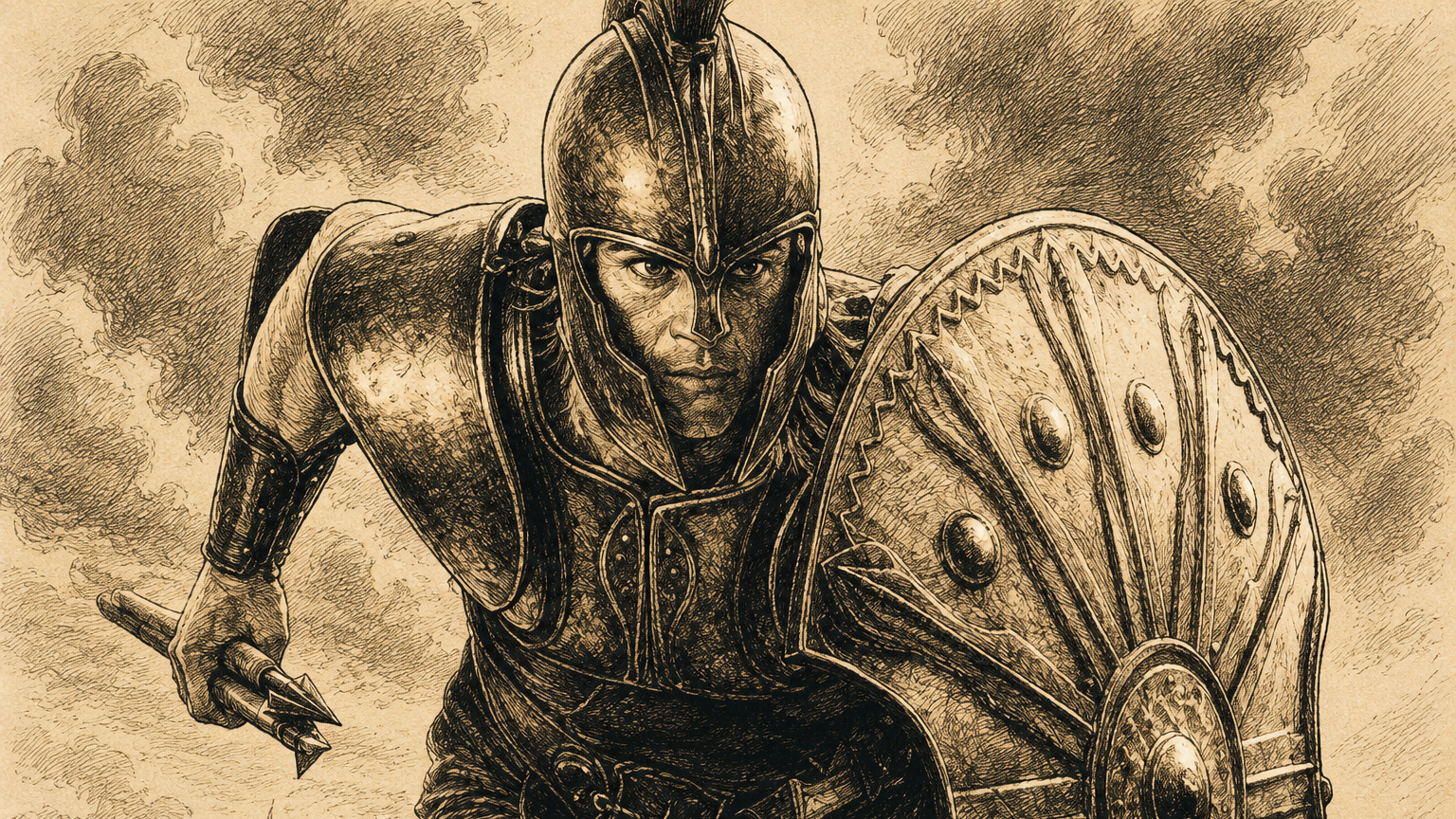
Homer gets a remarkable amount right, confirmed by surviving artifacts: the boar's-tusk helmet, body-length shields that were already obsolete by Homer's own day. The geography is largely accurate — Mycenaean-era geography survives, for instance, in the poem's catalogue of ships, which lists cities that mattered in the Mycenaean period but not in Homer's own time (conversely, Athens, which mattered in neither era particularly, may have been added into the catalogue later, in the sixth century, by an Athenian scribe with local pride). Details about Troy itself also seem accurate — the plain really is windy, and the bay has since silted in, though the sea once came much closer to the city than it does today.
But there are also real errors. Homer sometimes confuses his own era with the era of the Trojan War itself — conflating Bronze Age and Iron Age details, for instance treating iron as something rare and precious rather than commonplace. He also doesn't fully understand the historical use of chariots, treating them more like taxis for getting heroes to the battlefield rather than as an actual method of fighting. And there is very little evidence of writing anywhere in the poems — this is very much an oral world of singers, not written texts. Writing is mentioned only once, in connection with Bellerophon, and even there it may refer to some kind of sign or token rather than anything we would recognize as a written text.
Three Historical Layers, and the Elegiac Spirit of Epic
There are, in effect, three distinct historical layers embedded in the poem: the time of the action itself (the Trojan War), the time of the poem's original oral composition (Homer's own era), and the time the poems were finally written down (in Athens). A pervasive sense of looking back at an earlier, more heroic age runs through the whole poem — Nestor, a survivor of that earlier generation, is the poem's most explicitly nostalgic figure.
The epic is fundamentally elegiac: it mourns the passing of a heroic age even as it celebrates a nobility that is already dying. Homer's implicit view is that we now live in a diminished world — "there were giants in those days" — and the poem is, in part, an attempt to explain how we got from there to here. There was once a titanic struggle in which the heroes essentially killed each other off, leaving behind only our ordinary human world, the human condition as we now know it. Homer is trying to come to terms with this. We used to stand nearer to the gods in every sense — they spoke to us directly, took part in our affairs, and even fathered heroes as their own children. That is all over now. How did humanity become merely human? How do we come to terms with the human condition as it now stands, with our mortality, our ordinariness? The poem shows the passing of the heroic age as a great loss, but also suggests that this loss was, in some sense, necessary — the heroic age was fundamentally self-destructive, devoted single-mindedly to war. Heroes, after all, are difficult people to actually live with; their whole way of being is incompatible with ordinary civil life (compare Tolkien's own heroes and hobbits, worlds apart from each other).
An epic, broadly speaking, is a long narrative poem that celebrates a distinctive set of virtues and gives a people their sense of communal identity — it shows them exactly what they are meant to look up to. Homer effectively became the teacher of the entire Greek world, shaping their sense of the gods and providing enduring models of conduct — something visible precisely in the philosophers' later criticisms of him, Socrates and Plato among them. (Alexander the Great, famously, modeled himself on Achilles.)
Turning to the Poem: The Concept of Heroism
Part of Homer's genius lies in the poem's construction. He doesn't tell the whole story of the Trojan War; he concentrates instead on part of its final year, leaving a great deal out — there is no account of the Trojan Horse, and relatively little about Helen. The Iliad is not simply a chronicle; it doesn't begin on day one of the story and proceed day by day, which is part of what distinguishes it from the Balkan or African oral poems it otherwise resembles. Instead, Homer gives the story real focus, opening with the wrath of Achilles and closing with the death of Hector, in a way that brings out the story's inner meaning. Achilles is the central figure, but the poem is not called the Achilliad — it is the Iliad, named for Ilios, another name for Troy. There is more than one hero in this poem; Homer defines heroism by setting up a whole range of contrasting examples, a real spectrum of heroic types.
The wrath of Achilles itself begins when Agamemnon, forced to give up his own concubine Chryseis, takes Achilles's concubine Briseis in compensation (the very similarity of the two names suggests something telling about the interchangeability of women as pawns in the struggles of men). Achilles feels deeply insulted — in part because he genuinely cares about Briseis, but even more because he is far more concerned with someone he loves even more: himself. Greek heroes, in this sense, are fundamentally narcissistic, driven by an acute sense of personal honor. Achilles is, quite simply, the better man than Agamemnon. The real question the poem raises is: who is truly first among the Greeks — the highest-ranking monarch, or the finest soldier? Agamemnon leads by convention; Achilles leads by nature. This is a recurring situation in epic generally, reflecting a real structural problem within any military aristocracy — the best fighter is not always, or even usually, the same person as the ruler. A military aristocracy draws on two distinct principles of legitimacy, one rooted in the "military" half of the term and one in the "aristocratic" half — noble lineage on one hand, battlefield prowess on the other — and these two principles are often in real tension with each other. The most familiar version of this same tension is King Arthur and Lancelot, a staple of medieval epic that appears equally in the ancient world. This is a fundamentally feudal situation, a loose alliance of kings: Agamemnon is the greatest king because he rules the most people, his authority resting on lineage, symbolized by his scepter. But in wartime, the best fighter becomes, in practice, the single most important man in the whole army. When Achilles fights for the Greeks, they win; when he withdraws, the Trojans win. He is, in every practical sense, the man — and Agamemnon needs Achilles far more than Achilles needs Agamemnon (a point Nestor makes explicit). This is precisely what Achilles ends up questioning — after all, he is a king in his own right too.
Thumos: The Nature of Heroic Anger
The desire to be first is very much a Greek trait — not unique to the Greeks, but more highly developed among them than almost anywhere else: a naked ambition and aggressiveness quite unlike the Christian sense that pride and envy are themselves sins. We will see later that Homer does regard pride as genuinely problematic in certain respects, but the Greeks remain far more willing than Christians to accept pride as, on the whole, a positive trait. You can see this same competitiveness in Greek athletics — the ancient Olympics had very few rules by our standards, and only winning mattered; there were no silver medals — and equally in the dramatic competitions of Athenian theater.
Achilles's whole character is defined by thumos — a Homeric term later defined more formally by Plato, for which we have no exact English equivalent, though the underlying concept is not hard to understand. Thumos is what makes a man angry, what makes him want to fight — an aggressiveness with the odd characteristic of needing to feel justified, righteously indignant. Thumos attaches men to causes; it is what makes them willing to fight for their country (which is why Plato so admired it, insisting that the guardians of his Republic possess it). You see it in athletes too — thumos is what makes them want to win, though it helps enormously to have a larger cause to fight for, which is exactly why good coaches give their athletes something bigger to play for than themselves alone, encouraging them to "win one for the team." Thumos sits right at the intersection of what we would call body and soul — it has a real physical basis, what we might now call adrenaline, or "roid rage," fundamentally a matter of hormones — and yet it just as easily becomes something we would call spiritual, fighting for a cause rather than merely fighting for its own sake (though it can be that too).
Thumos is, more broadly, one of four Homeric terms that get translated as something like "mind." It can be rendered as spirit, spiritedness, heart, or guts — it has a clear physical seat in the chest, and Homeric heroes are often shown literally arguing with their own thumos. It stands opposed to eros, and it is what leads men to go without food or sex altogether, as Achilles does after the death of Patroclus. Thumos is, in the end, the central problem of heroism itself: heroes need it to win battles, but it very easily spirals out of control. Agamemnon is the more conventional ruler, well suited to peacetime — excellent, so to speak, at ribbon-cuttings and ceremonial appearances, relying heavily on the outward symbols of power. Achilles is the more natural ruler in war, relying on the sheer strength of his own arm — which makes him far more dangerous to manage. Agamemnon's real weakness, as Diomedes bluntly points out, is precisely that he lacks enough thumos, enough plain guts. This remains a perennial problem, very much still with us today: a great battlefield general does not automatically make a good peacetime ruler, though a great many American presidents have in fact been wartime generals, starting with Washington and continuing through Jackson, Tyler, Grant, and Eisenhower. Some generals prove genuinely difficult in this respect — Patton and MacArthur among them. Patton, nicknamed "Old Blood and Guts," is exactly the kind of thumos you want on the battlefield — and exactly the kind that can be very hard to live with once the war is over.