History of European Literature Introduction
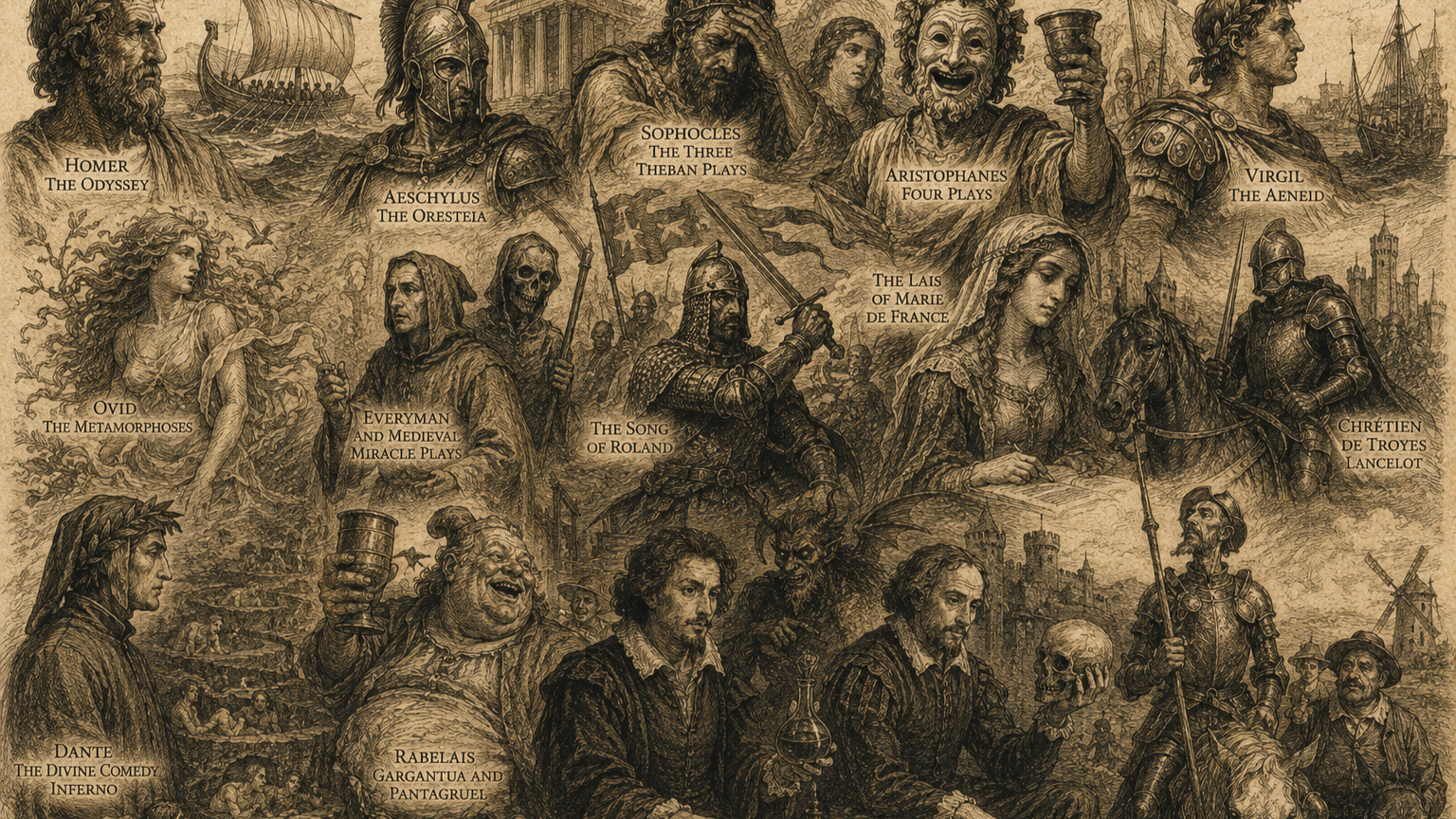
CPLT 2010 · Introduction
History of European Literature I
Paul Cantor · University of Virginia
Why This Course
This is my favorite course to teach — Homer, Dante, Shakespeare, Cervantes: what's not to like? These are the books that have changed my life. I hope they change yours too.
Courses like this one have become controversial. The assumption these days is often that reading the "great works" of literature is somehow oppressive. What we'll actually find is the opposite — it's liberating. It exposes you to genuinely different points of view.
The Trouble with "Canon"
This brings up the whole issue of the canon. The word is Greek, meaning "rule" or "rod," and it comes to us from biblical studies. At some point, a committee decided which books belonged in the Bible — these became the "canonical" books. The Book of Judges made it in; the Book of Maccabees did not. Ecclesiastes made it in; Ecclesiasticus did not. The books left out are what we call the Apocrypha.
"Canon" is a misleading term to borrow for literature, because it carries the wrong connotations. First, it suggests these works are religious, forming some kind of rigid orthodoxy. Second, it suggests a definite, fixed list — certain works definitely in, certain works definitely out, unchanging over time. Third, it suggests the whole collection forms one unified, harmonious work — the Book, the way the Bible is supposed to be one consistent whole.
No Single Authority Behind the Canon
In fact, no single authority ever assembled a literary canon in this sense, for a few reasons.
First, these works are enormously complicated when it comes to religion. Some are religious, some are not, and some have even been regarded as heretical or outright blasphemous. Consider Rabelais. Consider Dante. Consider Socrates, put to death by Athens for impiety — we'll see this reflected in Aristophanes, who Socrates himself apparently blamed for helping stir up the hostility that led to his trial. And even among the works that are religious, they represent very different religions entirely — paganism against Christianity, and even sharp divisions within Christianity itself, Protestant against Catholic.
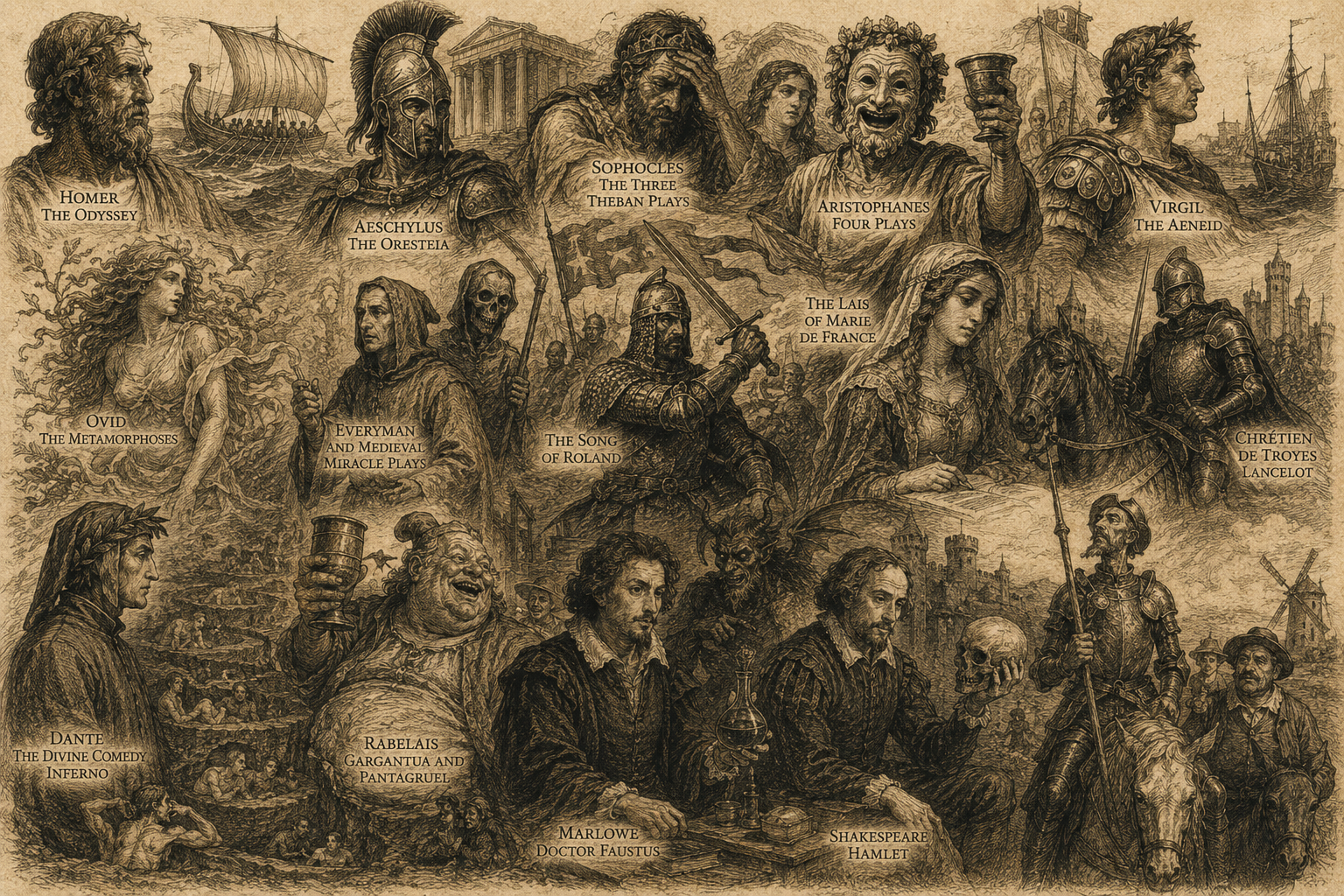
Second, there is no single definitive list of canonical works, and no authority empowered to decide who's in and who's out. Certain authors more or less have to be included — Homer, Virgil, Dante, Shakespeare — and there are a handful of works that appear on virtually every list: the Iliad, the Odyssey, the Aeneid, the Divine Comedy, Don Quixote. But beyond that core, there's a great deal of room to maneuver. I often change the reading list myself from year to year. I try to put together a good list, but not a perfect one — there's an inevitable degree of arbitrariness involved. At minimum, everything on the list is genuinely good and significant, but that doesn't mean there aren't other works equally worthy of inclusion. Sometimes a choice comes down to purely practical, pedagogical reasons — the medieval German epics, for instance, are simply too long to fit into a single semester.
No Uniform Point of View
Third, there is no uniform point of view running through these works at all. They are very much at odds with one another. The Western tradition is filled with tensions, contradictions, and real conflict — fundamental disagreements between one author and the next. Take the question of revenge: Homer treats it as noble; Christianity treats it as evil; Hamlet himself doesn't know what to think about it.
What we'll actually be tracing throughout this course is an ongoing dialogue — authors arguing with each other across the centuries. What's genuinely interesting about the Western tradition is not its uniformity but its sheer variety, its freedom to disagree — a freedom that has often been challenged throughout Western history but has generally been maintained in one form or another. It's fascinating to trace where we actually come from, the disputes that have shaped us. Reading these so-called canonical works lets us see what formed us. For one thing, we're studying works that were important to the authors themselves — even if your real interest is strictly in modern literature, you eventually have to go back to these earlier periods. Eliot's The Waste Land, for instance, assumes you already know Ovid, Dante, Shakespeare, and medieval romance. Canonical works, generally speaking, are simply the works that went on to influence later authors. In that sense the list isn't arbitrary at all, and it isn't something imposed on us by professors — it was, in effect, created by the authors themselves. Virgil chose Homer as his model. Dante chose Virgil as his. It's a kind of natural selection, survival of the most poetic — the process that actually forms literary history in the first place.
A Course in Literary History
This is, above all, a course in literary history. There are many different ways to study literature, and this is only one of them. You can study a work entirely independent of its history, looking purely at its formal properties — rhyme scheme, close reading of the language itself. We'll do a bit of that, but not much, since it's genuinely difficult to do well in translation. Mostly, we'll be doing something closer to "distant reading" — looking at these works within the larger context of literary history, seeing how they fit together into something like a historical sequence.
Internal and External Literary History
There are really two different senses of literary history worth distinguishing: internal and external. The internal sense means studying pure literary history as such — how authors react to one another, tracing patterns of influence, how a given author responds to the challenge posed by his predecessors. Authors don't write in a vacuum; they generally write with at least one eye on everything that's been written before them. The external sense means recognizing that literature itself doesn't exist in a vacuum either — studying how the history of literature is shaped by broader currents of political, economic, and social history. We'll see, for instance, how the arrival of Christianity fundamentally redirects the whole course of literary history; works simply cannot remain the same after a major religious revolution like that. In the spring semester we'll see something similar with the importance of the French Revolution.
There's a long-running argument about whether we should study literature internally or externally — whether to explain literature in terms of literature itself, or in terms of something outside of literature altogether. There's no real reason we can't do both at once. It's also worth remembering that authors don't simply react to what came before them — they actively make literary history too. They're creative forces in their own right; they genuinely shape our ideas, not merely reflect them. This course will draw on a variety of approaches to the material, and I'll try to introduce you to a number of basic concepts from literary theory along the way — but all of that will sit within the broader project of literary history. We won't be attempting to do absolutely everything in this one course.
Comparative Literature: Periods and Genres
This is also, specifically, a course in comparative literature. What's the real advantage of a comparative approach? Comparing across time lets us see how the same underlying idea gets treated differently in different historical civilizations. We'll try to develop some broad period concepts along the way — ancient, medieval, Renaissance — and try to give you a real sense of what we actually mean by these period labels. They're not exact, but they're not arbitrary either.
A second set of useful concepts involves genre. You can compare works across time, and you can also compare works across genre — we'll look closely at the basic concepts of epic, tragedy, and comedy, and see how the very same underlying idea can be treated either comically or tragically. Tyranny, for instance, is handled tragically in Sophocles and comically in Aristophanes (compare, much later, how Shakespeare and Jonson each treat Venice very differently). Genre itself turns out to be a genuinely complicated concept, without any rigid definitions available — we'll try to arrive at a working sense of these categories gradually and empirically, letting the definitions emerge from the actual examples rather than imposing them from outside.
This fall semester will concentrate mainly on epic and drama, the principal literary forms of the periods we'll be covering — traditionally considered the highest forms, the most artistically ambitious. Even Virgil himself started out with simpler forms, writing lyric poetry, the Georgics and pastoral poetry, before eventually attempting his own great epic. The novel doesn't enter the picture until the very end of the course, with Don Quixote — arguably the first novel in the modern sense of the term, and it's worth thinking carefully about why the novel as a form arrives so late in literary history. One real omission in this course is lyric poetry — not because it wasn't being written throughout this whole period; there were great lyric poets among the ancient Greeks, Sappho above all, and in Rome, Horace. It's simply very hard to study lyric poetry well in translation. I want to be upfront about my own biases in shaping this course. The spring semester will pick up the novel and lyric poetry in more depth. Given how much literary history we're covering, it helps to have a clear focus — and our focus here will be on epic and drama, organized specifically around the idea of the hero and heroism.
What to Expect
My hope is that you'll come away from this course with a real introductory knowledge of the great works that form our literary tradition, along with a genuine sense of what we mean by historical periods and by genre. My own aim, throughout, is to construct a coherent literary-historical narrative for you — to tie all these works together into something coherent.
The Iliad: Strange and Familiar
The overall effect of a course like this is a peculiar mixture of the strange and the familiar. A work may have been written thousands of years ago, and yet it can still seem to speak directly to us. That's genuinely true — but we have to be careful about it. If we simply assimilate these works to our own modern assumptions, we can't actually learn anything new from them. We have to look carefully, and deliberately, for the differences too.
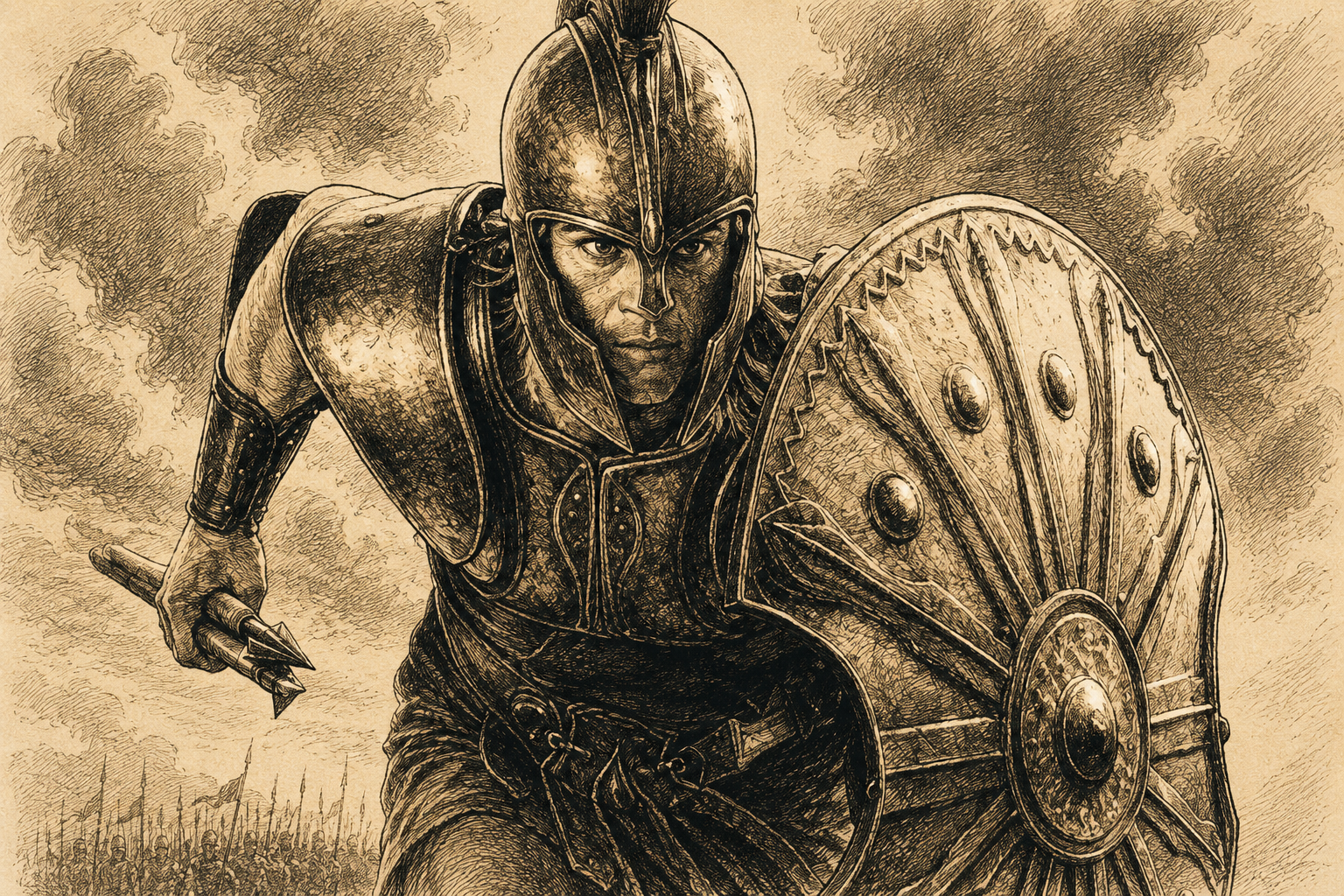
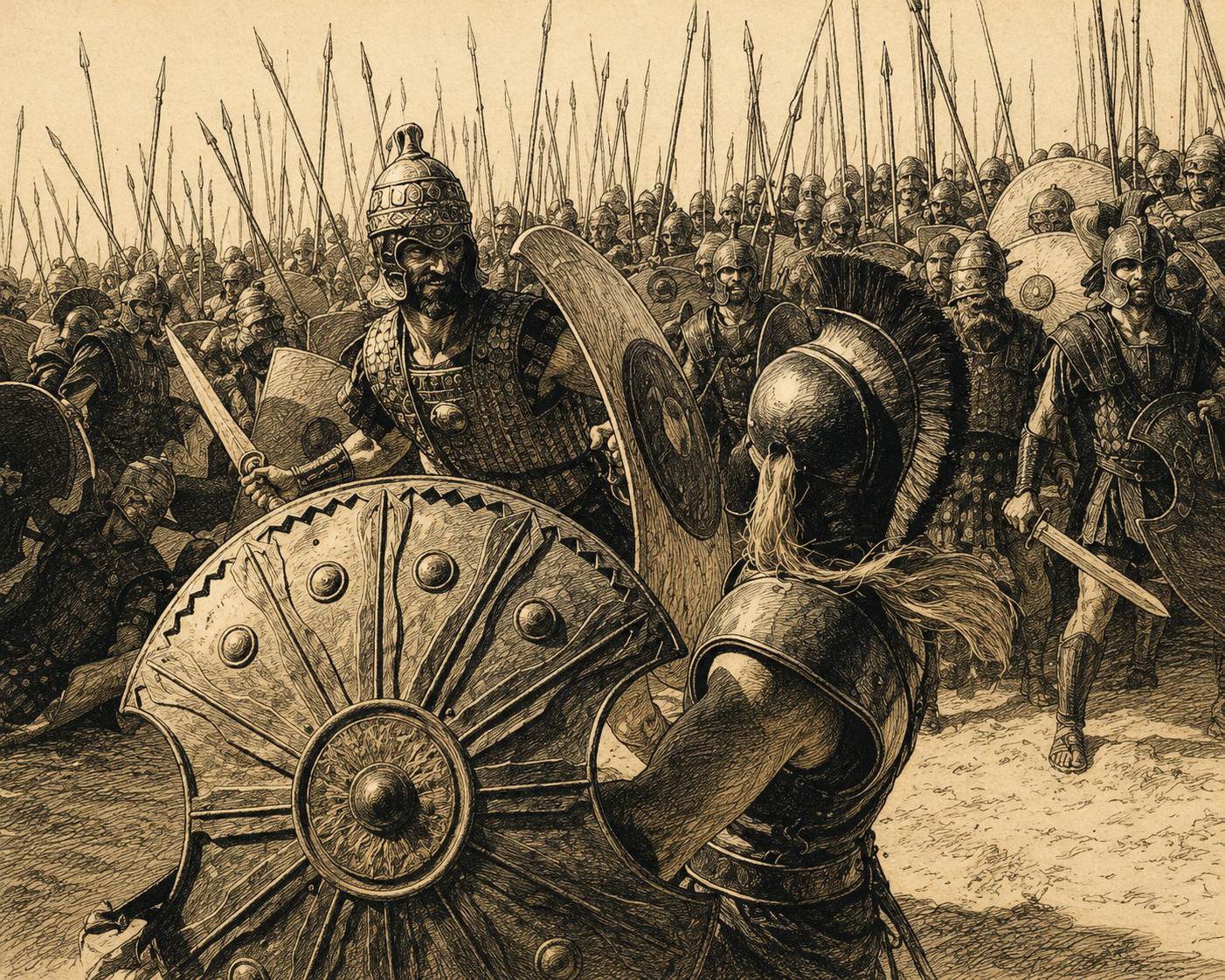
The Iliad is at once the most familiar and the strangest work we'll read all semester. It's the fountainhead of the whole Western literary tradition, and you can see directly in it where our own ideas about heroism actually come from. At one point a hero's boast sounds exactly like a boxer trash-talking in a television interview today. The Greeks, after all, are the origin of athletics — itself a Greek word — and the origin of the Olympics, another Greek word, and really the origin of the whole competitive spirit as such: "How can a man be first in all events?" That's the Greek spirit in a nutshell, the sheer desire to be first — we'll see it everywhere in this material. It's easy enough to understand. But the Greeks carry it to a real extreme, and there are moments — the sheer degree of ferocity in Achilles, for instance — that are genuinely shocking to us, almost inhuman. These Greek heroes really are something else. In a way, they're deeply alien to us — and that alienness is exactly what we have to sit with and think through.
Assignment on the Iliad
Read the prefatory material (there's a good summary early on), and use the glossary in the back to keep the names straight — watch especially for the Atrides, and for Paris, also called Alexandros, and for the two heroes named Ajax. Book VIII covers the Trojan rally that drives the Greeks back to their ships. Don't worry about tracking every single character by name, and be prepared for a good deal of repetition, especially in the battle scenes.